Imroatul Nasiyah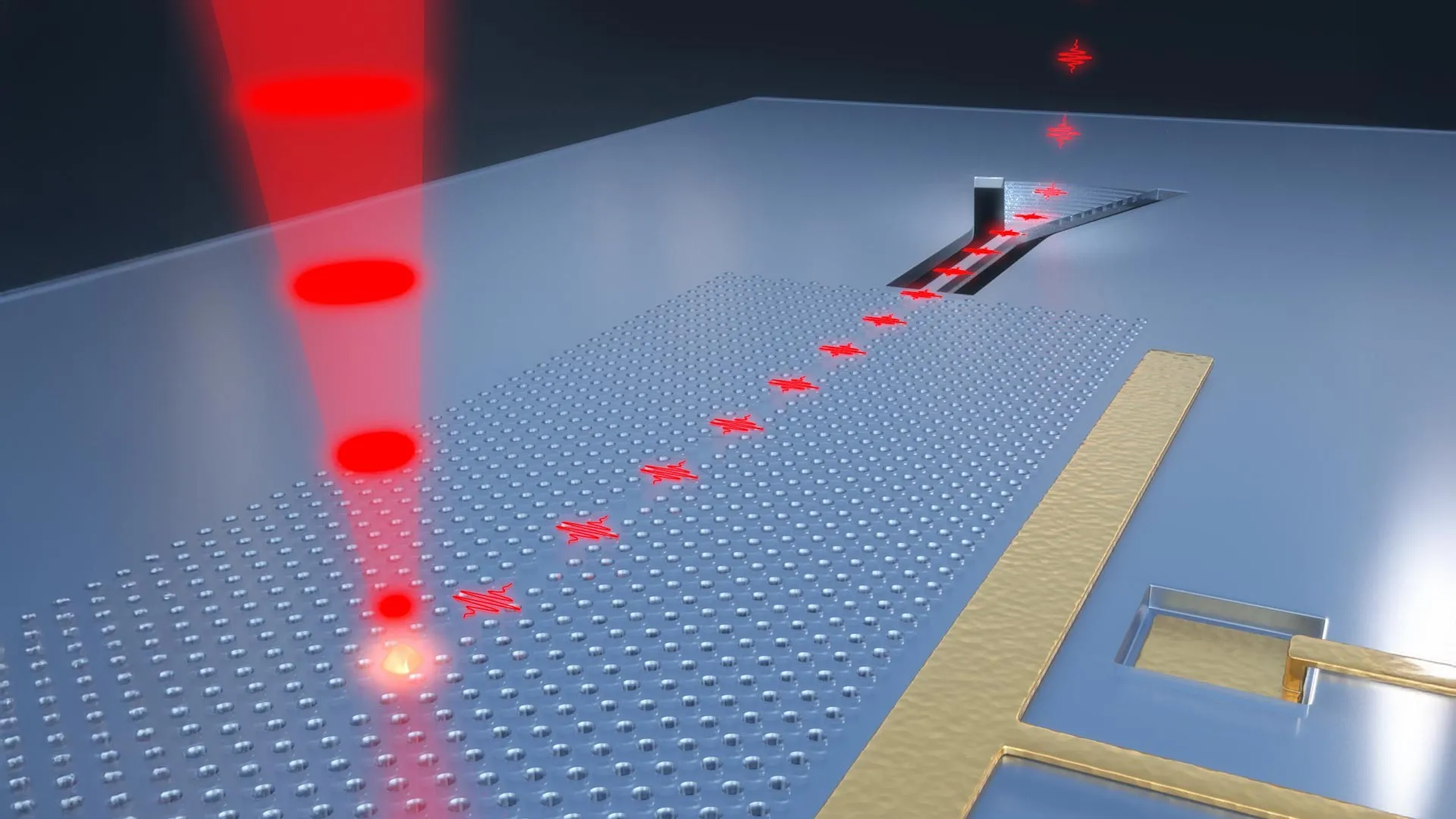
The quest for pristine single photons, the fundamental building blocks of advanced quantum technologies, has long been a formidable challenge for researchers. These elusive particles of light are absolutely critical for the development of photonic quantum computers, which leverage light to perform complex calculations at speeds and efficiencies far exceeding conventional electronic systems, and for secure communication networks that rely on the inherent security of quantum principles. However, the path to generating a reliable and pure stream of these single photons is fraught with significant obstacles, primarily stemming from two persistent issues: laser scatter and multi-photon emission. The University of Iowa team, through a novel theoretical approach, has unveiled a method that not only tackles these problems but ingeniously uses one to solve the other, potentially ushering in a new era of quantum technology.
One of the most persistent vexations in generating single photons is the phenomenon known as laser scatter. The process of exciting an atom with a laser to coax it into emitting a single photon is not always perfectly efficient. Often, the intense laser light can induce the release of additional, unwanted photons. These spurious particles act as a form of optical noise, akin to stray electrical current disrupting a sensitive electronic circuit. This interference degrades the purity of the photon stream, diminishing the overall efficiency and reliability of quantum operations. In a photonic quantum computer, for instance, these extra photons can lead to computational errors, while in secure communication, they can create vulnerabilities that could be exploited by eavesdroppers.
Compounding this challenge is a second, related issue: the unpredictable behavior of atoms when interacting with laser light. While the ideal scenario involves an atom emitting precisely one photon upon excitation, in reality, atoms can, on rare occasions, release more than one photon simultaneously. This multi-photon emission event is particularly problematic because quantum operations often depend on the precise timing and sequence of individual photons. When multiple photons are emitted at once, the intended one-by-one flow is disrupted, breaking the delicate quantum entanglement and timing crucial for computations and secure key distribution. The carefully orchestrated dance of single photons becomes a chaotic free-for-all, rendering the system unreliable.
For years, these two issues – laser scatter and multi-photon emission – have been viewed as independent nuisances, each requiring separate mitigation strategies. However, the recent groundbreaking work by Matthew Nelson, a graduate student in the Department of Physics and Astronomy at the University of Iowa, has revealed a profound and unexpected connection between them. Nelson’s theoretical investigation uncovered a remarkable similarity between the characteristics of the unwanted photons generated by laser scatter and those emitted in multi-photon events. Specifically, he found that when an atom releases multiple photons, the resulting wavelength spectrum and waveform of these photons bear a striking resemblance to the characteristics of the incident laser light itself.
This critical insight forms the bedrock of the new purification technique. The researchers realized that because the unwanted multi-photon emissions so closely mirror the laser light, they can be deliberately engineered to cancel each other out through a process of constructive and destructive interference. In essence, the very laser scatter that has historically been a source of interference can be repurposed, with careful adjustment, to suppress the very multi-photon emissions it helps create. This is a paradigm shift in how scientists approach photon generation, transforming a long-standing problem into a powerful, integrated solution.
"We have shown that stray laser scatter, typically considered a nuisance, can be harnessed to cancel out unwanted, multi-photon emission," stated Ravitej Uppu, assistant professor in the Department of Physics and Astronomy and the study’s corresponding author. "This theoretical breakthrough could turn a long-standing problem into a powerful new tool for advancing quantum technologies." This elegant solution, born from a deep understanding of the fundamental physics at play, has the potential to dramatically simplify the production of high-quality single photons.
The significance of single photons for quantum computing cannot be overstated. Photonic computing, an exciting frontier in computational science, aims to harness the unique properties of light to perform calculations. Unlike conventional computers that rely on bits – electrical or optical pulses representing either a 0 or a 1 – quantum computers utilize qubits. These qubits, often embodied by subatomic particles like photons, can exist in superposition, representing both 0 and 1 simultaneously, and can be entangled, allowing for complex correlations between multiple qubits. This inherent parallelism and interconnectedness grant quantum computers the potential to solve certain problems that are intractable for even the most powerful supercomputers today, such as drug discovery, materials science simulations, and complex optimization problems.
The widespread belief within the technology sector is that photonic platforms will be instrumental in realizing the full potential of quantum computing. However, the practical implementation of these systems hinges on the availability of a stable, well-controlled, and highly pure stream of single photons. An orderly photon stream is not only easier to manage and scale up for more complex quantum circuits but also inherently more secure. The researchers drew a compelling analogy: managing a stream of single photons is like guiding students through a cafeteria line one at a time, ensuring each student is accounted for and their progress is predictable. This contrasts sharply with allowing them to move as a crowd, where it becomes difficult to track individuals and increases the risk of mishaps. In the quantum realm, this orderly flow of single photons is crucial for preventing data interception or unauthorized access in secure communication channels, forming the basis of quantum key distribution.
The key to this novel purification method lies in the meticulous control of the laser beam. Uppu elaborated on the practical implications: "If we can control exactly how the laser beam shines on an atom — the angle at which it’s coming, the shape of the beam, and so on — you can actually make it cancel out all the additional photons that the atom likes to emit. We would be left with a stream that is actually very pure." This precision control allows for the fine-tuning of the laser-atom interaction, ensuring that the system preferentially emits single photons while actively suppressing unwanted multi-photon events and mitigating the impact of laser scatter.
This theoretical work demonstrates, for the first time, that two of the most significant barriers to the advancement of photonic circuitry can be addressed simultaneously using a unified approach. If this theoretical framework can be successfully translated into experimental reality, it could significantly accelerate the development of more powerful quantum computers and usher in a new generation of highly secure communication systems. The research team at the University of Iowa is already planning to conduct future experiments to validate their findings and explore the practical implementation of this revolutionary technique.
The study, titled "Noise-assisted purification of a single-photon source," was recently published in the prestigious journal Optica Quantum, marking a significant contribution to the field of quantum optics. The research was made possible through substantial funding from the Office of the Under Secretary of Defense for Research and Engineering within the U.S. Department of Defense, highlighting the strategic importance of this advancement for national security and technological leadership. Additional crucial support was provided through a seed grant from the University of Iowa Office of the Vice President for Research, administered via the P3 program, which played a vital role in initiating and nurturing this pioneering project. This collaborative effort underscores the multidisciplinary nature of cutting-edge scientific research and its reliance on both governmental and institutional backing.