Imroatul Nasiyah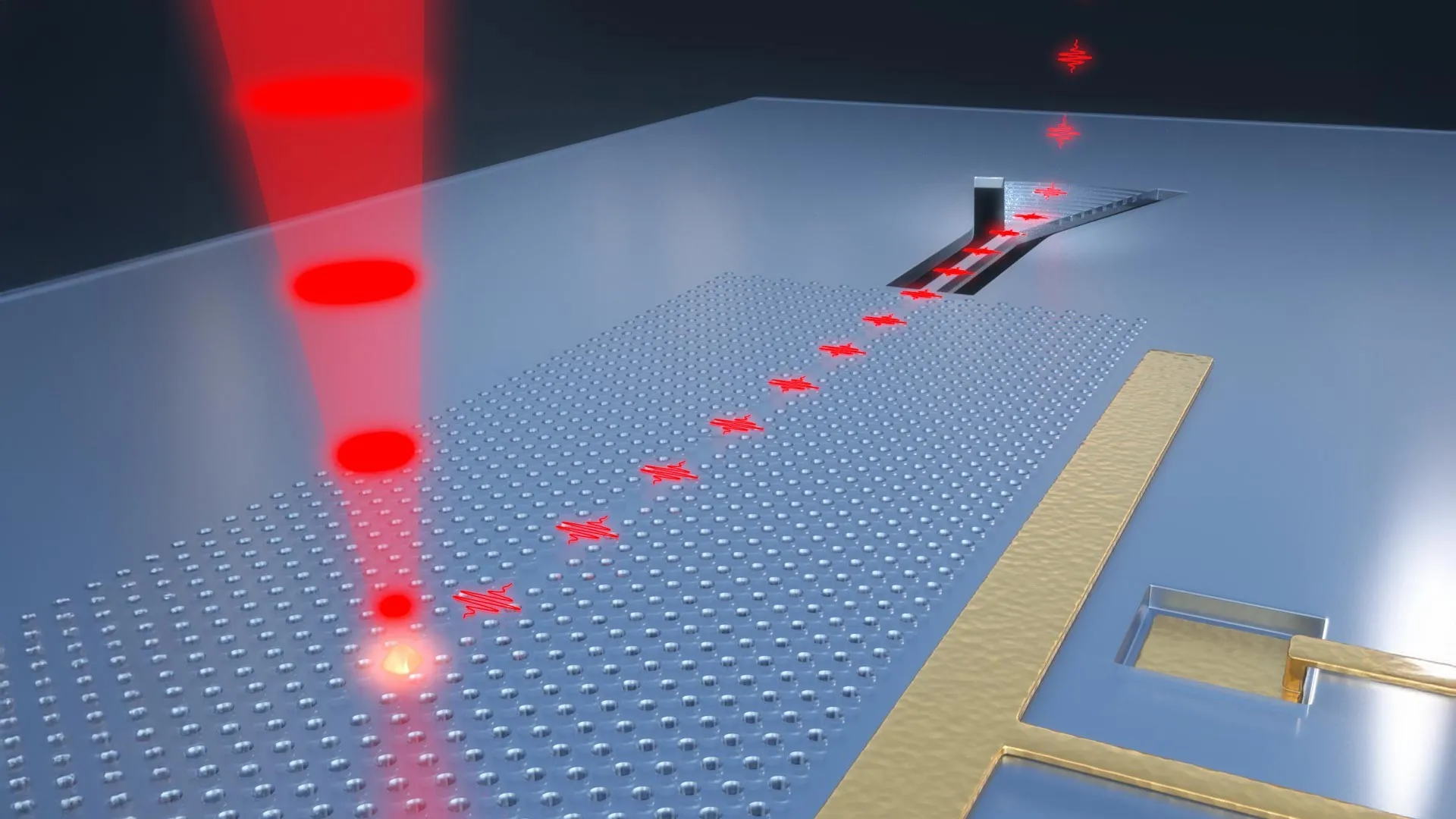
The core of this discovery lies in the team’s focused effort to overcome two primary impediments to generating a consistent and predictable stream of single photons – a fundamental requirement for the operation of photonic quantum computers and advanced secure communication protocols. These obstacles have historically presented significant challenges, hindering the scalability and efficiency of current quantum technologies.
The first major hurdle is a phenomenon known as laser scatter. In the process of using a laser to excite an atom and trigger the emission of a single photon, the intense laser light can inadvertently generate additional, unwanted photons. These extraneous particles act as disruptive interference within an optical circuit, much like stray electrical currents can degrade the performance of conventional electronic circuits. This interference degrades the purity of the single-photon stream, making it difficult to perform precise quantum operations.
Compounding this issue is a second problem related to the inherent nature of atomic responses to laser light. Occasionally, an atom, when stimulated by a laser, can emit more than one photon simultaneously. This multi-photon emission is particularly problematic because it disrupts the precise sequencing and timing crucial for quantum operations. The intended single photon, meant to carry a specific quantum state, can be obscured or corrupted by these extra photons, thereby breaking down the delicate one-by-one flow that underpins quantum computation and communication.
Harnessing Laser Noise to Achieve Photon Purity
In a remarkable turn of events, the new study, led by Matthew Nelson, a graduate student in the Department of Physics and Astronomy at the University of Iowa, has unearthed an unexpected and powerful synergy between these two seemingly disparate problems. Nelson’s research revealed a profound connection: when an atom emits multiple photons, the resulting spectral characteristics, including the wavelength distribution and the waveform of these unwanted photons, bear a striking resemblance to the properties of the original laser light used to stimulate the atom.
This newfound similarity is the key to the purification process. According to the researchers, this close match allows for a delicate and precise adjustment of both the laser light and the emitted photons, enabling them to effectively cancel each other out. In essence, the very laser scatter that has been a persistent nuisance in optical quantum systems can now be ingeniously repurposed to actively suppress these unwanted, multi-photon emissions. This represents a paradigm shift, transforming a long-standing problem into a sophisticated solution.
"We have demonstrated that stray laser scatter, which has traditionally been viewed as a detrimental interference, can actually be harnessed to cancel out unwanted, multi-photon emission," explained Ravitej Uppu, assistant professor in the Department of Physics and Astronomy and the study’s corresponding author. "This theoretical breakthrough has the potential to transform a persistent challenge into a potent new instrument for propelling quantum technologies forward."
The Indispensable Role of Single Photons in Quantum Computing
The significance of this development is deeply rooted in the fundamental principles of photonic quantum computing. Unlike conventional computers that rely on electrical signals to process information through bits representing ones and zeroes, photonic quantum computers leverage light – specifically, individual photons – to perform calculations. This reliance on light offers the tantalizing prospect of vastly faster processing speeds and enhanced energy efficiency, potentially unlocking computational power far beyond the capabilities of current supercomputers.
The building blocks of quantum computation are qubits, which, in photonic systems, are often represented by subatomic particles of light, i.e., photons. The ability to generate and control a stable, pure stream of single photons is paramount to realizing the full potential of photonic quantum computing. Many leading technology companies and research institutions are investing heavily in photonic platforms, recognizing their pivotal role in the future of quantum computing.
A consistent and well-controlled stream of single photons is not merely a technical nicety; it is a fundamental requirement for making the vision of practical quantum computing a reality. An orderly flow of photons is inherently easier to manage and scale, which is crucial for building larger and more complex quantum processors. Furthermore, the purity of the photon stream directly impacts the security of quantum communication networks. The researchers aptly draw an analogy: guiding students through a cafeteria line one by one ensures order and prevents chaos, much like a precisely ordered stream of single photons minimizes the risk of data interception or eavesdropping. In quantum communication, a pure single-photon stream ensures that the delicate quantum information encoded within each photon remains intact and uncompromised, thereby guaranteeing the utmost security for sensitive data transmission.
Achieving Unprecedented Purity Through Precision Control
The ingenuity of the new method lies in its emphasis on precise control over the laser beam. Uppu elaborates on the critical role of this meticulous control: "If we can precisely dictate how the laser beam interacts with the atom – controlling factors such as the angle of incidence, the shape of the beam, and other parameters – we can actually engineer the process to cancel out all the additional photons that the atom might otherwise emit," he stated. "The outcome is a stream of photons that is exceptionally pure."
This theoretical work demonstrates, for the first time, that two major impediments to the development of faster and more efficient photonic circuitry can be addressed simultaneously. If these theoretical findings are successfully validated through experimental verification, this novel technique could significantly accelerate the pace of progress in developing advanced quantum computers and establishing more secure communication systems. The research team is actively planning future experiments to put this innovative concept to the test.
Study Details and Funding
The groundbreaking research, titled "Noise-assisted purification of a single-photon source," has been formally published in the esteemed journal Optica Quantum, a leading publication for cutting-edge research in quantum optics and photonics.
The funding for this pivotal research was generously provided by the Office of the Under Secretary of Defense for Research and Engineering, an arm of the U.S. Department of Defense, underscoring the strategic importance of this work for national security and technological advancement. Additional crucial support was also received through a seed grant from the University of Iowa Office of the Vice President for Research via the P3 program, which played a vital role in launching and nurturing this ambitious project from its inception. This multifaceted support highlights the collaborative effort and significant investment dedicated to pushing the boundaries of quantum science and technology.