anjir abdul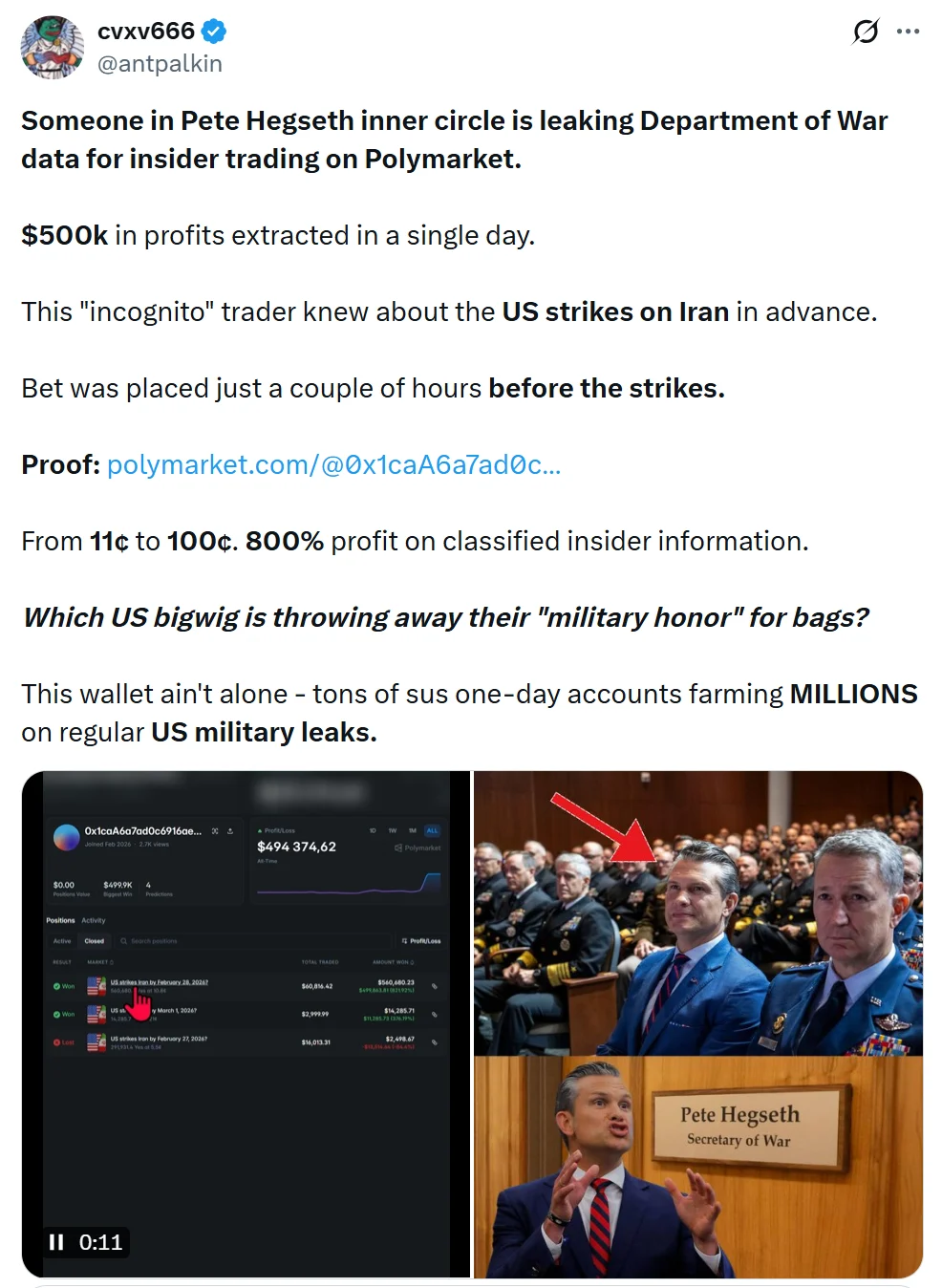
Six distinct wallets on the decentralized prediction market Polymarket collectively reaped approximately $1 million in profits after accurately forecasting that the United States would launch a military strike against Iran before the close of February, an outcome that has ignited widespread suspicions of insider trading within the cryptocurrency community and beyond. This significant financial gain, tied to a highly sensitive geopolitical event, has brought intense scrutiny upon the nature of prediction markets, their regulatory vulnerabilities, and the ethical implications of profiting from foreknowledge of conflict.
The genesis of these insider trading suspicions stems from a detailed analysis of blockchain data, specifically concerning the activities of the six aforementioned wallets. According to a report by Bloomberg, which cited data shared by the analytics firm Bubblemaps SA, all six wallets were conspicuously created in February, just weeks before the strike. What further raised red flags was the concentrated nature of their trading activity: nearly all their transactions were dedicated to contracts predicting the precise timing of a potential US attack on Iran. In several instances, shares in the "US strikes Iran by Feb 28" market were acquired mere hours before the initial reports of explosions emerged from Tehran. The timing and the exceptionally low purchase price of some of these contracts – reportedly around $0.10 per share – allowed for an extraordinary return on investment, solidifying the claims of suspiciously informed trading.
Onchain investigators, who constantly monitor blockchain activity for anomalous patterns, were quick to highlight this behavior. They noted that the trading patterns exhibited by these wallets bore a striking resemblance to those previously associated with suspected insider activity on other prediction markets. The ability to buy shares at such a low price, implying that the market had not yet priced in the high probability of a strike, and then see those shares skyrocket in value once the news broke, is a classic indicator of someone trading with privileged information.
Nicolas Vaiman, the chief executive of Bubblemaps, articulated the inherent challenges and incentives in such scenarios. "In cases involving war or conflict, information can circulate within a broader circle before becoming public," Vaiman reportedly stated. He further elaborated on the architectural features of Polymarket that exacerbate this issue: "Combined with the fact that Polymarket generally only requires a wallet to trade, which allows for a high level of anonymity, this can create incentives for informed participants to act early." The decentralized and pseudonymous nature of blockchain transactions, while offering privacy benefits, simultaneously creates a fertile ground for such allegations, as tracing the real-world identities behind these wallets is exceedingly difficult, if not impossible, without cooperation from the platform or a significant legal mandate. Cointelegraph reached out to Polymarket for an official statement regarding these serious allegations but had not received a response by the time of publication, leaving many questions unanswered about the platform’s stance and potential internal investigations.
The "US strikes Iran by" market on Polymarket became a focal point of intense speculation and trading activity during the recent escalation of tensions. Over $529 million in trading volume flowed into strike-related contracts, underscoring the market’s significant liquidity and the widespread interest in this high-stakes geopolitical event. The specific contract predicting a strike by February 28 alone attracted approximately $90 million in trading volume, making it the most popular strike date among traders. Another significant contract, speculating on a strike by January 31, followed with about $42 million in volume, demonstrating the sustained nature of the betting as the situation evolved.
While the pattern of these six wallets raises serious concerns, it is crucial to acknowledge the nuances and counter-arguments that often accompany such allegations. For instance, the original report noted that one of the flagged accounts had previously incurred losses on an earlier prediction market contract before placing the larger, ultimately profitable wager that returned more than $170,000. This detail, while not exonerating, suggests that not every profitable trade is necessarily a result of wrongdoing, and some traders might simply be exceptionally shrewd or lucky speculators. Furthermore, Washington had publicly issued warnings of possible military action for several weeks leading up to the strike, which naturally drew a considerable number of speculators to platforms like Polymarket, betting on various outcomes based on publicly available information and their own analyses of geopolitical trends. The challenge lies in distinguishing genuine, informed speculation from trading based on illicitly obtained non-public information.
However, the US-Iran strike bets are far from an isolated incident on Polymarket, which has repeatedly found itself embroiled in insider trading controversies. Just recently, a small cluster of crypto wallets collectively earned over $1.2 million betting on a contract linked to an onchain investigation into the decentralized finance (DeFi) platform Axiom. These profitable trades occurred shortly before the renowned blockchain investigator ZachXBT published his findings, alleging that an Axiom employee and their associates had been engaged in insider trading since early 2025. The precise timing of these Polymarket bets, preceding ZachXBT’s public exposé, mirrors the suspicious pattern observed in the US-Iran strike market.
Similarly, only a month prior, a Polymarket account quietly disappeared after making approximately $400,000 from a remarkably well-timed wager on the capture of Venezuelan President Nicolás Maduro. This wallet had placed a substantial bet of roughly $32,000 on Maduro’s removal shortly before the news became public, again raising significant insider trading concerns. These repeated instances paint a troubling picture, suggesting a recurring vulnerability within the prediction market model to individuals with privileged access to information, whether political, financial, or security-related.
The escalating frequency and scale of these allegations have not gone unnoticed by lawmakers. In response to the growing concerns, US Representative Ritchie Torres is actively preparing legislation specifically designed to combat insider trading on prediction platforms. The proposed bill, aptly named the "Public Integrity in Financial Prediction Markets Act of 2026," aims to impose strict limitations on who can trade on these markets and under what circumstances. Specifically, the proposal would explicitly bar elected officials, political appointees, and executive-branch employees from trading contracts tied to government policy or political outcomes when they are in possession of nonpublic information. This legislative effort underscores a growing recognition that prediction markets, while potentially valuable for aggregating information, also present unique ethical and regulatory challenges, particularly when they intersect with sensitive government actions and national security matters. The bill seeks to draw a clear line, preventing those with privileged access to government information from financially benefiting from it, thereby upholding the principles of public trust and integrity.
Beyond the insider trading debate, Polymarket has been grappling with a wave of regulatory actions across the globe. Numerous countries have taken steps to block or ban the platform, classifying its event-based contracts not as legitimate financial trading instruments but rather as unlicensed online gambling. This distinction has profound implications for Polymarket’s operational legality and its future expansion. Countries including the Netherlands, Hungary, Belgium, France, Italy, Romania, Poland, Singapore, and Portugal have all moved to restrict access to the platform, citing concerns about consumer protection, financial stability, and the lack of appropriate licensing for what they perceive as gambling activities. This patchwork of international regulations highlights the complex legal landscape facing decentralized applications that blur the lines between traditional financial instruments, information aggregation tools, and speculative betting platforms. The regulatory ambiguity poses a significant hurdle for Polymarket and other similar platforms, forcing them to navigate diverse legal frameworks that often lack specific provisions for their novel operating models.
The ongoing controversies surrounding Polymarket, from insider trading allegations on geopolitical and financial outcomes to widespread regulatory crackdowns, underscore a fundamental tension at the heart of decentralized prediction markets. On one hand, proponents argue that these platforms offer a powerful mechanism for aggregating dispersed information, allowing market prices to reflect collective wisdom and potentially predict future events with greater accuracy than traditional polls or expert opinions. They also champion the decentralization and anonymity as key features, enabling participation without censorship or traditional financial gatekeepers. On the other hand, the very features that make them appealing – anonymity and global accessibility – also make them vulnerable to exploitation by those with privileged information, raising serious ethical questions about fairness, market integrity, and the potential for financial gain from human suffering or sensitive national security events. The challenge for regulators and the platforms themselves will be to strike a balance: fostering innovation and the potential benefits of information aggregation while simultaneously safeguarding against illicit activities and ensuring public trust. As the digital frontier continues to expand, the debate over how to govern and regulate these powerful, yet potentially problematic, new financial instruments will undoubtedly intensify.