anjir abdul
President Nawrocki’s decision last week to decline signing Bill 2064 marks a significant political and regulatory impasse. The presidential office confirmed the veto on Thursday, stating that the bill was "practically identical" to the previously rejected Bill 1424, which Nawrocki had also vetoed in December. This consistent stance underscores a deep-seated philosophical divide within the Polish government regarding the optimal approach to regulating the burgeoning digital asset sector. The president’s actions reflect a strong preference for fostering innovation and preventing what he perceives as overly restrictive legislation that could deter growth and push nascent industries away from Poland’s shores.
The veto arrives at a particularly sensitive time, following a stark warning from the Polish Financial Supervision Authority (KNF). The KNF recently announced that Poland has yet to designate a competent national authority responsible for supervising the crypto market under MiCA, an essential prerequisite for its effective implementation. This administrative void is highly problematic given that the MiCA framework is being rolled out in phases, with key provisions for stablecoins becoming applicable in June 2024, for crypto-asset service providers (CASPs) in December 2024, and full application across the EU by July 1, 2026. Without a designated authority and enabling legislation, Polish firms face an impossible task of complying with a framework that technically applies to them but for which no domestic pathway exists.
The European Union’s Markets in Crypto-Assets Regulation (MiCA) is a pioneering legislative package designed to create a harmonized regulatory environment for crypto assets across all 27 member states. Its primary objectives include enhancing consumer protection, safeguarding market integrity, preventing market abuse, and establishing clear legal certainty for crypto-asset issuers and service providers. MiCA covers a broad spectrum of crypto assets, categorizing them and imposing specific requirements for their issuance and trading, as well as mandating licensing and operational standards for CASPs. Crucially, it introduces "passporting rights," allowing a crypto firm licensed in one EU country to operate across the entire bloc, thereby fostering a single market for digital assets. For Poland, as an EU member, the failure to integrate MiCA into its national law not only creates domestic challenges but also risks isolating its crypto industry from the broader European market.
For local players like Kanga Exchange, the president’s repeated vetoes, while disruptive, have not come as a complete surprise. Sławek Zawadzki, co-CEO of Kanga Exchange, conveyed to Cointelegraph that the company had anticipated such a possibility. "This does not change our strategy," Zawadzki stated, emphasizing their proactive approach. "From the beginning, we considered the possibility that the MiCA-implementing law in Poland might not enter into force in time, and we prepared alternative jurisdictional solutions accordingly." These "alternative jurisdictional solutions" typically involve establishing entities or seeking licenses in other EU member states that have successfully implemented MiCA, thereby allowing them to "passport" their services back into Poland and across the EU. This strategy, while pragmatic, highlights the extra hurdles and costs Polish firms must bear compared to their counterparts in more compliant nations.
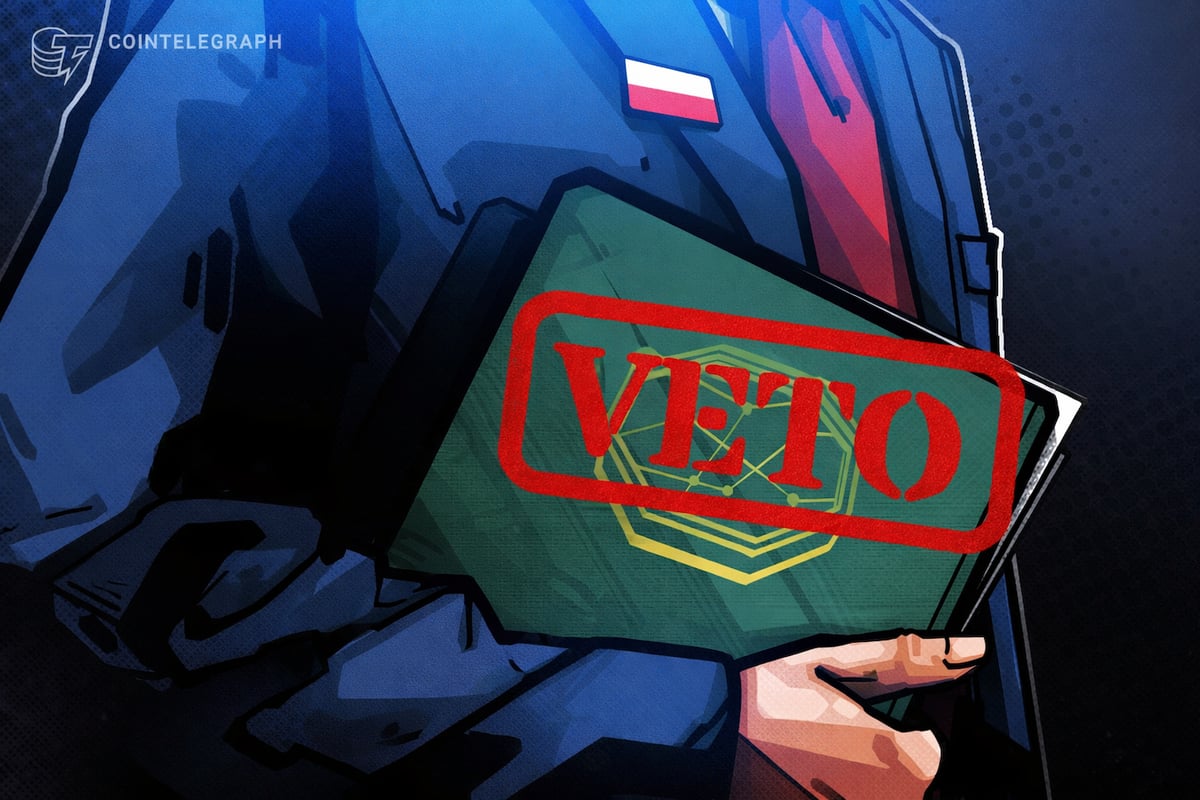
The vetoed bills, both Bill 1424 and Bill 2064, faced substantial criticism from various quarters, particularly from crypto market advocates and pro-innovation politicians. Polish politician Tomasz Mentzen, a vocal proponent of limited government intervention, openly described the proposed legislation as extensive "overregulation" that threatened to stifle the sector’s growth rather than nurture it. President Nawrocki echoed these sentiments, asserting, "I will not sign a wrong law just because it was passed again by the parliamentary majority. A wrong law that passed a hundred times still remains a wrong law." His further declaration, "Poland should attract innovation, not push it away," clearly articulates his vision for a regulatory environment that encourages technological advancement rather than burdening it with excessive rules. This stance positions Nawrocki as a significant figure in the global debate between stringent regulation and fostering technological innovation, siding firmly with the latter.
Despite the industry’s partial welcome of the president’s veto as a stand against stifling regulation, the current absence of MiCA-implementing legislation leaves local crypto platforms in an increasingly precarious and disadvantaged position. The regulatory vacuum creates a stark imbalance between Polish companies and their foreign competitors. For instance, major players like the U.S. crypto exchange Coinbase have strategically expanded operations into Poland, facilitated by securing a MiCA license in Luxembourg in 2025. This allows Coinbase to leverage MiCA’s passporting rights to offer services across the EU, including Poland, without needing a separate Polish license.
"Foreign entities that obtain a MiCA license in their home countries will be able to provide services in Poland, while Polish companies currently have no formal path to begin the licensing process domestically," Kanga’s Zawadzki elaborated, underscoring the severe "regulatory asymmetry" faced by Polish firms. This situation forces domestic companies into a difficult choice: either operate in a legal gray area, risking non-compliance with future regulations, or embark on a costly and complex process of establishing a legal presence and securing licenses in other EU jurisdictions. This not only saps resources but also leads to a potential "brain drain" and capital flight, as Polish entrepreneurs and innovators may choose to base their operations in more crypto-friendly EU nations.
Przemysław Kral, CEO of Zonda Crypto, an exchange that originated in Poland but is now registered in Estonia, further illustrated this dilemma. Zonda’s proactive strategy involved relocating its primary registration to Estonia, a country that has historically been more forward-thinking in its digital asset regulatory approach. Kral confirmed to Cointelegraph that Zonda plans to obtain its MiCA license outside Poland and then passport it back into its home market. While this strategy ensures Zonda’s continued operation and competitive edge, Kral warned of the broader implications for the domestic market. "Although we are a company with Polish roots and the largest player in the crypto industry on the Polish market, we have been operating outside Poland for years," Kral explained. "We are confident that we will remain a key player on the market. However, many small Polish crypto companies will lose the opportunity to operate on the market." This grim prediction highlights the disproportionate impact on smaller, less resourced Polish firms, which may lack the financial and logistical capacity to navigate complex international licensing processes.
The political landscape surrounding MiCA implementation in Poland is complex, with different factions holding divergent views. The government, led by Prime Minister Donald Tusk’s Civic Platform, typically aligns with broader EU directives, making the presidential veto a point of tension. Nawrocki, while not a member of the ruling coalition, represents a more conservative and nationalistic viewpoint that prioritizes domestic economic interests and aims to prevent what is perceived as overreach by Brussels or excessive state intervention. The legislative process itself involves the Sejm (the lower house of parliament) passing bills, which then require presidential assent. A presidential veto can be overridden by a three-fifths majority vote in the Sejm, but this has not occurred in this instance, suggesting either insufficient political will or continued disagreement within the parliament itself on the specifics of the proposed MiCA bills.

In the wake of the latest veto, a glimmer of hope has emerged for a more constructive path forward. Krzysztof Piech, a respected Polish economist and prominent voice in the country’s crypto community, announced over the weekend that he is actively working on a new, more crypto-friendly proposal for implementing MiCA in Poland. Piech indicated on social media that a draft of this alternative bill exists and is currently undergoing finalization. While details of Piech’s proposal are yet to be publicly disclosed, it is anticipated to address the president’s concerns regarding overregulation, potentially by advocating for a more proportionate approach to licensing, streamlined administrative processes, and clear definitions that avoid ambiguity and excessive burdens on smaller market participants. The success of this new initiative will depend on its ability to garner cross-party support in the Sejm and ultimately secure presidential approval, a task made challenging by the previous impasses. Cointelegraph’s attempts to reach Professor Piech for comment on the specifics of his draft bill had not received a response by the time of publication.
The situation in Poland stands in contrast to the proactive measures taken by other EU member states. Countries like France, Germany, and Luxembourg have been diligent in transposing MiCA into their national laws, demonstrating a commitment to embracing the new regulatory landscape and positioning themselves as attractive hubs for crypto innovation. Even countries like Greece, which might have historically been slower in adopting new financial regulations, have seen major players like Binance apply for MiCA licenses, signaling a broader EU-wide embrace of the framework. This divergence underscores the urgency for Poland to resolve its internal disagreements, not just to comply with EU law, but to remain competitive and relevant in the rapidly evolving global digital asset economy.
In conclusion, President Karol Nawrocki’s repeated vetoes of MiCA-implementing legislation have placed Poland at a critical crossroads. While his actions are framed as a defense against overregulation and a commitment to fostering innovation, they have inadvertently created a regulatory vacuum that severely disadvantages domestic crypto firms. The approaching MiCA deadlines amplify this challenge, forcing Polish companies to seek licenses and operational bases abroad, thereby creating a significant regulatory asymmetry. The future of Poland’s crypto industry now hinges on the ability of stakeholders, including economists like Krzysztof Piech, to craft a new, balanced legislative proposal that satisfies both the need for regulatory clarity and the president’s vision for an innovation-friendly environment. Failure to do so risks marginalizing Poland’s burgeoning digital asset sector, pushing talent and capital to more accommodating EU neighbors, and diminishing the nation’s potential as a leader in the global crypto economy.