anjir abdul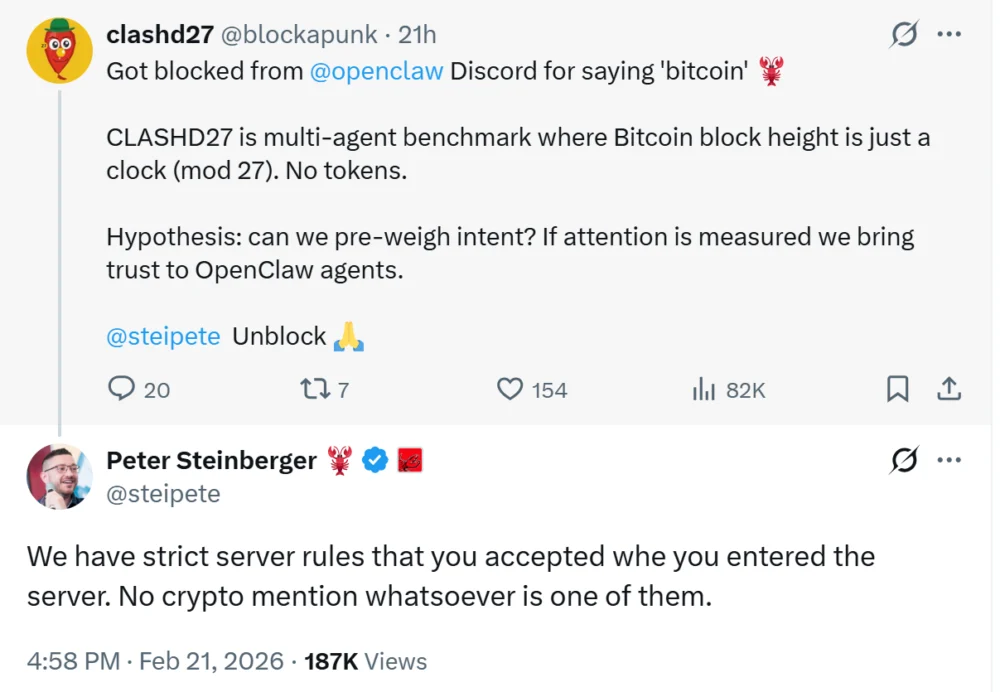
The rapidly expanding open-source AI agent framework, OpenClaw, has unequivocally stated that any discussion of Bitcoin or other cryptocurrencies within its official Discord server will result in immediate removal. This stringent "no crypto whatsoever" policy comes in the wake of a traumatic incident involving a fraudulent token scam that capitalized on the project’s growing popularity and a critical rebranding period. The developer’s decision highlights the complex challenges emerging AI projects face in navigating the volatile and often scam-ridden cryptocurrency landscape.
The controversy came to light recently when a user, identified as "blockapunk" on X (formerly Twitter), publicly revealed they had been banned from OpenClaw’s Discord. The user’s offense? Simply referencing Bitcoin’s block height as a neutral timing mechanism within a multi-agent benchmark — a technical, non-financial use of blockchain data. This seemingly innocuous mention triggered the server’s strict protocol, leading to their swift expulsion.
In response to blockapunk’s public post, OpenClaw creator Peter Steinberger wasted no time confirming the action. Steinberger, known for his direct communication, clarified that all members implicitly accept "strict server rules" upon joining, and the community staunchly enforces its "no crypto mention whatsoever" policy. This firm stance underscored the project’s determination to maintain a clear separation from the crypto world, a decision rooted in painful past experiences. While the initial ban was upheld, Steinberger later showed a degree of flexibility, agreeing to re-add the user after they provided their username, indicating a willingness to restore access once the policy had been clearly communicated and understood.
The genesis of OpenClaw’s zero-tolerance approach to cryptocurrency lies in a calamitous event that unfolded during a pivotal rebrand. The project, which had garnered significant attention for its innovative AI agent framework, found itself in an unexpected crisis. Steinberger had initiated a rebrand after receiving a trademark notice related to the project’s original name. This transition period, fraught with the complexities of updating digital identities across various platforms, inadvertently created a window of vulnerability.
In the short interim between the relinquishment of old social media accounts and the successful claim of new ones, opportunistic scammers moved with alarming speed and precision. They seized the abandoned social media handles and leveraged them to promote a fraudulent Solana-based token, deceptively named "$CLAWD." The timing was impeccable from the scammers’ perspective: OpenClaw was gaining immense traction, generating buzz within both the AI and developer communities, making it an ideal target for a pump-and-dump scheme.
The fake $CLAWD token experienced a meteoric, albeit brief, surge. Within mere hours, its market capitalization skyrocketed to approximately $16 million, luring unsuspecting investors drawn by the perceived association with the legitimate OpenClaw project. However, the euphoria was short-lived. As soon as Steinberger publicly and emphatically denied any involvement with the token or any cryptocurrency launch, the speculative bubble burst. The token’s value plummeted by more than 90%, leaving early buyers with significant losses and, understandably, feelings of betrayal. Many of these victims, misinformed by the scam, unfortunately, accused Steinberger and the OpenClaw team of orchestrating the fraud.

Steinberger’s response at the time was swift and unequivocal. He issued a stark warning to users, unequivocally stating that he would never launch a cryptocurrency and that any token claiming affiliation with him or OpenClaw was fraudulent. This public declaration was crucial in mitigating further damage and clarifying the project’s official stance. The incident also drew the attention of security researchers, with firms like SlowMist later identifying hundreds of exposed OpenClaw instances online. Even more concerning, they uncovered dozens of malicious plug-ins, many specifically designed to target cryptocurrency traders, underscoring the sophisticated and pervasive nature of the threats lurking in the intersection of emerging tech and crypto. These malicious tools could range from phishing for wallet keys to redirecting transactions or even deploying sophisticated social engineering tactics against unsuspecting users.
Despite this unfortunate entanglement with the crypto underworld, OpenClaw has continued its rapid ascent. Since its launch in late January, the framework has exploded in popularity, surpassing an impressive 200,000 GitHub stars within weeks. This meteoric rise underscores its appeal to a wide developer audience captivated by the potential of autonomous agents – AI systems capable of operating independently to achieve specific goals. The project’s success is a testament to the innovation it brings to the field of AI, even as it grapples with the fallout of its unintended association with crypto scams.
The OpenClaw incident, while specific to its context, also casts a spotlight on a broader industry trend: the increasing convergence of artificial intelligence and cryptocurrency. Many industry leaders are bullish on the prospect of crypto serving as the default payment rail for the burgeoning AI economy. Jeremy Allaire, CEO of Circle, a prominent stablecoin issuer, has famously predicted that billions of AI agents will leverage stablecoins for routine payments within just a few years. His vision paints a future where AI agents seamlessly interact with financial systems, paying for data, compute resources, API access, and even engaging in complex decentralized finance (DeFi) activities, all powered by the speed and efficiency of stablecoins.
Echoing this sentiment, Coinbase, a leading cryptocurrency exchange, recently made significant strides in this domain. Earlier this month, Coinbase launched its "Agentic Wallets" infrastructure, a groundbreaking development that empowers AI agents to hold their own wallets and autonomously spend, earn, and trade crypto on-chain. Built on its innovative AgentKit developer framework and powered by the x402 payments protocol, this system is designed to enable software agents to actively manage DeFi positions, intelligently rebalance portfolios, pay for various compute and data services, and participate seamlessly in digital marketplaces. This move by Coinbase signifies a strategic bet on a future where AI agents are not just tools but active participants in the digital economy, requiring robust and secure financial infrastructure.
Furthermore, partnerships such as Deel, a global payroll platform, tapping MoonPay to roll out stablecoin salary payouts in the UK and EU, further illustrate the growing acceptance and utility of crypto as a practical payment solution for global, distributed workforces. As AI agents become more sophisticated and operate across borders, the need for efficient, low-cost, and programmable payment rails will only intensify, making cryptocurrencies, particularly stablecoins, an attractive option.
The OpenClaw saga serves as a stark reminder of the dual nature of innovation in the digital age. While projects like OpenClaw push the boundaries of AI, their very success can make them targets for malicious actors seeking to exploit new technologies and eager communities. The decision to implement a strict "no crypto" policy, while seemingly extreme to some, is a defensive measure designed to safeguard the community and the project’s integrity from the persistent threat of scams and fraudulent activities that unfortunately plague the crypto space. It underscores the ongoing challenge for developers and community managers to foster innovation while also ensuring a safe and trustworthy environment for their users, especially in areas where technological advancements intersect with high-risk financial instruments.
Cointelegraph is committed to independent, transparent journalism. This news article is produced in accordance with Cointelegraph’s Editorial Policy and aims to provide accurate and timely information. Readers are encouraged to verify information independently. Read our Editorial Policy https://cointelegraph.com/editorial-policy