Imroatul Nasiyah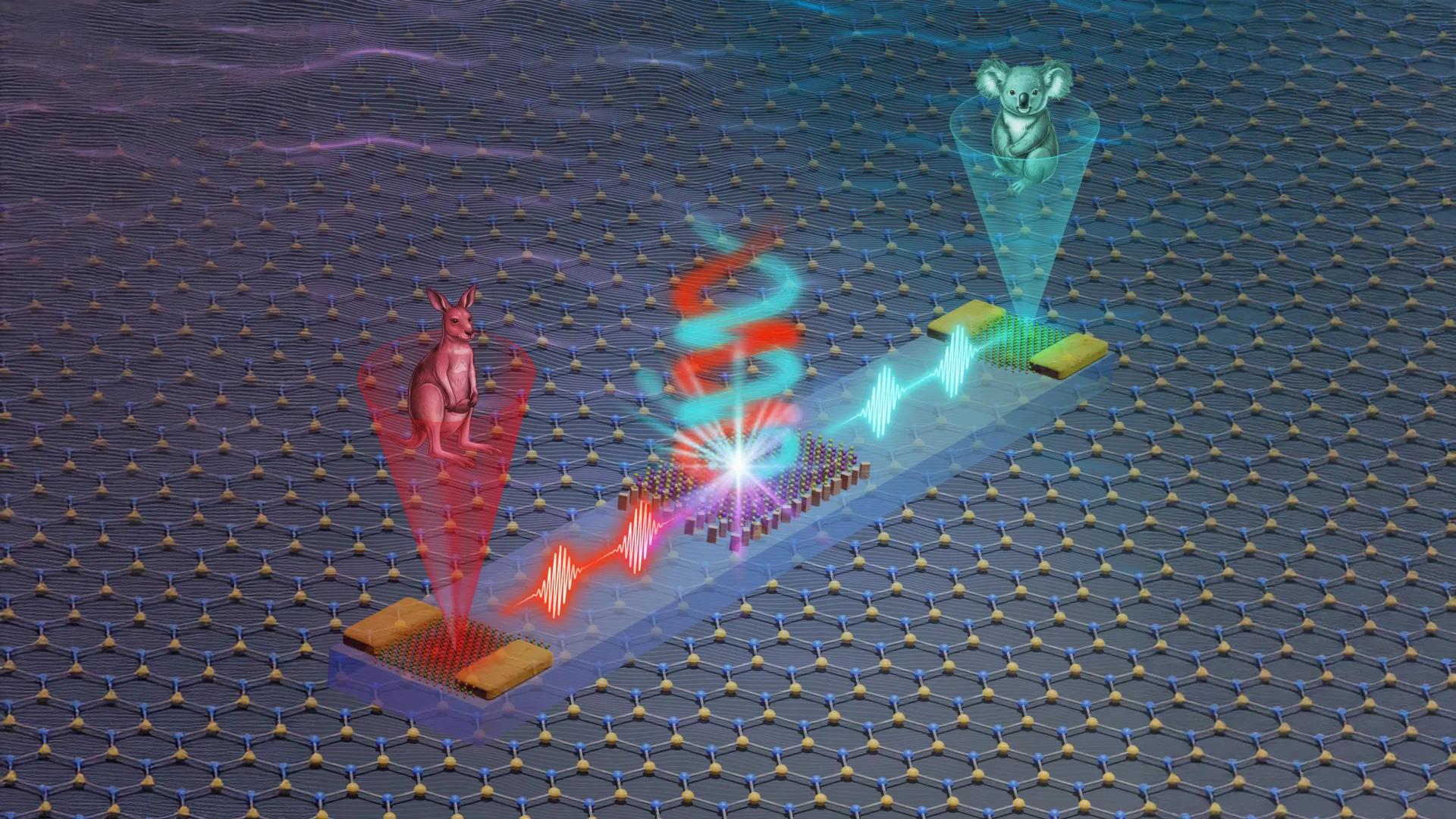
The pioneering device, conceived and meticulously engineered by researchers from the Monash School of Physics and Astronomy, masterfully integrates sophisticated nanotechnology with state-of-the-art materials. This synergistic approach tackles a persistent challenge that has, until now, acted as a significant bottleneck for the progress of valleytronics. For the very first time, the Monash team has successfully constructed a fully integrated chip that not only produces specialized light signals but also precisely guides these signals along predetermined paths, and crucially, converts them into electrical signals – all within the confines of a single, remarkably compact system. The information itself is encoded using a fundamental quantum property known as the "valley degree of freedom." This unique characteristic, residing within the electronic structure of certain materials, offers scientists entirely novel paradigms for encoding, transmitting, and processing vast quantities of data with unparalleled efficiency.
At the heart of this innovation lies the "Integrated Valleytronics Chip Solves Long-Standing Challenge," a testament to the researchers’ ability to overcome a major hurdle in valleytronics. Dr. Chi Li, the lead author of the study whose team’s seminal findings were recently published in the prestigious journal Nature Photonics, emphasized the significance of this achievement. "Until now," Dr. Li explained, "we could generate or detect these signals, but not do everything in one integrated device. What we’ve built is a complete on-chip system that can create, route and read this information with very high precision." This integrated capability is transformative, moving beyond fragmented approaches to a holistic solution.
The device’s architecture is built upon ultra-thin materials, meticulously engineered to be mere atoms thick. These exotic materials are then expertly paired with precisely designed nanostructures. These nanostructures act as sophisticated controllers, enabling the manipulation of light at infinitesimally small scales with extraordinary accuracy. Dr. Kaijian Xing, a co-first author of the study and a dedicated Research Fellow at Monash University, elaborated on the practical ingenuity behind the integration process. "We employ a straightforward stacking approach to integrate ultra-thin materials with metasurfaces," Dr. Xing stated. "This method effectively overcomes the technical challenges of direct material growth on photonic structures, thereby paving the way for further, more ambitious advances in valleytronics." This innovative stacking technique simplifies manufacturing and enhances the potential for scalability.
A particularly compelling advantage of this novel technology is its ability to operate at room temperature. This stands in stark contrast to many existing quantum systems, which necessitate cryogenic environments – extremely cold temperatures – making them prohibitively complex and expensive for widespread real-world implementation. The room-temperature operation dramatically broadens the accessibility and applicability of valleytronic devices.
Senior author Dr. Haoran Ren, an ARC Future Fellow and the distinguished leader of the Monash NanoMeta Group, highlighted the broader implications of this breakthrough. According to Dr. Ren, the work is poised to usher in a new era of compact photonic devices that are not only programmable but also exhibit exceptional levels of efficiency. He further elaborated on the potential impact, stating that the technology could be instrumental in supporting the development of significantly faster computing systems, drastically reducing energy consumption across various applications, and enabling entirely new methodologies for secure communications and advanced data processing. "This is a significant step toward scalable, chip-based technologies that use light instead of electricity to process information," Dr. Ren asserted. "Photonic devices use light to achieve massive bandwidths, ultra-fast data transmission speeds, and lower energy consumption, so what we have achieved has strong potential for applications in quantum computing, advanced imaging, and next-generation optical communication systems." The inherent advantages of light-based communication – speed, bandwidth, and energy efficiency – are now more attainable than ever.
The researchers demonstrated the chip’s remarkable capabilities by successfully encoding and processing two separate images simultaneously. This experiment unequivocally showcased the device’s prowess in managing multiple streams of information concurrently. This parallel processing capability is a critical feature for the evolution of future computing technologies, promising to unlock new levels of performance and multitasking.
Professor Stefan A. Maier, Head of the School of Physics and Astronomy and Director of the Nanophotonics Laboratory at Monash University, underscored the significance of this development in bridging the gap between fundamental scientific discovery and tangible technological application. "This is an important step toward fully integrated valleytronic systems," Professor Maier commented. "By combining light and quantum materials on a chip, we can access new ways of encoding and processing information." This integration of fundamental quantum phenomena with practical engineering is the hallmark of transformative innovation.
The international collaborative effort behind this groundbreaking research brought together a diverse and talented pool of experts from Australia, China, Singapore, Germany, and Japan. This multidisciplinary approach leveraged extensive expertise in nanophotonics, the intricate science of manipulating light at the nanoscale; two-dimensional materials, with their unique electronic and optical properties; and optoelectronics, the field concerned with electronic devices that source, detect, and control light.
The core Monash University team, instrumental in this breakthrough, comprised Dr. Chi Li, Dr. Kaijian Xing, Professor Michael S. Fuhrer, Professor Stefan A. Maier, and Dr. Haoran Ren. Their collective knowledge and dedication were pivotal. Further invaluable contributions to this international project were provided by esteemed researchers from the Singapore University of Technology and Design, LMU Munich, and the University of Technology Sydney, underscoring the global nature and impact of this scientific endeavor. This collaborative spirit highlights the shared pursuit of advancing human knowledge and technological capability.