anjir abdul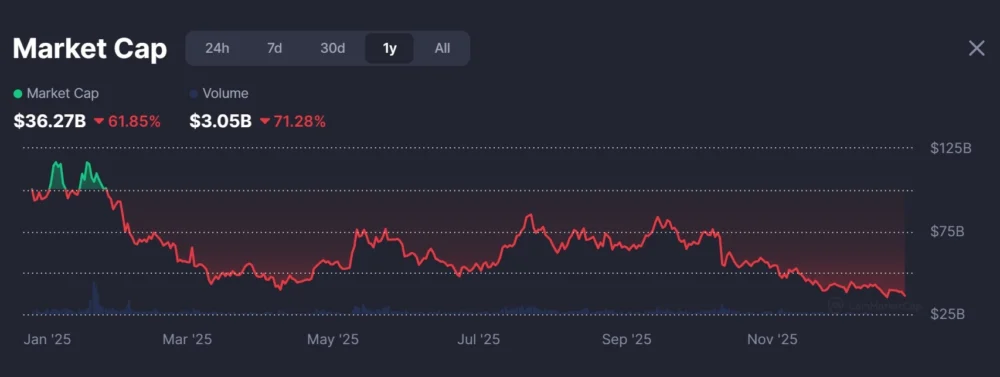
Memecoins, once the darlings of speculative crypto markets and symbols of unbridled optimism, are currently languishing near their year-end lows, marking a stark and painful reversal from the euphoric peaks achieved during the festive season of Christmas 2024. This dramatic shift underscores a profound change in investor sentiment, as the sector grapples with a harsh cold reality following a year of sustained decline.
The sector’s market capitalization plummeted by a staggering 65% over the past year, shrinking to a mere $35 billion by December 19, 2025, according to comprehensive data from CoinMarketCap. This figure represents the lowest valuation recorded for memecoins throughout the entirety of 2025, painting a grim picture for investors who had ridden the wave of their explosive growth. While the sector did manage a slight rebound on Friday, climbing marginally to approximately $36 billion, this minor uptick does little to mitigate the significant losses sustained over the preceding twelve months.
Just a year prior, the landscape was vastly different. Around Christmas Day 2024, memecoins were thriving, buoyed by an influx of speculative capital and widespread retail enthusiasm. During this period, their collective valuation soared to an impressive $100 billion, a testament to the sector’s incredible, albeit fleeting, ability to capture the imagination of the crypto community. The rapid ascent was fueled by a confluence of factors, including widespread social media virality, celebrity endorsements, and a general market environment ripe for high-risk, high-reward investments. Projects like Dogecoin, Shiba Inu, Pepe, and newer entrants like BONK and WIF had demonstrated the potential for astronomical gains, turning everyday internet memes into multi-billion-dollar assets. This era was characterized by a distinct "Christmas cheer," where quick riches seemed attainable, and the fear of missing out (FOMO) drove unprecedented liquidity into these highly speculative tokens.
However, the celebratory mood quickly dissipated as 2025 progressed. Alongside the precipitous drop in market capitalization, the trading volume within the memecoin sector also experienced a significant contraction. Over the year, trading volume fell by a dramatic 72%, settling at $3.05 trillion. This decline in trading activity is a crucial indicator, reflecting a broader exodus of retail investors from highly speculative assets. As the crypto market matured and faced increasing headwinds, the appetite for pure speculation waned, with capital gradually shifting towards more established cryptocurrencies or projects with tangible utility and robust technological foundations. The once-vibrant trading floors, bustling with rapid buy and sell orders for the latest meme-inspired token, became notably quieter, signaling a significant loss of liquidity and investor interest.
Memecoins have historically served as an informal, yet highly effective, temperature check for the risk appetite of retail traders within the crypto ecosystem. Their performance often acts as a barometer for market sentiment; when memecoins are surging, it typically indicates a bullish market brimming with confidence and a willingness to embrace high-risk ventures. Conversely, a collapse in the sector’s market cap, as witnessed in 2025, unequivocally signals a more cautious and risk-averse market environment. In such conditions, capital becomes harder to attract for projects lacking intrinsic value or clear use cases, with investors prioritizing capital preservation and seeking out assets perceived as more stable or fundamentally sound. The dramatic cooling of the memecoin market suggests that the era of easy money and impulsive speculation, at least for now, has drawn to a close, giving way to a more discerning and conservative investment landscape.
How Politics Shaped the Memecoin Sector’s Rise and Fall
One of the most intriguing and influential drivers behind memecoins’ explosive growth in 2024 was the pervasive presence of political narratives. These narratives effectively transformed the sector into a dynamic proxy for election-driven speculation, intertwining digital assets with real-world political discourse in unprecedented ways.
According to analysis from CoinGecko, the palpable enthusiasm surrounding the United States presidential race played a pivotal role in pushing memecoin valuations to record highs. Election-themed tokens, often humorously or controversially linked to specific political figures, parties, or campaign slogans, dominated social media feeds, gained prominence on various launchpads, and drove a significant amount of on-chain activity. Investors and speculators, often driven by a combination of political affiliation, entertainment, and the hope for quick returns, poured funds into these tokens. The viral nature of political discussions, amplified by social media, provided fertile ground for memecoins to flourish, creating a unique intersection of finance, politics, and internet culture. Tokens associated with figures like Donald Trump or even international leaders such as Argentina’s President Javier Milei became focal points of this speculative frenzy, attracting attention far beyond traditional crypto circles. This phenomenon underscored how memecoins, despite their often whimsical origins, could tap into powerful real-world events and sentiments, leveraging them for massive, albeit volatile, growth.
However, this very political momentum, which had initially propelled the sector to such dizzying heights, ironically became a significant catalyst for its decline further into 2025. The launch of numerous high-profile tokens directly tied to political figures, including a specific memecoin token linked to US President Donald Trump and the Libra token associated with Argentina President Javier Milei, marked a critical turning point. While initially generating immense hype, these politically charged assets often proved to be exceptionally volatile and susceptible to external influences.
The subsequent sharp price collapses experienced by many of these political memecoins, coupled with widespread reports of insider activity, systematically undermined investor confidence. Allegations of developers or early investors "dumping" large quantities of tokens onto the market, or other forms of manipulative practices, fueled a growing sense of distrust. This insider activity, perceived by many as unethical and exploitative, eroded the communal spirit that often underpins memecoin success. What began as enthusiasm quickly morphed into deep skepticism. Investors, having witnessed significant losses and the perceived manipulation within these high-profile political memecoin projects, became increasingly wary of the entire sector. The narrative shifted from one of democratic speculation to one of potential scams and unfair practices, making it significantly harder for new or existing memecoins to attract and retain capital. The political memecoin experiment, while demonstrating the power of narrative, ultimately left a trail of disillusioned investors and contributed significantly to the broader cooling of the memecoin market.
NFTs Hit 2025 Lows in December, Mirroring Memecoin Woes
The struggles of memecoins were not an isolated incident but rather indicative of a broader trend affecting other highly speculative sectors within the cryptocurrency market. Non-fungible tokens (NFTs), another category of digital assets that had experienced their own explosive growth phase, also witnessed a sharp and significant dip in valuations in December 2025, mirroring the downturn observed in the memecoin space.
According to data compiled by CoinGecko, the collective market capitalization of NFTs plummeted to $2.5 billion in December, reaching its lowest level throughout 2025. This dramatic fall represents a staggering 72% decline from their peak valuation of $9.2 billion recorded in January of the same year. The trajectory of NFTs, much like memecoins, paints a picture of a sector that struggled to maintain momentum after an initial period of intense speculative interest. NFTs, which represent unique digital items ranging from art and collectibles to virtual land and gaming assets, captivated the world in previous years with record-breaking sales and the emergence of blue-chip collections like Bored Ape Yacht Club and CryptoPunks. They were championed as the future of digital ownership and creativity, attracting artists, celebrities, and investors alike.
However, the speculative bubble surrounding NFTs appears to have deflated considerably in 2025. Further reinforcing this downturn, NFT data tracker CryptoSlam reported a significant drop in market activity. The number of weekly sellers in the NFT market fell below 100,000 for the first time since April 2021. This metric is particularly telling; a reduction in active sellers indicates not only a decrease in new entrants but also a potential reluctance among existing holders to liquidate their assets at current, diminished prices. It suggests a market that has become illiquid and less dynamic, where the fervor for buying and selling has largely subsided. Both memecoins and NFTs, sharing characteristics of being driven by hype, community, and speculative demand rather than inherent utility in many cases, have demonstrated a synchronized vulnerability to shifts in market sentiment and overall risk appetite. Their parallel declines underscore a market-wide pivot away from purely speculative digital assets towards more established or utility-driven blockchain projects.
The Broader Implications and Lessons Learned
The significant downturn in both the memecoin and NFT sectors in 2025 carries substantial implications for the broader cryptocurrency market and for retail investors. The "cold reality" that has set in highlights the cyclical and often volatile nature of speculative assets. For many, memecoins and NFTs represented an entry point into crypto, promising rapid wealth creation. The current market conditions serve as a harsh reminder that such high-risk investments come with an equally high potential for loss.
This shift in sentiment could foster a more cautious and discerning investment approach among retail traders. Rather than chasing the latest viral token, investors may increasingly prioritize projects with robust technology, clear use cases, strong development teams, and sustainable economic models. The experience of 2025 might encourage a move away from purely narrative-driven speculation towards a greater emphasis on fundamental analysis and long-term value.
Furthermore, the decline in speculative sectors could also be seen as a sign of the crypto market’s maturation. As the industry evolves, there is an ongoing tension between the pursuit of innovative utility and the allure of pure speculation. The correction in memecoins and NFTs might indicate a recalibration, where the market begins to distinguish more sharply between projects offering genuine innovation and those relying solely on hype.
Looking ahead, while memecoins and NFTs will likely remain a part of the crypto landscape due to their unique appeal and community aspects, their role might be redefined. Future cycles may see them emerge again, but perhaps with a more tempered enthusiasm, or with a greater focus on integrating actual utility, however niche, to sustain their value beyond fleeting trends. The lessons from 2025 – regarding the dangers of unchecked speculation, the impact of insider activity, and the fickle nature of viral trends – will undoubtedly shape how investors and developers approach these categories of digital assets in the years to come. The era of effortless "Christmas cheer" for memecoins has clearly given way to a sobering "cold reality," compelling the market to reflect on its priorities and risk tolerance.