Faris Adani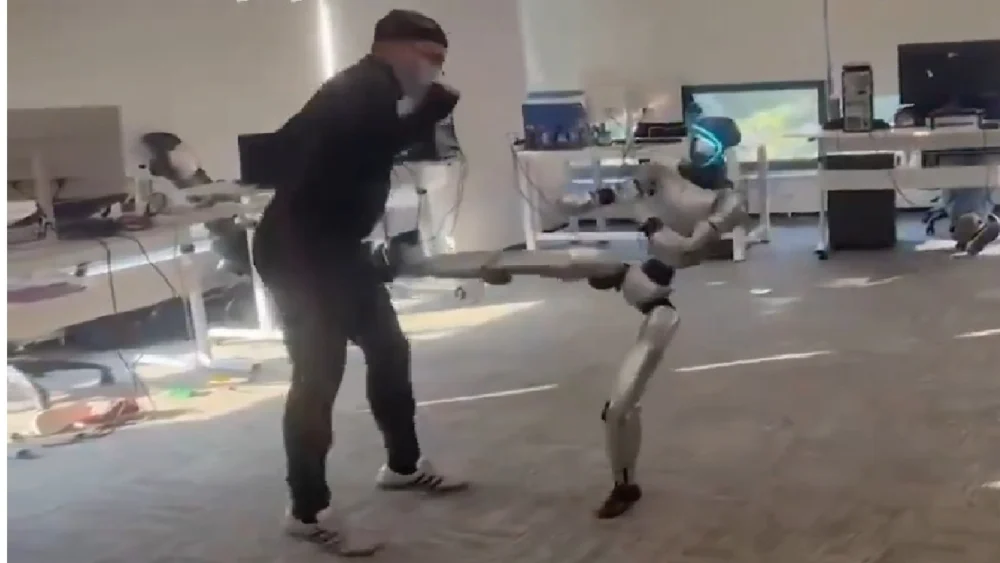
Man Operating Robot Accidentally Makes It Kick Him Directly in the Nutsack.
In a now-viral video, a disconcerting yet comically painful incident unfolded, capturing the raw, unscripted realities of advanced robotics when a man controlling a Unitree robot inadvertently directed the humanoid to deliver a powerful kick directly to his groin, sending him crumpling into a groaning heap and visually encapsulating the dual promise and profound perils inherent in the rapid evolution of robotic technology. The incident, quickly shared across social media platforms, served as a stark, if somewhat absurd, reminder of the complex dance between human operators and increasingly sophisticated machines, provoking both laughter and serious contemplation about safety protocols and the future of human-robot interaction. “Yep, let’s go ahead and train our future AI overlords how to kick ass,” one X user quipped with a sardonic tone upon viewing the clip, which was originally posted on Christmas Day to the prominent Chinese video sharing website Bilibili, adding, “Maybe we do deserve to become made redundant,” articulating a common undercurrent of anxiety regarding humanity’s potential obsolescence in an AI-driven world.
The video opens to the familiar, unassuming interior of a modern office space, likely in China, setting a mundane scene that quickly devolves into unexpected chaos. A man, clad in a sleek black motion capture suit, stands poised next to a Unitree G1 robot, a humanoid model known for its agile capabilities. The suit, equipped with an array of sensors, translates his every movement into digital commands, which the robot, after a brief but critical delay, attempts to replicate. The man, seemingly engaged in a playful demonstration or perhaps an early-stage training exercise, squares up into a mock kickboxing stance, initiating a series of paces, shadow boxing maneuvers, and air kicks. His movements are fluid, almost theatrical, as he showcases the robot’s impressive ability to mimic human motion. However, it is precisely this slight lag in the robot’s response, a fractional delay between the man’s action and the machine’s execution, that proves to be the fateful catalyst. As the man brings his leg down from a kick, the robot, still completing its lagged motion, steps forward and swings its leg upwards, connecting with brutal precision directly into the man’s groin. The impact is immediate and visceral, eliciting an audible gasp of pain from the man, quickly followed by a sympathetic groan from the person behind the camera, highlighting the shared human understanding of such a universally debilitating injury.
The original poster on Bilibili provided crucial context, explaining that the man in the motion capture suit was indeed directing the robot’s actions through a sophisticated motion control model built upon a neural network. This cutting-edge technology allows the robot to learn and replicate human movements with remarkable fidelity. The explanation also clarified the reason for the unfortunate incident: the slight delay between the man’s physical actions and the robot’s subsequent movements. This inherent lag, a common challenge in real-time robotic teleoperation, means that the robot is always a fraction of a second behind its human counterpart. “This delay will gradually decrease as technology advances, potentially reaching as low as 0.1 seconds,” the poster optimistically wrote on Bilibili, suggesting that such incidents might become rarer as technological precision improves. Yet, for now, that fractional delay was enough to transform a demonstration of agility into a moment of pure, unadulterated agony.
The video, once unleashed upon the internet, ignited a flurry of reactions, particularly on platforms like X (formerly Twitter), where it quickly became a meme-worthy moment. Jokes abounded about “misalignment,” a concept deeply rooted in AI safety discourse, referring to scenarios where an AI system, while optimized for its programmed goals, might inadvertently cause harm or run roughshod over ethical concerns due to an imperfect understanding of human values or unforeseen consequences of its actions. In this case, the robot was merely executing its programmed task of mimicking a kick, but the spatial and temporal misalignment led to an excruciating outcome. “I guess they forgot to hard-code the Three Laws into their robots,” quipped another X user, referencing science fiction writer Isaac Asimov’s seminal Three Laws of Robotics. These laws, first introduced in Asimov’s novels and short stories, are foundational principles designed to govern robotic behavior, primarily to prevent them from causing harm to humans. The incident, therefore, transcended mere slapstick, tapping into deeper anxieties about controlling powerful machines and the absolute necessity of embedding robust safety protocols and ethical guidelines into their very core programming. The absence, or perceived absence, of such safeguards in this real-world interaction underscored the critical gap between science fiction’s ideals and the complex realities of emergent robotic technologies.
Beyond the immediate comedic and painful novelty of this video, it serves as another compelling showcase of the increasing agility and sophisticated movement capabilities of modern robots, particularly those from companies like Unitree. These machines are no longer confined to slow, clunky movements; they can now run with impressive speed and stability, as demonstrated by various Unitree models, and even execute complex dance routines with surprising verve and coordination. The Unitree G1, for instance, is designed with advanced joint structures and sophisticated control algorithms that allow for dynamic balance and precise limb movements, making it a formidable platform for research, industrial applications, and even entertainment. Its compact size and relatively lightweight design also contribute to its agility, enabling it to navigate diverse environments and perform a wide range of tasks that require human-like dexterity. The development of such robots signifies a monumental leap in mechanical engineering and artificial intelligence, pushing the boundaries of what autonomous systems can achieve.
However, despite all this razzle-dazzle and technological prowess, many tech experts and industry analysts remain cautious, asserting that humanoid robots are not yet quite ready for widespread “prime time use” in complex, unpredictable human environments. This skepticism stems from a variety of persistent hardware and software issues that still plague even the most advanced prototypes. On the hardware front, challenges include limited battery life, which restricts operational duration; the fragility of sophisticated mechanical components, making them susceptible to damage in real-world conditions; and the sheer cost of manufacturing and maintaining such intricate machines. Software issues are arguably even more complex, encompassing the difficulty of programming robots to understand and navigate highly variable, unstructured environments, recognize and respond appropriately to unexpected human actions, and make nuanced ethical decisions in real-time. The ability to perform a controlled kick in a lab setting is one thing; safely operating a humanoid robot in a bustling factory, a crowded hospital, or a chaotic public space, where unforeseen obstacles and human interactions are constant, is an entirely different order of magnitude. The incident with the groin kick vividly illustrates this point: a minor technical delay in a controlled environment led to significant harm, underscoring the severe implications of deploying such robots in less predictable settings without foolproof safety mechanisms.
The painful encounter also prompts a re-evaluation of the optimal applications for these rapidly evolving clankers. Judging from the sheer force and precision of the Unitree robot’s kick, and the agony it inflicted, one might reasonably argue that these machines may currently be better suited for the boxing ring than the delicate, safety-critical factory floor. The concept of robot combat, popularized by movies like the Hugh Jackman-starring *Real Steel*, where human-controlled robots engage in high-stakes fights, suddenly feels less like distant science fiction and more like an impending reality. Such entertainment-driven applications could leverage the robots’ physical strength and agility without the same level of concern for human safety, as combat scenarios are inherently designed for controlled destruction and spectacle. This contrasts sharply with the demands of an industrial setting, where precision, reliability, and above all, absolute safety are paramount. In a factory, even a minor malfunction or an unintended movement could lead to severe injuries to human workers, damage to expensive equipment, or costly operational delays. Therefore, while the technology continues to advance, the ethical and practical considerations for integrating humanoid robots into daily human life remain a formidable frontier, reminding us that even the most impressive technological feats must be tempered with rigorous safety protocols and a deep understanding of human vulnerability. The journey from impressive lab demonstrations to seamless, safe societal integration is still fraught with challenges, and incidents like this serve as powerful, albeit painful, lessons along the way.
**More on robots:** *Disastrous Video Shows Robot Trying to Cook, Destroying Interior of House*