Imroatul Nasiyah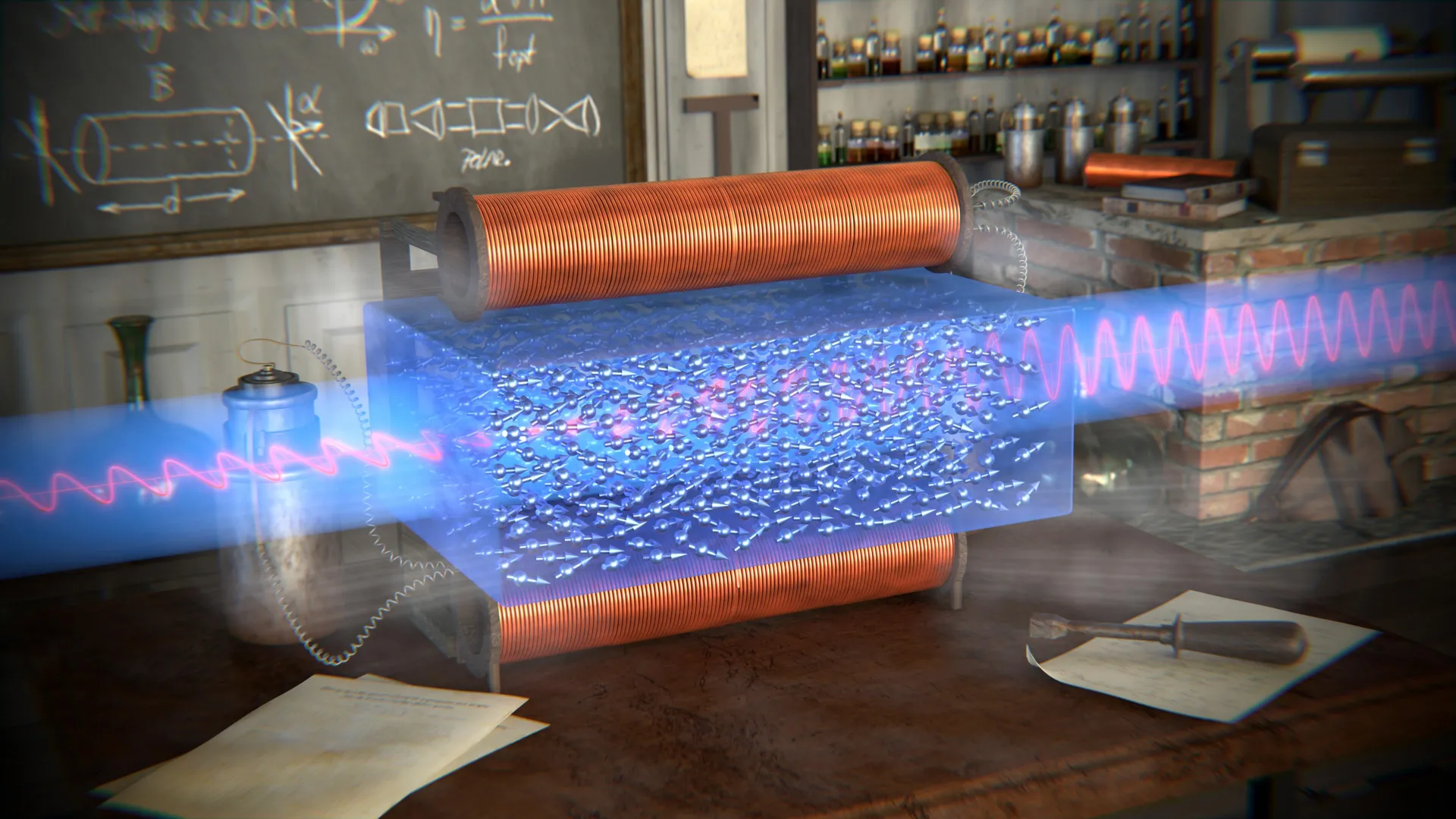
The seminal findings, meticulously detailed in the esteemed journal Scientific Reports by Nature, unequivocally establish that the magnetic facet of light exerts a measurable and meaningful impact on how light interacts with materials. This stands in stark contrast to the prevailing scientific paradigm that has dictated the understanding of the Faraday Effect since the 19th century. The research, spearheaded by the dedicated efforts of Dr. Amir Capua and Benjamin Assouline from the university’s distinguished Institute of Electrical Engineering and Applied Physics, provides the inaugural theoretical framework positing that the oscillating magnetic field inherent in light directly contributes to the Faraday Effect. The Faraday Effect itself describes the phenomenon wherein the polarization plane of light undergoes a rotation as it traverses a material that has been subjected to an external, constant magnetic field.
"At its core, this is an interaction between light and magnetism," elucidates Dr. Capua, offering a simplified yet profound explanation of their discovery. "The static magnetic field, in essence, ‘twists’ the light. In return, the light then serves as a conduit, revealing the intrinsic magnetic properties of the material it encounters. What we have unearthed is that the magnetic component of light is not a passive bystander but an active participant, exerting a first-order effect, a finding that is as surprising as it is significant."
For an astonishing span of nearly two hundred years, the scientific community largely attributed the entirety of the Faraday Effect to the interaction between the electric field of light and the electric charges residing within matter. The new study, however, meticulously dissects this long-standing assumption, demonstrating that the magnetic field of light also engages in a direct and crucial role by interacting with atomic spins. This particular interaction was previously presumed to be of negligible importance, a secondary or even insignificant factor in the overall phenomenon.
The researchers meticulously employed sophisticated computational methods, drawing heavily upon the principles of the Landau-Lifshitz-Gilbert (LLG) equation. This fundamental equation is renowned for its ability to accurately describe the intricate behavior of electron spins within magnetic materials. Through these advanced calculations, they were able to conclusively demonstrate that the magnetic field of light can indeed generate a magnetic torque within a material, mirroring the mechanism by which a static magnetic field exerts its influence. Dr. Capua further elaborates on this pivotal aspect, stating, "To put it plainly, light does not merely illuminate matter; it actively influences it at a magnetic level."
To quantify the precise extent of this magnetic influence, the research team ingeniously applied their theoretical model to a specific material: Terbium Gallium Garnet (TGG). TGG is a crystal that has been historically and is still commonly utilized in experimental studies of the Faraday Effect. Their rigorous analysis of TGG revealed a remarkable truth: the magnetic component of light accounts for approximately 17% of the observed polarization rotation within the visible spectrum of light. Astonishingly, this percentage escalates dramatically to as much as 70% when considering the infrared portion of the spectrum. This quantitative data provides compelling evidence for the substantial and previously underestimated role of light’s magnetic field.
"Our findings definitively illustrate that light communicates with matter through a dual mechanism," states Benjamin Assouline, emphasizing the broader implications of their work. "It interacts not only via its electric field, as has been the conventional wisdom, but also, and crucially, through its magnetic field – a component that has, until this point, been largely relegated to the shadows of scientific inquiry."
The implications of this revised understanding of light’s magnetic behavior are profound and far-reaching. The researchers foresee this discovery as a catalyst for a wave of innovations across several cutting-edge technological domains. In the realm of optical data storage, for instance, a more nuanced understanding of light-matter magnetic interactions could lead to novel methods for encoding and retrieving information with unprecedented density and speed. The field of spintronics, which aims to harness the intrinsic spin of electrons in addition to their charge for electronic devices, stands to benefit immensely. This research could pave the way for more efficient and sophisticated spintronic components, leading to faster and more energy-efficient electronics.
Furthermore, the burgeoning field of quantum technologies, particularly spin-based quantum computing, is poised for significant advancements. Quantum computers rely on the precise manipulation of quantum bits (qubits), which can be realized through the spin states of electrons. A deeper understanding of how light’s magnetic field can interact with and control these spins could unlock new avenues for qubit initialization, manipulation, and readout, thereby accelerating the development of powerful quantum computing architectures.
The study also opens up exciting possibilities for new optical phenomena and devices. By understanding and leveraging the magnetic influence of light, scientists might be able to develop new types of optical modulators, sensors, and even components for advanced optical communication systems. The ability to magnetically control light-matter interactions with greater precision could lead to the creation of entirely new classes of metamaterials and photonic devices with tailored electromagnetic properties.
The journey to this discovery was not without its challenges. The inherent weakness of the magnetic field of light compared to its electric field, coupled with the complexity of measuring such subtle interactions, has historically made it difficult to isolate and quantify the magnetic contribution to phenomena like the Faraday Effect. The Hebrew University team’s success lies in their innovative theoretical approach, which allowed them to model and predict the magnetic effects with remarkable accuracy, subsequently validated by their application to TGG.
This work represents a significant paradigm shift in our understanding of the fundamental nature of light and its interaction with the material world. It underscores the importance of re-examining established scientific principles with fresh perspectives and advanced tools. The nearly 200-year-old belief that light’s magnetic component was insignificant in the Faraday Effect has been decisively challenged, revealing a hidden layer of complexity and potential that has been waiting to be uncovered. As Dr. Capua and Assouline continue their research, the scientific community eagerly anticipates further revelations stemming from this momentous discovery, which promises to illuminate new pathways for technological progress and deepen our fundamental understanding of the universe. The magnetic secret of light, once hidden, now stands revealed, beckoning a new era of scientific exploration and innovation.