Imroatul Nasiyah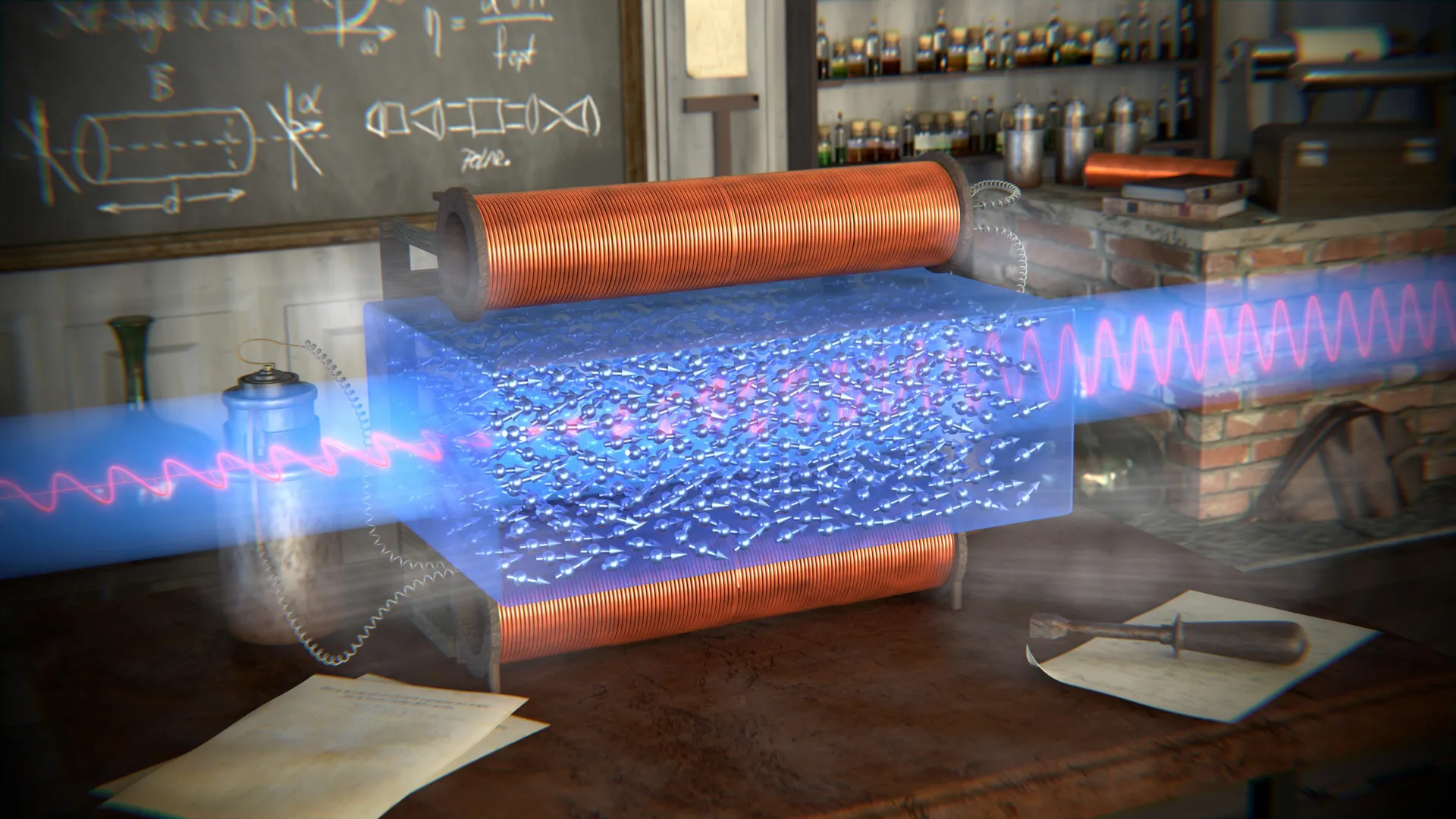
The seminal work, published in the esteemed journal Scientific Reports by Nature, meticulously demonstrates that the magnetic portion of light exerts a meaningful and measurable influence on the way light behaves when it encounters materials. This finding directly contradicts a foundational scientific explanation that has guided the study and application of the Faraday Effect since its discovery in the 19th century. The implications are profound, suggesting that light is not merely a passive illuminator but an active participant capable of magnetic interaction with the material world.
Leading the charge in this paradigm shift are Dr. Amir Capua and Benjamin Assouline from the Hebrew University of Jerusalem’s Institute of Electrical Engineering and Applied Physics. Their research provides the first robust theoretical evidence that the oscillating magnetic field inherent to light contributes directly to the Faraday Effect. The Faraday Effect itself is a fascinating phenomenon where the plane of polarization of light rotates as it traverses a material that is subjected to a constant external magnetic field. This rotation is a key indicator of the material’s magnetic properties and has been a cornerstone in various optical sensing and measurement techniques.
Dr. Capua eloquently simplifies the complex interaction: "In simple terms, it’s an interaction between light and magnetism. The static magnetic field ‘twists’ the light, and the light, in turn, reveals the magnetic properties of the material. What we’ve found is that the magnetic part of light has a first-order effect, it’s surprisingly active in this process." This statement encapsulates the essence of their discovery: the magnetic field of light is not a passive bystander but an active agent, directly influencing the magnetic properties of matter in conjunction with an external magnetic field.
Historically, the scientific community attributed the Faraday Effect exclusively to the interaction between the electric field of light and the electric charges within a material. This prevailing view, deeply ingrained in physics textbooks and research, suggested that the magnetic field of light was too weak to have any significant impact. The new study, however, meticulously dismantles this long-standing assumption by demonstrating that the magnetic field of light directly engages with atomic spins – fundamental quantum mechanical properties of electrons that dictate their magnetic behavior. This interaction with atomic spins, previously considered insignificant, is now revealed to be a crucial component of the Faraday Effect.
To rigorously quantify this magnetic contribution, the research team employed sophisticated computational methods. These calculations were informed by the Landau-Lifshitz-Gilbert (LLG) equation, a fundamental equation in magnetism that precisely describes the dynamics of magnetic spins within materials. By applying these advanced theoretical tools, the researchers were able to model and predict how the magnetic field of light could generate a "magnetic torque" within a material. This torque, similar in nature to that produced by an external static magnetic field, is what causes the polarization of light to rotate. Dr. Capua’s observation, "In other words, light doesn’t just illuminate matter, it magnetically influences it," underscores the transformative nature of their findings.
The team then moved from theoretical modeling to practical application by applying their validated model to Terbium Gallium Garnet (TGG). TGG is a material of particular interest because it is frequently used in experimental studies of the Faraday Effect due to its strong magneto-optical properties. Their analysis of TGG revealed a startling quantitative insight: the magnetic component of light accounts for approximately 17% of the observed rotation in the visible light spectrum. This figure escalates dramatically in the infrared spectrum, where the magnetic influence of light can be responsible for as much as 70% of the observed polarization rotation. These figures are not merely academic; they represent a significant re-evaluation of the fundamental forces at play in light-matter interactions.
Benjamin Assouline articulated the broader implications of their work: "Our results show that light ‘talks’ to matter not only through its electric field, but also through its magnetic field, a component that has been largely overlooked until now." This "dialogue" between light and matter is now understood to be more nuanced and multifaceted than previously imagined. The recognition of light’s magnetic influence opens up entirely new avenues for scientific exploration and technological innovation.
The researchers are optimistic about the potential applications stemming from this discovery. They foresee breakthroughs in several key areas. In optical data storage, a deeper understanding of light’s magnetic interaction could lead to more efficient and denser data recording mechanisms. Spintronics, a rapidly evolving field that harnesses the electron’s spin in addition to its charge for electronic devices, stands to benefit immensely. The ability to precisely control spin dynamics using the magnetic component of light could revolutionize the design and performance of spintronic devices, leading to faster, more energy-efficient electronics.
Furthermore, the implications for emerging quantum technologies are particularly exciting. The development of spin-based quantum computing, which relies on the manipulation of quantum bits (qubits) encoded in the spin of particles, could be significantly accelerated. The ability to precisely control and read out spin states using the magnetic field of light offers a novel and potentially powerful tool for building and operating quantum computers. This discovery could provide the missing pieces for overcoming some of the current challenges in quantum information processing, bringing the promise of practical quantum computers closer to reality.
In essence, the work by the Hebrew University of Jerusalem researchers represents a fundamental revision of our understanding of light. It highlights that light, a ubiquitous phenomenon, possesses a hidden magnetic dimension that has been actively influencing our world, and the scientific understanding of it, for centuries. This re-evaluation of a nearly 200-year-old scientific principle is not just an academic curiosity; it is a testament to the ongoing power of scientific inquiry to uncover profound truths and to unlock the potential for transformative technologies that could shape the future of our technological landscape. The universe, it seems, still holds secrets, and the seemingly simple phenomenon of light has just revealed one of its most surprising.