Imroatul Nasiyah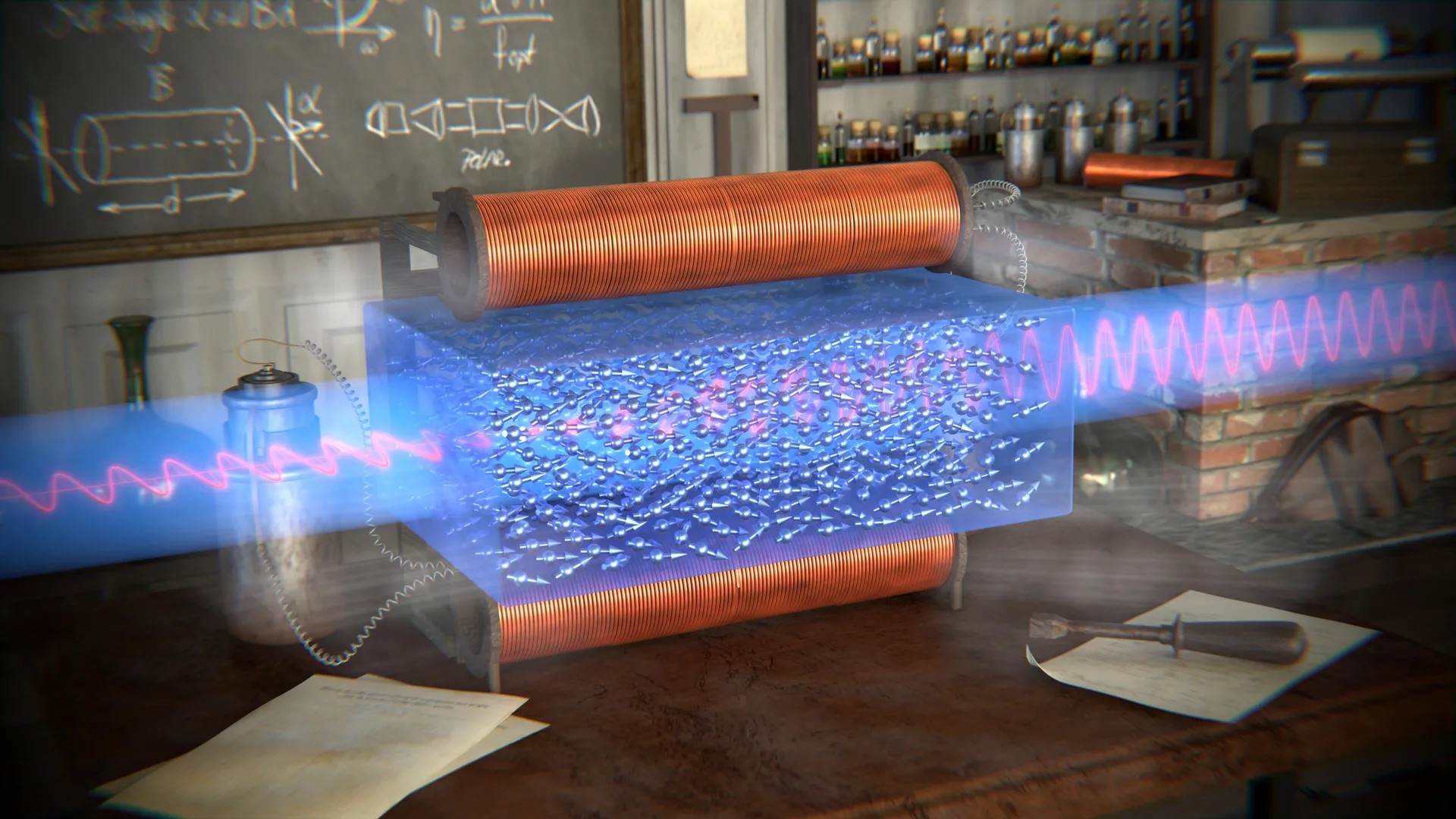
For nearly two centuries, the scientific community has operated under the assumption that the Faraday Effect, which describes the rotation of the polarization plane of light as it passes through a material subjected to a static magnetic field, was exclusively a consequence of the interaction between light’s electric field and the electric charges within the material. This long-held belief, deeply embedded in the fabric of physics education and research, has guided countless studies and technological developments. However, the meticulous work of Dr. Amir Capua and Benjamin Assouline, leading a team at the university’s Institute of Electrical Engineering and Applied Physics, has provided the first compelling theoretical and quantitative evidence to the contrary. Their research posits that the oscillating magnetic field of light, a component previously relegated to a secondary or even negligible role, is, in fact, a crucial and active participant in this fundamental interaction.
"In simple terms, it’s an interaction between light and magnetism," Dr. Capua explained, offering a simplified analogy for the complex phenomenon. "The static magnetic field ‘twists’ the light, and the light, in turn, reveals the magnetic properties of the material. What we’ve found is that the magnetic part of light has a first-order effect; it’s surprisingly active in this process." This statement, seemingly straightforward, carries immense weight, as it directly contradicts the prevailing paradigm. The researchers have not merely suggested a theoretical possibility; they have provided a framework for understanding and quantifying this magnetic contribution, opening up entirely new avenues for scientific inquiry and technological innovation.
The cornerstone of their findings lies in their rigorous theoretical model, which leverages advanced calculations informed by the Landau-Lifshitz-Gilbert (LLG) equation. This equation, a fundamental tool in the study of magnetism, describes the dynamics of magnetic moments within materials. By applying and extending its principles to the interaction with light, the team demonstrated that the magnetic field of light can indeed exert a torque on the magnetic spins within a material. This torque, analogous to the influence of an external static magnetic field, causes the spins to precess, thereby affecting the polarization of the light passing through. "In other words, light doesn’t just illuminate matter; it magnetically influences it," Dr. Capua emphasized, highlighting the profound implication of their work. Light, far from being a passive observer of magnetic phenomena, is an active agent, capable of directly manipulating the magnetic properties of materials.
To move beyond theoretical conjecture and provide concrete, measurable evidence, the researchers applied their model to Terbium Gallium Garnet (TGG), a widely recognized and extensively studied crystal that serves as a standard for investigations into the Faraday Effect. TGG’s well-characterized magnetic and optical properties made it an ideal testbed for their new theory. The analysis conducted on TGG yielded striking results. The team’s calculations revealed that the magnetic component of light is not a minor contributor but a significant one, responsible for approximately 17% of the observed polarization rotation in the visible spectrum. This figure, while already substantial, becomes even more impressive when considering the infrared spectrum, where the magnetic influence of light escalates dramatically, accounting for as much as 70% of the observed rotation. These quantitative findings underscore the substantial underestimation of light’s magnetic influence that has persisted for so long.
The implications of this paradigm shift are far-reaching and extend across various scientific and technological domains. "Our results show that light ‘talks’ to matter not only through its electric field, but also through its magnetic field, a component that has been largely overlooked until now," stated Benjamin Assouline, underscoring the novelty and significance of their discovery. This dual mode of interaction means that our understanding of how light manipulates matter, and vice versa, needs to be fundamentally re-evaluated.
In the realm of optics, a deeper understanding of light’s magnetic interaction could lead to the development of novel optical devices with enhanced functionalities. For instance, the ability to precisely control the magnetic properties of materials using light’s magnetic field could revolutionize optical data storage, allowing for higher densities and faster read/write speeds. Imagine storage devices where information is encoded not just in the presence or absence of light, but in the magnetic orientation of individual atoms, precisely manipulated by the magnetic field of light pulses.
The field of spintronics, which focuses on harnessing the intrinsic spin of electrons in addition to their charge, stands to benefit immensely. Spintronic devices offer the promise of lower power consumption and faster operation compared to conventional electronics. By understanding and exploiting the magnetic influence of light on electron spins, researchers could develop new methods for manipulating and detecting spin states, leading to more efficient and powerful spintronic components. This could include novel spin transistors, magnetic random-access memory (MRAM) with unprecedented performance, and advanced magnetic sensors.
Furthermore, the discovery has significant implications for the burgeoning field of quantum technologies. Quantum computing, in particular, relies on the precise control of quantum states, often involving the manipulation of individual spins. The ability to use light’s magnetic field to interact with and control atomic spins opens up new pathways for the development of quantum bits (qubits) and quantum algorithms. This could accelerate the development of stable and scalable quantum computers, capable of solving problems currently intractable for even the most powerful supercomputers. The potential for spin-based quantum computing, where information is encoded in the quantum spin states of particles, could be significantly enhanced by this new understanding of light-matter magnetic interactions.
The research also opens doors for exploring new phenomena at the interface of light and magnetism. For example, it might provide a more comprehensive explanation for certain magneto-optical effects that have previously been difficult to fully account for with existing models. The interplay between light’s electric and magnetic fields, and their respective interactions with the electric and magnetic degrees of freedom in matter, is now a richer landscape for exploration.
The journey to this discovery was not without its challenges. The prevailing scientific consensus, built over 180 years, is a formidable barrier to overcome. The researchers had to meticulously develop theoretical frameworks, perform complex calculations, and then find ways to quantitatively validate their findings. The choice of TGG as a test material was crucial, as its known properties allowed for a direct comparison between theoretical predictions and experimental observations. The fact that their model accurately predicted significant magnetic contributions across different spectral ranges provides strong evidence for the validity of their revised understanding.
In essence, this work represents a fundamental re-calibration of our understanding of light. It is no longer solely a wave of oscillating electric and magnetic fields where only the electric component is actively engaged in magnetic interactions. Instead, light is revealed as a more versatile and potent force, capable of directly influencing the magnetic world. This revelation, emerging from the esteemed halls of the Hebrew University of Jerusalem, is poised to ignite a new wave of scientific inquiry and technological innovation, rewriting textbooks and shaping the future of our interaction with the fundamental forces of nature. The nearly 200-year-old secret of light’s magnetic influence is finally out, and the scientific world is eager to explore its vast potential.