Imroatul Nasiyah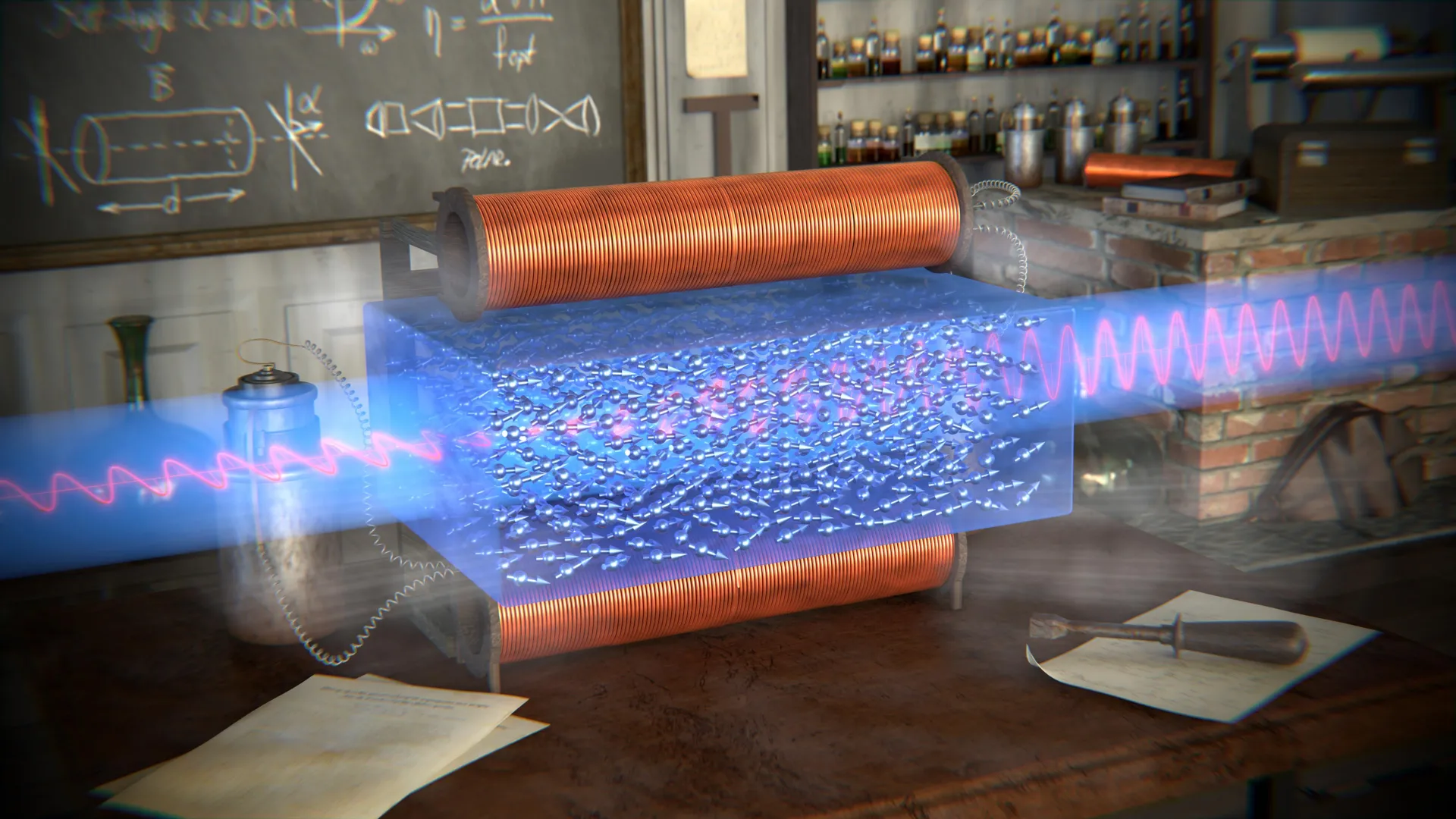
The ramifications of this discovery are profound, as it directly contradicts a foundational scientific explanation that has shaped our comprehension of the Faraday Effect since its initial observation in the mid-nineteenth century. The team’s meticulous findings, formally published in the esteemed scientific journal Scientific Reports by Nature, unequivocally demonstrate that the magnetic portion of light exerts a meaningful and measurable influence on the intricate dance of light’s interaction with various materials. This revelation necessitates a re-evaluation of established theories and experimental approaches that have, until now, largely relegated the magnetic aspect of light to an almost negligible status.
The Faraday Effect, at its core, describes a fascinating phenomenon where the polarization plane of light undergoes a rotation as it traverses through a material that has been subjected to an external, static magnetic field. This rotation is a key characteristic that has been exploited in numerous optical devices and scientific investigations. The traditional explanation posited that the electric field of the incident light was responsible for interacting with the electric charges within the material, thereby inducing the observed rotation. However, the Hebrew University team’s work introduces a crucial missing piece to this puzzle: the magnetic field of light itself.
Dr. Amir Capua eloquently summarizes the essence of their findings, stating, "In simple terms, it’s an interaction between light and magnetism." He elaborates on the established understanding, explaining how "The static magnetic field ‘twists’ the light, and the light, in turn, reveals the magnetic properties of the material." The revolutionary aspect of their research lies in the subsequent revelation: "What we’ve found is that the magnetic part of light has a first-order effect, it’s surprisingly active in this process." This assertion directly challenges the long-held view that the magnetic field of light’s contribution to the Faraday Effect was insignificant. For close to two centuries, the prevailing scientific narrative attributed the entire effect to the electric field’s interaction with electrons in matter. The new study, however, meticulously demonstrates that the magnetic field of light also plays a direct and vital role by interacting with atomic spins within the material – a contribution that was previously assumed to be too weak to matter.
To quantify this hitherto unrecognized magnetic contribution, the researchers employed sophisticated theoretical calculations. These calculations were informed by the principles of the Landau-Lifshitz-Gilbert (LLG) equation, a fundamental model in magnetism that accurately describes the dynamics of magnetic spins within materials. By applying these advanced theoretical tools, the team was able to demonstrate a remarkable parallel: the oscillating magnetic field of light can indeed generate magnetic torque within a material, mirroring the action of a static external magnetic field. Dr. Capua further clarifies the broader implication of this finding: "In other words, light doesn’t just illuminate matter, it magnetically influences it." This statement underscores the active, physical role that light’s magnetic field plays in manipulating the magnetic properties of the materials it encounters.
To provide empirical grounding for their theoretical model, the researchers applied their calculations to Terbium Gallium Garnet (TGG), a crystal that is a common and well-characterized material used in studies of the Faraday Effect. Their rigorous analysis of TGG revealed that the magnetic component of light is not a trivial factor. Astonishingly, their findings indicate that the magnetic field of light is responsible for a substantial portion of the observed polarization rotation. Specifically, in the visible spectrum, the magnetic component accounts for approximately 17% of the effect, a figure that rises dramatically to as much as 70% in the infrared spectrum. These percentages are far from insignificant and necessitate a revision of how the Faraday Effect is understood and modeled.
Benjamin Assouline, a key member of the research team, emphasizes the broader implications for our understanding of light-matter interactions: "Our results show that light ‘talks’ to matter not only through its electric field, but also through its magnetic field, a component that has been largely overlooked until now." This anthropomorphic description vividly illustrates the dual nature of light’s influence. It suggests that the interaction is not a one-sided affair but a more complex dialogue where both the electric and magnetic facets of light contribute to shaping the material’s response.
The potential applications stemming from this revised understanding are vast and exciting. The researchers are optimistic that their work will pave the way for significant innovations across several cutting-edge technological domains. For instance, in the field of optical data storage, a more nuanced understanding of light’s magnetic interaction could lead to the development of higher-density and more efficient storage media. Spintronics, a field that leverages the spin of electrons in addition to their charge for information processing, stands to benefit immensely. The ability to precisely control or manipulate electron spins using the magnetic field of light could unlock entirely new paradigms in electronic devices.
Furthermore, the implications for emerging quantum technologies are particularly profound. Quantum computing, which relies on the delicate manipulation of quantum states, could see significant advancements. The ability to influence quantum systems, such as electron spins, with light’s magnetic field offers a novel and potentially powerful tool for quantum control and computation. This could accelerate the development of more stable, scalable, and efficient quantum computers.
In essence, this research by the Hebrew University of Jerusalem team represents a pivotal moment in our scientific understanding of light and magnetism. By uncovering the long-hidden magnetic secret of light’s role in the Faraday Effect, they have not only corrected a centuries-old misconception but have also illuminated a path towards transformative technological advancements. The dual nature of light’s interaction with matter – through both its electric and magnetic fields – is now more apparent than ever, promising a future where light is not just a source of illumination but a powerful tool for magnetic manipulation and quantum innovation. The scientific community eagerly anticipates the further exploration and exploitation of this newly revealed magnetic dimension of light.