Imroatul Nasiyah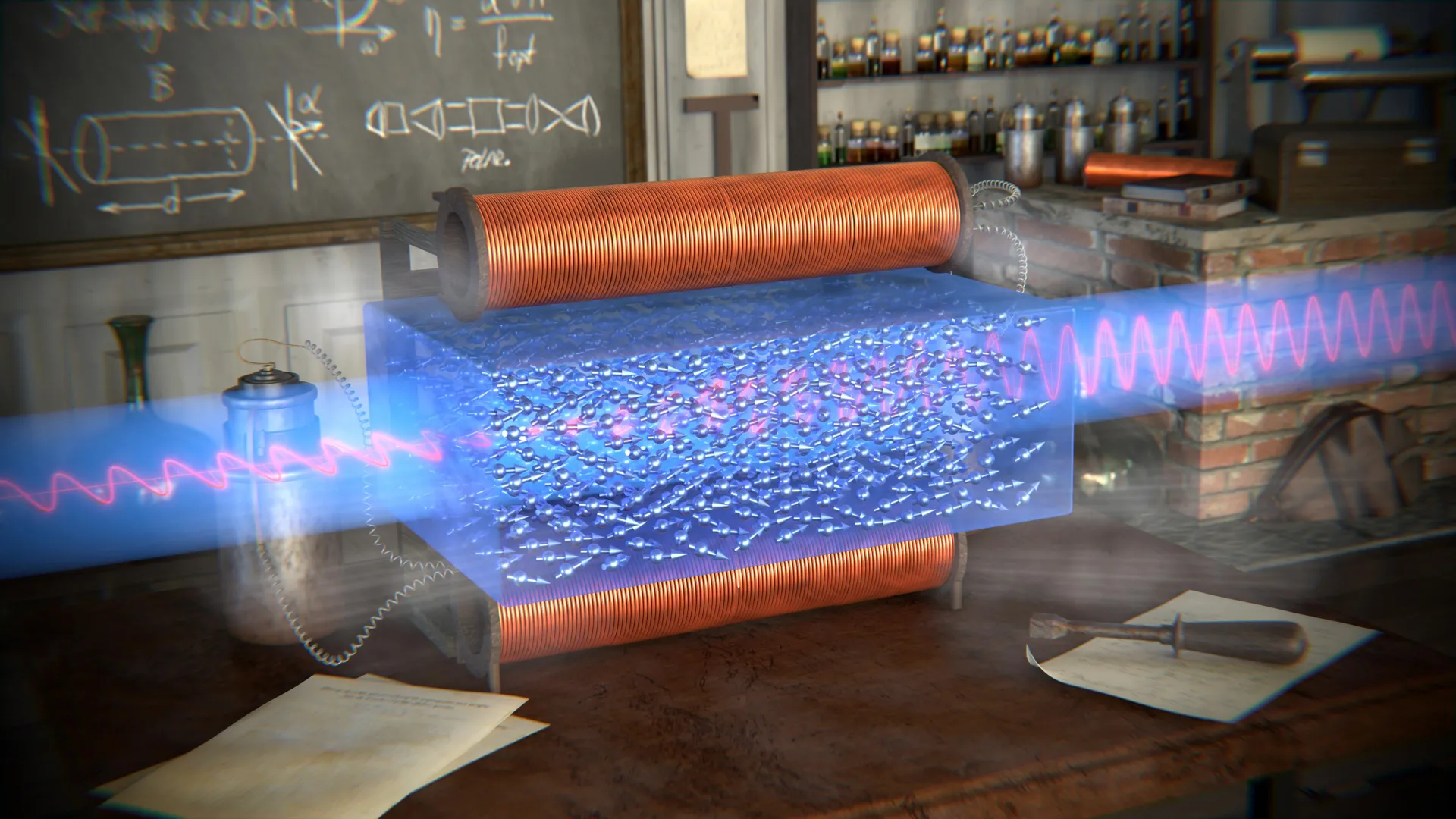
The team’s seminal findings, meticulously detailed in the prestigious journal Scientific Reports published by Nature, unequivocally establish that the magnetic portion of light exerts a measurable and meaningful influence on how light behaves when interacting with materials. This revelation directly challenges a cornerstone of scientific understanding that has guided the study and application of the Faraday Effect since its discovery in the mid-nineteenth century. The Faraday Effect, in essence, describes the fascinating phenomenon where the polarization plane of light rotates as it traverses a material subjected to an external, static magnetic field. For decades, the prevailing scientific consensus held that this rotation was exclusively a consequence of light’s electric field interacting with the charged particles (electrons) within the material. However, the new research from the Hebrew University of Jerusalem, spearheaded by the diligent efforts of Dr. Amir Capua and Benjamin Assouline from the university’s esteemed Institute of Electrical Engineering and Applied Physics, provides the first robust theoretical evidence that the oscillating magnetic field inherent in light itself is a direct and active participant in this intricate dance between light and magnetism.
Dr. Capua eloquently articulates the essence of their discovery, stating, "In simple terms, it’s an interaction between light and magnetism. The static magnetic field ‘twists’ the light, and the light, in turn, reveals the magnetic properties of the material. What we’ve found is that the magnetic part of light has a first-order effect; it’s surprisingly active in this process." This statement encapsulates the profound implication of their work: light is not merely a passive illuminator of matter; it is an active agent capable of exerting magnetic influence. This contrasts sharply with the previous understanding, which viewed light’s role as primarily one of probing existing magnetic properties through its electric field’s interaction with electric charges. The new study posits that light’s magnetic field directly engages with the atomic spins within materials, a mechanism that was previously dismissed as negligible or entirely absent from the Faraday Effect’s equation.
The theoretical underpinnings of this revolutionary insight are rooted in sophisticated calculations informed by the Landau-Lifshitz-Gilbert (LLG) equation. This fundamental equation, a cornerstone of magnetic materials science, describes the dynamic behavior of magnetic spins under the influence of external magnetic fields. By applying and extending the principles of the LLG equation, the Hebrew University researchers were able to demonstrate, with compelling theoretical rigor, that the magnetic field component of light can indeed generate a magnetic torque within a material. This generated torque, the study reveals, acts in a manner analogous to the torque produced by an external, static magnetic field, effectively "twisting" the spins of the atoms within the material. Dr. Capua further elaborates on this crucial point, emphasizing, "In other words, light doesn’t just illuminate matter; it magnetically influences it." This assertion marks a significant departure from established scientific paradigms and opens up entirely new avenues for understanding and manipulating magnetic phenomena.
To quantify the magnitude of this newly identified magnetic contribution of light, the research team applied their theoretical model to Terbium Gallium Garnet (TGG). TGG is a well-established crystalline material frequently employed in scientific research for its excellent Faraday rotation properties, making it an ideal testbed for their groundbreaking theory. The detailed analysis conducted by the researchers revealed that the magnetic component of light is not a minor player but a substantial contributor to the observed Faraday Effect. Their calculations indicated that light’s magnetic field is responsible for approximately 17% of the polarization rotation observed in the visible spectrum. Even more strikingly, in the infrared spectrum, where the magnetic interaction can be more pronounced, the magnetic component of light accounts for a staggering 70% of the observed rotation. These figures underscore the critical oversight in previous understandings and highlight the significant role that light’s magnetic field has been playing, unnoticed, for so long.
Benjamin Assouline, a key contributor to the study, eloquently summarizes the broader implications of their findings: "Our results show that light ‘talks’ to matter not only through its electric field, but also through its magnetic field, a component that has been largely overlooked until now." This statement emphasizes the dual nature of light’s interaction with matter, a duality that has been only partially appreciated until the present study. The implications of this revised understanding are far-reaching and have the potential to catalyze innovation across a spectrum of advanced technological fields.
The researchers foresee that this enhanced comprehension of light’s magnetic capabilities could unlock new frontiers in optical data storage, enabling the development of more efficient and higher-capacity storage solutions. In the realm of spintronics, a field that harnesses the intrinsic spin of electrons in addition to their charge for information processing, this discovery could lead to the creation of novel devices and architectures. Furthermore, the ability to control magnetic properties using light opens up exciting possibilities for emerging quantum technologies. The precise manipulation of quantum states, often reliant on delicate magnetic interactions, could be significantly advanced by leveraging light’s magnetic influence. The work is also anticipated to contribute to the future development of spin-based quantum computing, a highly promising but technically challenging area of research, by offering new methods for initializing, manipulating, and reading out quantum information encoded in spins.
The historical context of the Faraday Effect, discovered by Michael Faraday in 1845, has always focused on the interaction of light’s electric field with the charged particles within a material placed in a magnetic field. The prevailing explanation, rooted in classical electromagnetism, posited that the applied magnetic field altered the electronic orbits or energy levels within the material, thereby affecting how the electric field of light propagated and caused a rotation in polarization. This model, while successful in explaining many aspects of the phenomenon, had always contained subtle discrepancies or required complex elaborations to fully account for all observed behaviors. The Hebrew University’s research suggests that these discrepancies might have stemmed from the deliberate exclusion of light’s inherent magnetic field’s contribution.
The beauty of the new theory lies in its elegant simplicity and its ability to provide a more complete picture. By considering the magnetic field of light as an active player, the researchers have developed a more holistic model of light-matter interaction. The LLG equation, traditionally used to describe the dynamics of magnetization in bulk materials, has been adapted here to a mesoscopic or even microscopic level, where the magnetic field of light itself acts as the driving force. This innovative application of a well-established theoretical framework to a new domain underscores the ingenuity of the research team.
The experimental validation of this theoretical breakthrough is the next critical step. While the current study provides robust theoretical evidence, future experiments will be crucial to directly measure and confirm the magnetic torque exerted by light’s magnetic field on atomic spins. Such experiments could involve highly sensitive magnetic detectors or advanced spectroscopic techniques capable of probing spin dynamics at the nanoscale. The success of these future endeavors would further solidify the paradigm shift initiated by the Hebrew University researchers.
In conclusion, the discovery that light’s magnetic component plays a direct and significant role in the Faraday Effect marks a pivotal moment in our understanding of fundamental physics. For nearly two centuries, science has been operating with an incomplete picture, overlooking a crucial aspect of light’s interaction with matter. This revelation, born from rigorous theoretical work and poised for experimental verification, promises to unlock a cascade of innovations, propelling us towards a future where light is not just a source of illumination but a powerful tool for manipulating magnetism and advancing cutting-edge technologies. The magnetic secret of light, long hidden in plain sight, is finally being brought to light.