Faris Adani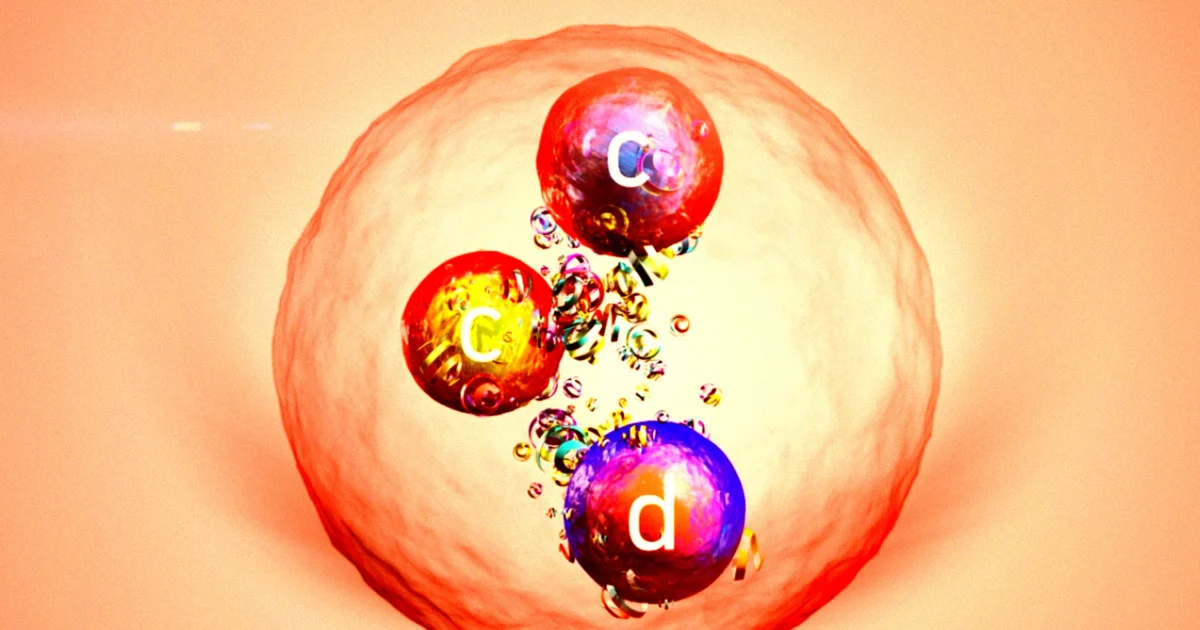
CERN / Futurism
Sign up to see the future, today
Can’t-miss innovations from the bleeding edge of science and tech
Large Hadron Collider Discovers All-New Particle, Unveiling Deeper Secrets of the Strong Force
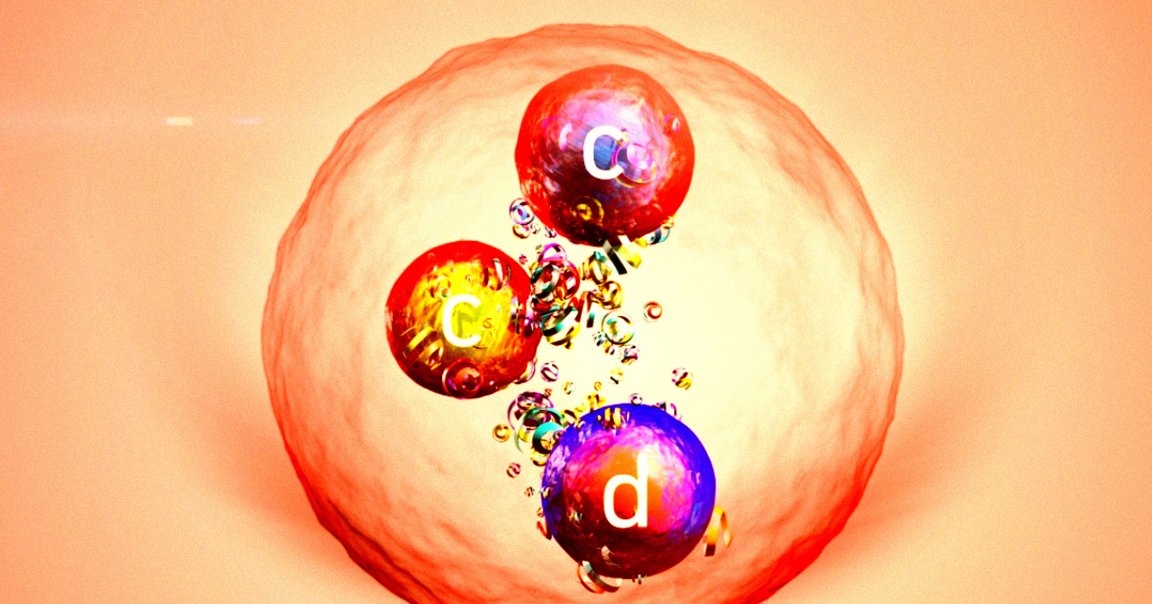
In a landmark achievement for particle physics, scientists at CERN’s Large Hadron Collider (LHC) near Geneva, Switzerland, have announced the discovery of an entirely new type of particle, dubbed Xi-cc-plus (Ξcc+). This groundbreaking finding, made by the LHCb experiment, offers unprecedented insights into the fundamental forces that govern matter and the intricate world of subatomic particles. The newly identified baryon, composed of two charm quarks and one down quark, represents a crucial step forward in our understanding of Quantum Chromodynamics (QCD), the theory describing the strong nuclear force.
For decades, physicists have delved deeper than the atomic level, exploring the realm of subatomic particles that constitute the very fabric of the universe. Atoms, long considered the basic building blocks, are themselves complex structures made of a nucleus surrounded by electrons. The nucleus, in turn, consists of protons and neutrons. Further still, protons and neutrons are not fundamental particles; they are made up of even smaller entities called quarks. According to the Standard Model of particle physics, quarks are fundamental fermions that combine to form composite particles known as hadrons.
Quarks come in six “flavors”: up, down, charm, strange, top, and bottom. Each flavor possesses distinct properties, including mass and electric charge. Up and down quarks are the lightest and are found in ordinary matter, forming protons (two ups, one down) and neutrons (one up, two downs). Charm and strange quarks are heavier, while top and bottom quarks are the heaviest and most unstable. These quarks are held together by the strong nuclear force, mediated by particles called gluons. The strong force is unique in its behavior: unlike gravity or electromagnetism, its strength increases with distance, akin to a stretched rubber band. This phenomenon, known as “color confinement,” is why individual quarks are never observed in isolation but always bound within hadrons.
Hadrons are broadly categorized into two types: baryons, which are composed of three quarks (like protons and neutrons), and mesons, which consist of a quark-antiquark pair. The Xi-cc-plus particle belongs to the baryon family, but with a unique twist: it is a “doubly-charmed” baryon, containing two heavy charm quarks in addition to a single down quark (ccd). This configuration makes it particularly interesting for testing the predictions of QCD, as the presence of two heavy quarks fundamentally alters the internal dynamics of the particle.
The discovery was made possible by the Large Hadron Collider, the world’s most powerful particle accelerator. Located in a 27-kilometer (17-mile) tunnel beneath the Franco-Swiss border, the LHC accelerates beams of protons to nearly the speed of light before colliding them head-on. These collisions generate immense amounts of energy, briefly recreating conditions similar to those just after the Big Bang. In these extreme environments, exotic subatomic particles, often highly unstable and fleeting, are produced. Detectors positioned around the collision points then record the decay products of these new particles, allowing physicists to reconstruct their properties and confirm their existence.
The LHCb (Large Hadron Collider beauty) experiment is one of four major detectors at the LHC, specifically designed to study particles containing “beauty” (bottom) and “charm” quarks. Its precise tracking and identification capabilities are crucial for detecting and characterizing heavy hadrons. The discovery of Xi-cc-plus marks a significant milestone, as it is the first new particle identified since the comprehensive upgrades to the LHCb detector were completed in 2023. These upgrades enhanced the detector’s sensitivity and data-taking capabilities, allowing it to sift through billions of collisions with even greater precision.
“This is the first new particle identified after the upgrades to the LHCb detector that were completed in 2023, and only the second time a baryon with two heavy quarks has been observed, the first having been observed by LHCb almost ten years ago,” stated Vincenzo Vagnoni, LHCb spokesperson, in an announcement of the findings. The previous discovery he refers to was the Xi-cc++ (Ξcc++) particle in 2017, which consisted of two charm quarks and an up quark (ccu). The new Xi-cc-plus, with its down quark (ccd) instead of an up quark, offers a crucial comparative study point.
One of the most striking characteristics of the Xi-cc-plus is its mass. It is approximately four times as heavy as a regular proton, weighing in at around 3.6 GeV/c². This substantial mass is primarily attributed to the two heavy charm quarks it contains. Charm quarks are significantly more massive than the up and down quarks found in protons, directly contributing to the new particle’s heft. Understanding the exact mass and other properties of such particles helps refine theoretical models of quark interactions.
Moreover, the lifetime of the Xi-cc-plus is remarkably short. Despite closely resembling its doubly-charmed cousin, the Xi-cc++ (ccu) discovered in 2017, the Xi-cc-plus (ccd) has a significantly briefer existence, up to six times shorter than its ccu counterpart. This difference in lifetime, stemming from a single quark change (down instead of up), provides invaluable data for physicists studying how quarks interact and decay. Subtle variations in quark composition can lead to dramatic differences in particle stability, offering a window into the complex interplay of the strong and weak nuclear forces.
The significance of this discovery extends far beyond merely adding another particle to the catalog. It serves as a vital testbed for Quantum Chromodynamics (QCD), the fundamental theory of the strong force. QCD is notoriously complex, describing how quarks and gluons bind together. While the Standard Model of particle physics has been incredibly successful, QCD presents unique challenges, particularly in predicting the properties of strongly interacting particles.
“The result will help theorists test models of quantum chromodynamics, the theory of the strong force that binds quarks into not only conventional baryons and mesons but also more exotic hadrons such as tetraquarks and pentaquarks,” Vagnoni emphasized. By observing and characterizing baryons with unusual quark compositions, like the doubly-charmed Xi-cc-plus, physicists can refine their QCD calculations and improve their understanding of how the strong force operates at different energy scales and with different quark flavors.
The “rubber band” analogy often used to describe the strong force highlights its peculiar nature: it becomes stronger as quarks try to pull apart, preventing them from existing in isolation. This force is responsible for holding atomic nuclei together, overcoming the electromagnetic repulsion between positively charged protons. “The more we learn about these particles, the more we can learn about the strong force, and that is the same strong force that binds our protons and neutrons together,” explained University of Manchester physicist Chris Parkes to *The Guardian*. Every new discovery like the Xi-cc-plus provides a unique data point that helps to calibrate and validate theoretical models of this fundamental interaction.
The search for new particles is also driven by the quest for “exotic hadrons.” While conventional hadrons consist of either two (mesons) or three (baryons) quarks, QCD also predicts the existence of more complex arrangements, such as tetraquarks (four quarks) and pentaquarks (five quarks). Discoveries of particles like the Xi-cc-plus, with its unusual heavy quark content, pave the way for a deeper understanding of quark confinement and could illuminate the pathways to finding and confirming these even more exotic states of matter.
The technical challenges in observing such short-lived and rare particles are immense. The LHCb detector’s ability to precisely track and identify the decay products of these fleeting particles, even amidst the millions of other particles produced in each collision, is a testament to sophisticated engineering and analytical techniques. The successful detection of the Xi-cc-plus underscores the continued capability of the LHC and its upgraded detectors to push the boundaries of particle physics.
Looking ahead, the scientific community anticipates many more breakthroughs from the upgraded LHCb detector. University of Warwick professor Tim Gershon, who is set to take over the lead at the LHCb in July, stated, “This is just the first of many expected insights that can be gained with the new LHCb detector.” The coming years promise an exciting era of discovery, as physicists continue to probe the fundamental constituents of matter and the forces that bind them, potentially uncovering new phenomena that could reshape our understanding of the universe. The discovery of the Xi-cc-plus is not merely an addition to the particle zoo; it is a critical piece of the puzzle, bringing us closer to a complete picture of the cosmos at its most fundamental level.