anjir abdul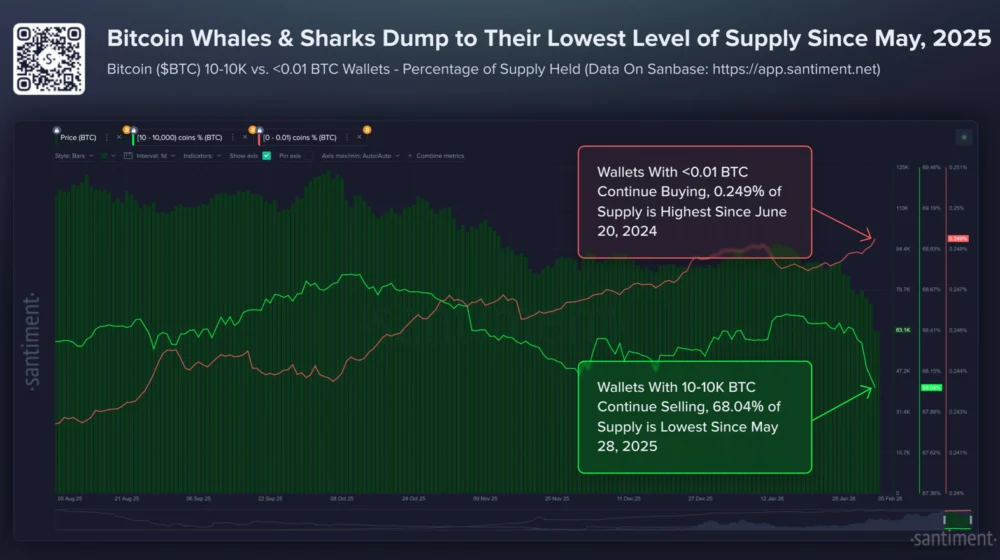
A significant shift is underway in the Bitcoin market, as large holders, often dubbed "whales" and "sharks," are now controlling the smallest share of the cryptocurrency’s total supply since late May of the previous year. This development, flagged by crypto sentiment platform Santiment, comes amidst a period of heightened market volatility and a sharp downturn in Bitcoin’s price, signaling a potentially critical juncture for the digital asset.
According to a detailed post by Santiment on X (formerly Twitter) on Thursday, wallets holding between 10 and 10,000 Bitcoin (BTC) have collectively seen their holdings dwindle to a nine-month low, now accounting for approximately 68.04% of the entire Bitcoin supply. This reduction represents a substantial offloading by these influential market participants, with Santiment specifically highlighting a dramatic "dump of -81,068 BTC in just the past 8 days alone." To put this into perspective, with Bitcoin trading around the $65,000 mark during this period, this translates to an estimated divestment of over $5.27 billion in a little over a week.
This aggressive selling by large holders has coincided precisely with a steep price correction in Bitcoin, which saw its value plummet from around $90,000 to approximately $65,000 over the same eight-day period, marking a roughly 27% decline. At the time of publication, Bitcoin is trading at $64,792, having clawed back slightly from a 24-hour low of just over $60,000. The rapid decline underscores the outsized impact that such concentrated selling pressure from whales can exert on the broader market. Market participants closely monitor the movements of these large holders, as their accumulation or distribution patterns are often interpreted as leading indicators of potential market uptrends or downtrends, reflecting their collective belief in the asset’s near-term prospects.
The prevailing sentiment extends beyond just the on-chain data of large holders. Prominent figures in the crypto space are also voicing caution. Ki Young Ju, CEO of analytics firm CryptoQuant, posted to X on Wednesday that, in his assessment, "every Bitcoin analyst is now bearish." This widespread bearish outlook among industry experts and analysts further amplifies the concerns raised by the whale activity. Such a consensus often suggests either a market bottom is imminent as all the negative sentiment is priced in, or it indicates a confirmation of further downside as conviction wanes across the board.

Adding to the stark picture of market apprehension, the Crypto Fear & Greed Index, a widely referenced metric that gauges overall crypto market sentiment, plunged to a score of 9 out of 100 on Friday. This represents its lowest score since mid-2022, a period notoriously remembered for the devastating collapse of the Terra blockchain ecosystem, which triggered a cascade of bankruptcies and widespread contagion across the crypto industry. The index, which considers factors like volatility, market momentum, social media sentiment, and search trends, reaching such extreme "extreme fear" levels signals a profound lack of confidence among investors, mirroring the capitulation seen during some of the market’s darkest periods. Historically, such extreme fear levels have sometimes preceded significant price reversals, as they often indicate that sellers are exhausted, creating an opportunity for contrarian buyers. However, they can also persist for extended periods during prolonged bear markets.
While large holders are showing signs of significant caution and aggressive offloading, an intriguing counter-narrative is unfolding among smaller retail investors. Santiment’s data reveals that "shrimp wallets," defined as those holding less than 0.1 Bitcoin, have been accumulating aggressively during this downturn. These smaller holders have collectively seen their balances rise to a 20-month high since June 2024. This was a period when Bitcoin was trading around $66,000, before experiencing another significant drop to $53,000 just two months later in August of that year. Despite these past corrections, the "shrimp" cohort has continued to grow its holdings.
Currently, these shrimp wallets account for 0.249% of Bitcoin’s total circulating supply, which is equivalent to roughly 52,290 Bitcoin. This accumulation by smaller investors, however, is viewed with caution by Santiment, which warned: "This combination of key stakeholders selling and retail buying is what historically creates bear cycles." This pattern suggests that smart money, or institutional and large individual investors with deeper market insights and resources, are distributing their holdings to less experienced retail investors who may be buying into perceived dips, often to their detriment. This dynamic has historically been a hallmark of market tops or significant corrections, where retail FOMO (fear of missing out) meets institutional profit-taking or risk-off sentiment.
Looking at the broader historical context, the market has seen dramatic swings in recent times. Bitcoin had previously reclaimed the $100,000 mark in late May 2024, after more than three months of recovery from a prior dip. This marked a significant milestone, yet it was followed by the aforementioned corrections. By December 2024, the cryptocurrency once again surged to $100,000 for the first time in what was described as a booming market, notably following Donald Trump’s victory in the US presidential election. This rally was largely attributed to investor optimism regarding a potentially more favorable regulatory environment for cryptocurrencies under a new administration, alongside a broader shift in global economic sentiment. The current price of $64,792 and the significant whale sell-off suggest that the enthusiasm from the late 2024 rally has largely dissipated, giving way to a new phase of uncertainty and price discovery. The statistic showing Bitcoin is down 29.62% over the past 12 months further underscores the challenging and volatile environment that has characterized the market for a considerable period.
The current market dynamics present a complex picture for investors. On one hand, the aggressive selling by large Bitcoin holders and the widespread bearish sentiment, as reflected by the Fear & Greed Index, paint a concerning outlook, suggesting that further downside could be possible if the selling pressure persists. The sheer volume of Bitcoin offloaded by whales in a short period indicates a strong conviction among these sophisticated players that the current market conditions warrant a reduction in exposure. Their motivations could range from securing profits after the previous rally to anticipating a deeper correction due to macroeconomic headwinds, such as persistent inflation, rising interest rates, or broader geopolitical instability.

On the other hand, the sustained accumulation by retail investors, despite falling prices and dire sentiment, highlights the enduring belief in Bitcoin’s long-term value proposition among a segment of the market. While Santiment’s historical analysis suggests this pattern often precedes bear cycles, it also demonstrates a persistent demand base that could eventually help stabilize the market once the institutional selling abates. The resilience of these "shrimp wallets" suggests a deeper conviction that Bitcoin, as a decentralized and finite asset, will eventually resume its upward trajectory, possibly driven by the next halving event or a shift in the global financial landscape.
For the market to regain its footing, a confluence of positive catalysts would likely be required. This could include a stabilization or reversal of macroeconomic trends, clearer and more favorable regulatory frameworks emerging from major economies, or a renewed wave of institutional adoption. The impact of derivatives markets, while not explicitly detailed in the sentiment analysis, also plays a crucial role. Large liquidations in futures or options markets can amplify price movements, creating a cascading effect that further drives down prices, especially during periods of high leverage.
In conclusion, the Bitcoin market finds itself at a critical juncture, characterized by a stark divergence between large and small holders. The significant reduction in supply held by whales, reaching a nine-month low, combined with extreme bearish sentiment across analyst circles and the Fear & Greed Index, signals a period of profound uncertainty and potential further price volatility. While retail investors continue to accumulate, historical patterns suggest this dynamic could contribute to prolonged bear market conditions. Investors are advised to remain vigilant, carefully monitoring these on-chain metrics, broader market sentiment, and macroeconomic developments as Bitcoin navigates this challenging phase following its recent highs and subsequent corrections. The path forward remains highly speculative, reinforcing Bitcoin’s inherent nature as a high-risk, high-reward asset.