anjir abdul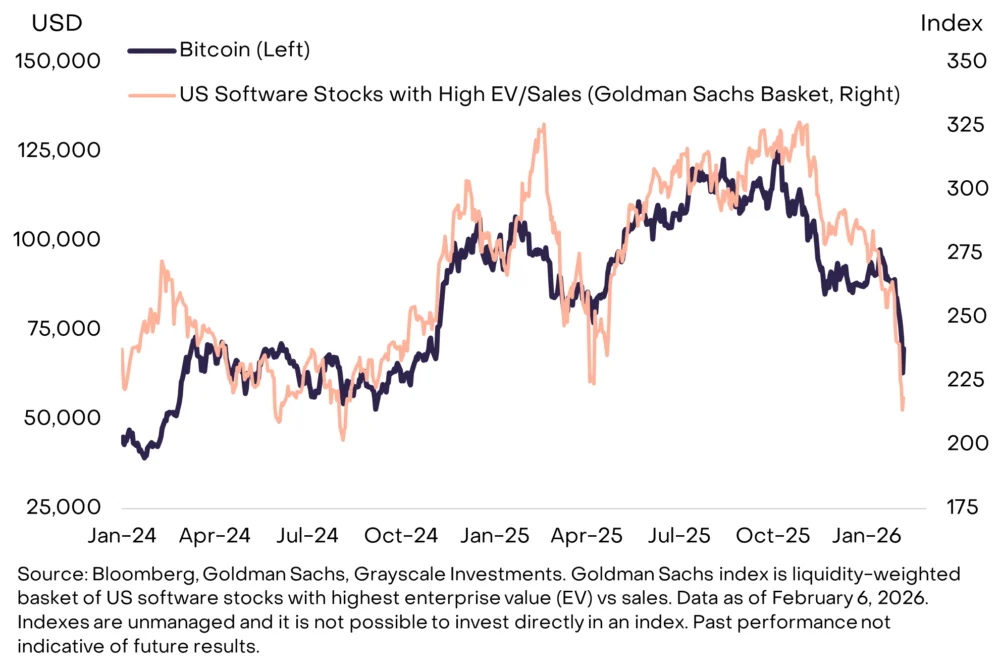
The digital asset landscape has experienced considerable turbulence in recent months. Following an impressive rally that saw Bitcoin’s price soar to a high of over $120,000 in October of the previous year (2025), the leading cryptocurrency has embarked on a gradual but persistent decline. This downward trend intensified in recent weeks, with Bitcoin shedding over 25% of its value within a single month, leaving investors and analysts searching for explanations beyond the usual market volatility. This sharp correction has inevitably led to comparisons with prior "crypto winters," periods of prolonged bear markets that have historically followed major bull runs, such as those witnessed in 2018 and 2022. However, a growing consensus suggests that this particular market contraction may be uniquely shaped by its context.
Among the various theories attempting to explain the current sell-off, some prominent figures lean on historical precedents. Matt Hougan, Chief Investment Officer at Bitwise, a leading crypto asset manager, attributed the recent fall to the notorious four-year cycles that have historically dictated the ebbs and flows of crypto market price swings. These cycles are often linked to Bitcoin’s halving events, which reduce the supply of new Bitcoin entering the market, typically preceding a bull run, followed by a period of correction. Hougan’s perspective suggests that, despite the market’s evolving structure, the fundamental, cyclical nature of Bitcoin’s price action remains a powerful force.
However, other influential voices offer a more nuanced, and perhaps more modern, interpretation. These observers, including a governor of the United States Federal Reserve, contend that the recent price movements are less about inherent cycles and more about the increasing footprint of institutional investors. Their argument posits that these sophisticated entities, while bringing substantial capital to the crypto market, possess a fundamentally different risk tolerance compared to the retail investors who historically dominated the space. Crucially, Bitcoin has not yet achieved the widely anticipated status of a "digital gold" – a safe-haven asset that investors flock to during times of economic uncertainty. This perceived failure to act as a risk-off asset, particularly in the face of broader economic headwinds or institutional de-risking, is seen as a significant differentiator for the current market environment.
The notion that Bitcoin is still primarily perceived as a risky asset, rather than a store of value akin to gold, underpins much of this new analysis. Institutional interest in Bitcoin and the broader crypto market, while a testament to its maturation, also introduces a new dynamic. Major financial institutions, equipped with vast sums of capital, are naturally more constrained by fiduciary duties, regulatory frameworks, and stringent risk management protocols than individual retail investors. This means their appetite for volatile assets like Bitcoin is inherently lower, leading to more cautious positioning and quicker de-risking during periods of uncertainty.
Chris Waller, a governor of the United States Federal Reserve, articulated this sentiment clearly during a recent monetary policy conference. Speaking on Monday, he observed that much of the "euphoria" that surrounded crypto during the early days of President Donald Trump’s new administration (implying a pro-innovation, less regulatory stance) is now fading. Waller suggested that a significant portion of the recent sell-off could be attributed to traditional finance firms adjusting their risk positions. "I think there was a lot of sell-off just because firms that got into it from mainstream finance had to adjust their risk positions," he stated, highlighting the reactive nature of institutional capital to market shifts.

These sentiments found an echo in the crypto industry itself. Mike Novogratz, CEO of Galaxy Digital, a prominent crypto investment firm, reiterated Waller’s point in an interview with CNBC on Tuesday. Novogratz emphasized that the industry’s growth has increasingly brought in "institutions where people have a different risk tolerance." He starkly contrasted this with the motivations of retail investors, stating, "Retail people don’t get into crypto because they want to make 11% annualized… They get in because they want to make 30 to one, eight to one, 10 to one." This fundamental difference in investment objectives and risk appetite means that institutional withdrawals can trigger more significant and rapid price corrections than previous retail-driven sell-offs.
Further challenging the "digital gold" narrative, crypto asset manager Grayscale released a report noting that recent Bitcoin price action more closely correlates to software stocks with high enterprise values than to historically stable assets like gold. The investment company stated explicitly that short-term price movements have not been tightly correlated with gold or other precious metals. This observation is crucial because it suggests Bitcoin is still largely treated as a growth asset within the technology sector, susceptible to the same economic and market pressures that affect tech stocks, rather than serving as a hedge against inflation or geopolitical instability.
Bloomberg commodity strategist Mike McGlone, a noted Bitcoin bear, has consistently maintained that Bitcoin remains a highly speculative asset. He provocatively claimed that Bitcoin has "proven it’s neither digital gold nor leveraged beta," adding that "It’s a highly speculative [number]-on-the-screen tracking nothing with unlimited competition.” McGlone’s view underscores the skepticism from a segment of traditional finance that questions Bitcoin’s intrinsic value and its long-term viability amidst a proliferation of competing digital assets.
Despite these immediate concerns and bearish outlooks, Grayscale maintained a more optimistic long-term perspective on Bitcoin’s prospects. The company’s report posited that "The network will likely continue operating well beyond our lifetimes and the asset may retain its value in real terms… in a wide range of outcomes for the economy and society." This enduring optimism is rooted in Bitcoin’s fundamental properties: its decentralized nature, fixed supply, and robust network security, which proponents believe will eventually solidify its status as a foundational digital asset regardless of short-term volatility. Grayscale also strategically highlighted the central role institutions will play in the future success of the asset, a success it noted was heavily dependent on achieving regulatory clarity – a goal the U.S. has yet to fully realize.
The lack of decisive progress on regulatory frameworks, particularly the proposed CLARITY Act, signals significant risk and acts as a major impediment to deeper institutional adoption. This crucial piece of legislation, currently under debate in the U.S. Senate, aims to overhaul how crypto is regulated in the country, defining the roles of various agencies in overseeing decentralized finance (DeFi) and other crypto sectors. However, the bill has stalled for weeks, largely due to a fierce disagreement between crypto industry giants like Coinbase and the traditional banking lobby over stablecoin interest. Stablecoins, which are central to many crypto exchanges’ business models, are viewed by banks as potential threats to financial stability and their own revenue streams, creating a significant roadblock to legislative consensus.
The failure of Congress to swiftly deliver a comprehensive crypto market structure bill has undoubtedly compounded market insecurity. Fed Governor Waller explicitly linked this legislative inertia to investor sentiment, stating, "The lack of passing of the CLARITY Act I think has kind of put people off on this.” Novogratz similarly emphasized the profound effect such a bill could have on the markets, noting that both Democrats and Republicans ostensibly desire its passage, and that "we need it for spirit back in the crypto market.” This legislative vacuum creates uncertainty, making it difficult for institutions to confidently allocate capital and fully integrate crypto into their operations.

Grayscale’s report further underscored the critical importance of both the CLARITY Act and the GENIUS Act (the latter having passed in July 2025), stating that "improving regulatory clarity for the crypto industry is a structural trend much bigger than one piece of legislation." The company argued that more favorable and unambiguous regulations would drive a significant increase in use cases for stablecoins, tokenized assets, and other applications of public blockchain technology. This, in turn, would "drive value to blockchain networks and their native tokens," creating a virtuous cycle of innovation, adoption, and price appreciation.
In a positive sign for potential breakthroughs, high-level talks to clear the roadblocks on the CLARITY Act are currently underway. Executives from both the crypto and banking industries met at the White House for another closed-door meeting on Tuesday, signaling serious efforts to bridge the divide. Ripple legal chief Stuart Alderoty expressed cautious optimism, remarking, “Compromise is in the air. Clear, bipartisan momentum remains behind sensible crypto market structure legislation.” This dialogue, if successful, could unlock significant institutional capital and fundamentally alter the perception of crypto risk.
Meanwhile, analysts continue to debate just how low the Bitcoin bear market can go. Kaiko Research, in a note shared with Cointelegraph, suggested that the $60,000 mark could represent a "halfway point" in the current crypto bear market. "Analysis of on-chain metrics and comparative performance across tokens reveals a market approaching critical technical support levels that will determine whether the four-year cycle framework remains intact," Kaiko noted, indicating that traditional technical and on-chain analysis still holds relevance.
Conversely, McGlone offered an even more pessimistic outlook, asserting that $60,000 is merely a "speedbump on the way back down" to $10,000. He cited several reasons for his dire prediction, including a supposed shift in interest from digital assets to stablecoins (implying a preference for stability over speculative gains) and the likelihood that "cheer-leader and chief, President Trump, will be a lame duck this time next year.” A lame-duck president, even one who is outwardly pro-crypto, may find it exceedingly difficult to enact the legislative changes required to provide the regulatory clarity the industry craves.
Ultimately, whether this "crypto winter" is truly different hinges on the resolution of these multifaceted issues. The market is caught between the historical patterns of its four-year cycles and the transformative influence of institutional money. The latter’s full potential remains tethered to the elusive promise of regulatory clarity from governments worldwide, particularly in the United States. Until a comprehensive and clear regulatory framework is established, the inherent risk perception of Bitcoin and other digital assets will likely persist, influencing their price action and shaping the trajectory of this evolving financial landscape. The coming months will be crucial in determining if the foundation is laid for a new era of institutional adoption, or if the market remains trapped in a familiar cycle of speculative fervor and corrective downturns.