anjir abdul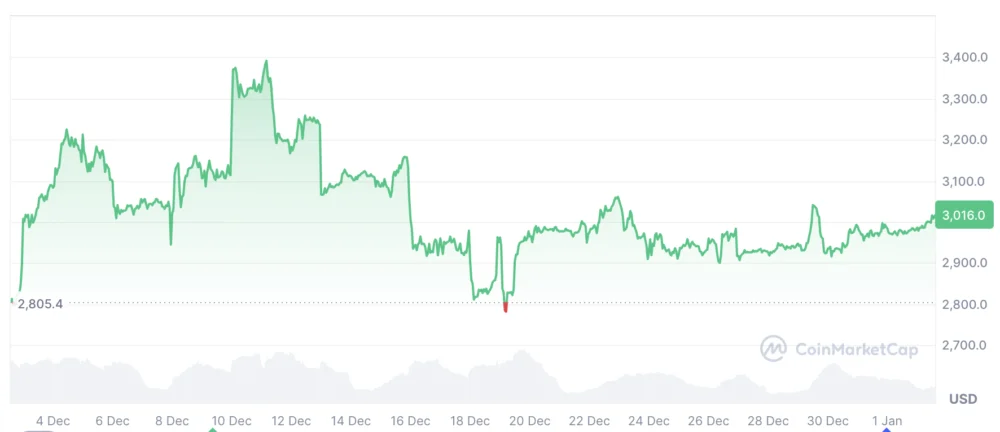
The high-stakes bet, which garnered significant attention within crypto circles, was born from a spirited exchange in November 2025 between Warwick and Multicoin Capital managing partner Kyle Samani. Samani, known for his incisive market analysis and often contrarian views, expressed skepticism regarding Ether’s prospects of reaching such an astronomical valuation within the given timeframe. Warwick, however, remained steadfast in his conviction, undeterred by the prevailing market conditions, and confidently took Samani’s challenge, agreeing to 10:1 odds that ETH would indeed breach the $25,000 mark by December 31, 2025. The final figures, however, painted a starkly different picture. Ether (ETH) concluded the year trading at approximately $2,980, a significant 13.7% lower than its starting price at the beginning of 2025, according to data compiled by CoinMarketCap, leaving a substantial chasm between prediction and reality.
A major contributing factor to Ether’s muted performance and its inability to ascend to Warwick’s projected heights was a severe market correction that swept through the crypto ecosystem. On October 10, a staggering $19 billion crypto market liquidation event sent shockwaves across the digital asset landscape, triggering a pronounced downtrend. This sudden and sharp market contraction was reportedly fueled by a confluence of macroeconomic uncertainties, including persistent inflation concerns, an unexpected tightening of monetary policies by central banks globally, and a series of high-profile regulatory crackdowns in key jurisdictions that injected a fresh wave of FUD (fear, uncertainty, and doubt) into an already sensitive market. The liquidation cascade pushed Ether’s price as low as $2,767 before a tentative, slow upward creep began, but the momentum was severely hampered, making any rapid recovery to five-figure valuations an increasingly distant dream.
The interaction confirming the bet’s outcome came swiftly after the year’s end. "Time to pay up," Samani succinctly declared in an X post directed at Warwick on Wednesday, January 1, 2026, a post that quickly circulated and became a symbol of the inherent unpredictability of even the most liquid and technologically advanced digital assets. The public acknowledgment underscored the transparency and good sportsmanship often seen in such high-profile crypto wagers, even when significant sums are involved.
Warwick’s bullish stance on Ether was rooted in a widely held optimism that permeated much of the crypto industry at the dawn of 2025. Many, including Warwick, had anticipated a year marked by surging institutional adoption of cryptocurrencies and a significant acceleration in the trend of real-world asset (RWA) tokenization. The narrative was compelling: as major financial institutions continued to explore and integrate digital assets into their portfolios and service offerings, and as the tokenization of tangible assets like real estate, commodities, and art gained traction, Ethereum, as the leading smart contract platform, was poised to be the primary beneficiary. The expectation was that increased utility, liquidity, and mainstream acceptance would naturally translate into a dramatic appreciation in ETH’s value. Proponents pointed to ongoing developments in Ethereum ETFs, burgeoning enterprise blockchain solutions, and a growing understanding among traditional investors of crypto’s potential as both an investment and a technological paradigm shift.
However, the pace of these developments proved to be slower than many had hoped. While institutional interest certainly grew, the anticipated floodgates of capital did not open with the velocity required to propel ETH to $25,000. Regulatory clarity remained elusive in many jurisdictions, acting as a bottleneck for large-scale institutional entry. Similarly, while RWA tokenization made strides, particularly in niche markets, it had yet to achieve the broad market penetration and liquidity necessary to act as a significant price catalyst for Ethereum itself. The process of integrating traditional assets onto blockchain rails proved more complex and slower than the initial hype suggested, involving intricate legal frameworks, interoperability challenges, and significant technological hurdles that required more time to overcome.
Speaking to Cointelegraph on Friday, following the conclusion of the bet, Warwick adopted a more tempered tone when discussing his revised price target for Ether in 2026. In light of the recent loss and the lessons learned from 2025’s market dynamics, he set a considerably more modest, almost "measly $10,000" as his new target. This significant downward revision from $25,000 to $10,000 for the following year reflects a recalibration of expectations, acknowledging the formidable challenges and inherent volatility of the crypto market. Despite the loss, Warwick maintained a degree of philosophical optimism, noting, "Akkkkktually [Actually] ETH is up 50% from when we made our bet. Just needed another clean 8x for me to win." This comment highlights that while he lost the specific bet on the year-end price, his overall investment in ETH from the time of the wager in November still yielded substantial gains, demonstrating the potential for profitability even in a highly unpredictable asset class, provided the entry point is strategic.

Warwick was not alone in his bullish, albeit sometimes overly optimistic, outlook for Ether in 2025. Just weeks before he doubled down on his $25,000 prediction, other respected industry analysts had also tipped Ether for significant gains, albeit at a more conservative ceiling. Tom Lee, the chair of BitMine (and co-founder of Fundstrat Global Advisors), a long-standing crypto bull, speculated that the cryptocurrency could conclude the year at approximately $10,000. "For Ethereum, somewhere between [$10,000] and $12,000," Lee stated on the popular Bankless podcast on October 13, 2025. His reasoning often centered on macro factors, increasing network utility, and the anticipated supply shock post-merge.
Concurrently, BitMEX co-founder Arthur Hayes, another influential voice in the crypto space, who also appeared on the same podcast episode, reiterated his consistent $10,000 prediction for Ether by the end of 2025. Hayes’s analysis typically blends macroeconomic trends, derivatives market insights, and a deep understanding of crypto market structure. The convergence of these two prominent analysts around the $10,000 mark suggests a widespread belief in Ether’s strong fundamentals and growth potential, even if Warwick’s $25,000 target stood out as exceptionally ambitious. The failure to even reach these more conservative targets underscores the unforeseen headwinds that materialized in the final quarter of 2025.
While the price did not achieve the lofty expectations set by many, Ethereum’s underlying technology and ecosystem continued to evolve and reach other significant milestones in 2025. The network underwent two major protocol upgrades, Pectra in May and Fusaka in December. The Pectra upgrade focused primarily on enhancing Ethereum’s scalability and security, introducing new sharding capabilities and optimizing transaction processing. It aimed to lay further groundwork for future scaling solutions, making the network more robust and capable of handling increased transaction volumes without compromising decentralization.
The Fusaka upgrade, launched in December, was particularly noteworthy. The Ethereum Foundation stated that Fusaka brought Ethereum a crucial step closer to providing "near-instant transactions." This upgrade introduced significant improvements to data availability and execution layers, reducing latency and making the user experience more seamless. For decentralized applications (dApps) and various on-chain activities, faster transaction finality is a critical factor for wider adoption. While these technical advancements were pivotal for the network’s long-term health and capabilities, they did not immediately translate into the expected price surge, demonstrating that technological prowess, while essential, is not always an immediate price driver in a market influenced by a myriad of other factors, including macroeconomics, regulatory sentiment, and investor psychology.
Adding a reflective note to the year’s developments, Ethereum co-founder Vitalik Buterin himself commented on Thursday, January 2, 2026, that Ethereum needed to intensify its efforts to achieve its overarching mission of "[building] the world computer that serves as a central infrastructure piece of a more free and open internet." Buterin’s statement, made shortly after the close of 2025, implies that despite the significant technical progress with upgrades like Pectra and Fusaka, there are still fundamental challenges to overcome in terms of scalability, user experience, and broader accessibility for Ethereum to truly fulfill its ambitious vision. This candid assessment from the network’s co-creator serves as a reminder that the journey of building decentralized infrastructure is a continuous process of innovation and problem-solving, often proceeding independently of short-term price fluctuations.
The experience of 2025, marked by a high-profile bet lost and a market that defied even bullish predictions, offers valuable lessons for all participants in the crypto space. It highlights the inherent unpredictability of nascent markets, where even the most informed experts can misjudge the timing and magnitude of price movements. While technological advancements and growing utility lay a strong foundation for long-term growth, external factors such as macroeconomic conditions, regulatory shifts, and unexpected market liquidations can exert profound short-term pressures. Kain Warwick’s $50,000 bet serves as a poignant reminder that conviction must always be balanced with a realistic assessment of market forces, and that even in the rapidly evolving world of decentralized finance, patience and prudence remain invaluable virtues. The crypto market’s journey in 2025, while not reaching the speculative peaks many had hoped for, nevertheless showcased Ethereum’s continued technological evolution and its unwavering commitment to building the infrastructure for a more decentralized future, albeit at a pace slower than some might have preferred.