Faris Adani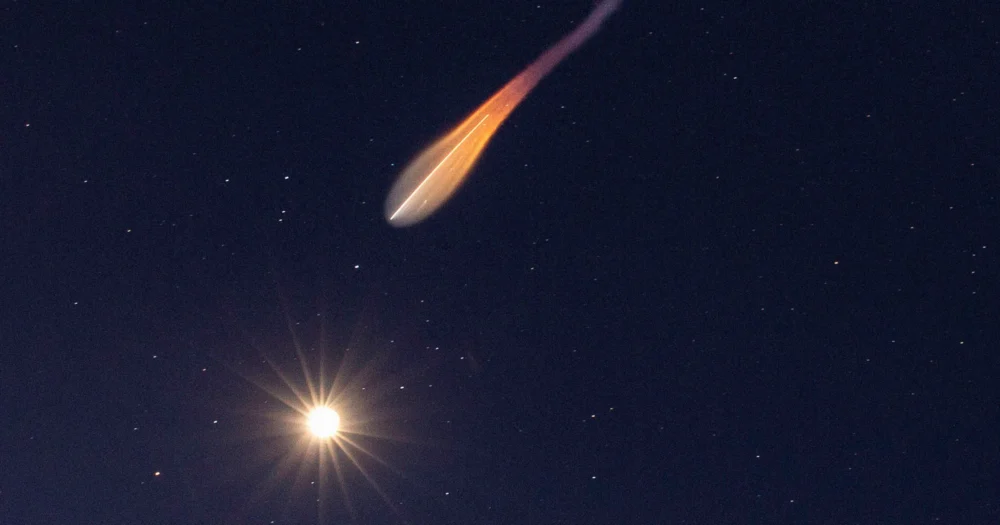
The upper stage of a SpaceX Falcon 9 rocket, following a routine mission that delivered 23 Starlink satellites into low-Earth orbit, recently made an uncontrolled descent back through Earth’s atmosphere. This seemingly mundane event, one among hundreds of launches contributing to a growing orbital fleet of nearly 10,000 broadband-beaming satellites, was far from inconsequential. Scientists have now meticulously detailed how this particular reentry, occurring in February 2025, unleashed a colossal cloud of lithium and other metallic pollutants approximately 62 miles above Europe. This startling revelation, published in the prestigious journal Communications Earth & Environment, marks a critical turning point in our understanding of the environmental footprint of the burgeoning space industry, raising profound questions about its long-term impact on our planet’s delicate upper atmosphere.
The incident involved the second stage of a Falcon 9, the expendable part of the rocket that pushes payloads to their final orbital velocity before detaching. Unlike the reusable first stage, which performs controlled landings, the upper stage typically reenters the atmosphere without guidance, burning up due to atmospheric friction. This particular event, however, offered an unprecedented opportunity for scientific observation. An international team of researchers, utilizing a sophisticated resonance lidar system situated in Germany, was able to detect and characterize a massive lithium plume directly attributable to the rocket’s ablation. The lidar, an acronym for "light detection and ranging," works by emitting pulsed laser light and measuring the backscattered light, allowing scientists to identify and quantify specific chemical elements in the atmosphere at varying altitudes. The plume, observed west of Ireland at an altitude corresponding to the mesosphere/lower thermosphere boundary, was a direct consequence of the Falcon 9’s structural materials being subjected to intense heat during reentry.
SpaceX’s rockets, like many modern aerospace vehicles, employ advanced materials designed for strength and lightweighting. A key component of the Falcon 9’s structure is an aerospace-grade aluminum-lithium alloy. This alloy, while excellent for reducing mass and improving performance, becomes a source of atmospheric pollution when it ablates – or erodes away due to extreme heat – during reentry. The study’s authors emphasized the significance of their findings: it represents the "first measurement of upper-atmospheric pollution resulting from space debris re-entry and the first observational evidence that the ablation of space debris can be detected by ground-based lidar." This isn’t merely an academic curiosity; it’s a tangible demonstration of how our activities in space are directly altering the chemical composition of Earth’s protective atmospheric layers.
The implications extend far beyond a single SpaceX reentry. Researchers have been increasingly vocal about the environmental consequences of the accelerating pace of satellite launches. The era of mega-constellations, pioneered by SpaceX’s Starlink and rapidly followed by competitors like Amazon’s Project Kuiper, OneWeb, and China’s planned GW constellation, promises global internet connectivity but at a potentially steep environmental cost. These constellations involve thousands, even tens of thousands, of satellites, each requiring multiple rocket launches for deployment. Critically, these satellites have a limited operational lifespan, typically five to ten years, meaning a continuous cycle of replacement launches is necessary to maintain the constellations. This relentless "ad infinitum" launching schedule translates into an ongoing, and escalating, injection of chemicals into our atmosphere.
The problem isn’t just the sheer volume of launches; it’s the nature of the materials involved and their interactions with atmospheric chemistry. While rocket exhaust during launch injects various gases and particulate matter into the lower atmosphere – including carbon dioxide, water vapor, and soot from kerosene engines, contributing to climate change and air quality issues – the reentry phase introduces metallic compounds directly into the upper atmosphere. This region, typically spanning the mesosphere (31-50 miles up) and thermosphere (50-370 miles up), is usually dominated by natural processes like meteoroid ablation and highly sensitive to anthropogenic disturbances. The primary concern is not just lithium, but also aluminum and its oxides. Aluminum oxide, in particular, is a known catalyst for ozone depletion. The ozone layer, located primarily in the stratosphere between 10 and 25 miles above the surface, acts as Earth’s natural sunscreen, absorbing the vast majority of harmful ultraviolet (UV) radiation from the Sun. Any threat to its integrity is a matter of grave global concern, reminiscent of the alarm raised decades ago by CFCs (chlorofluorocarbons) and their role in creating the ozone hole.
Indeed, a 2024 study, published in Geophysical Research Letters, already highlighted that satellites burning up during reentry could be injecting harmful pollutants such as aluminum oxides into the upper atmosphere. This earlier research provided theoretical models and laboratory evidence, cautioning that the metallic particles could perturb stratospheric chemistry and potentially impact the ozone layer. The latest Communications Earth & Environment paper, however, provides direct observational proof, linking a specific rocket reentry to a measurable plume of pollutants. This shift from theoretical concern to empirical validation dramatically elevates the urgency of the issue.
To put the scale of the observed pollution into context, Professor Robin Wing of the Leibniz Institute of Atmospheric Physics, a coauthor of the new paper, offered a stark comparison. Small meteors naturally deposit approximately 50 to 80 grams of lithium into Earth’s atmosphere daily as they ablate. In contrast, a single Falcon 9 upper stage contains roughly 66 pounds (approximately 30,000 grams) of lithium within its aluminum-lithium alloy structure. This means that a single rocket reentry can release hundreds of times the amount of lithium that enters our atmosphere naturally on an average day. While lithium itself isn’t the primary atmospheric concern compared to aluminum oxides – which are more reactive and have a longer atmospheric lifetime – this comparison vividly illustrates the disproportionate impact of human-made space activities. "Our largest concern is aluminum and aluminum oxides interacting with the ozone layer," Wing emphasized in an interview with the BBC, underscoring the potential for long-term damage.
The upper atmosphere, comprising the mesosphere and thermosphere, is a region critical for atmospheric dynamics and climate regulation, yet it remains relatively understudied compared to the lower atmosphere. The continuous deposition of metallic aerosols and other compounds from rocket reentries could have unforeseen consequences. These particles can serve as condensation nuclei for noctilucent clouds – high-altitude clouds that are sensitive indicators of atmospheric changes – affect radiative transfer, alter atmospheric temperatures, and potentially catalyze or inhibit crucial chemical reactions. While the exact long-term implications for the atmosphere’s ability to control climate and temperature are still being investigated, the potential for cumulative effects is a significant worry. The international team behind the study explicitly stated: "Continued growth in satellite launches and re-entries may lead to cumulative effects, with implications for long-term atmospheric composition and climate interactions." This includes potential impacts on the ionosphere, which is vital for radio communications and GPS signals, and could even influence global electric circuits.
This burgeoning environmental challenge also highlights a significant regulatory gap. Unlike other forms of pollution, there are currently no specific international treaties or regulations governing the chemical output of rocket launches and reentries into the upper atmosphere. The focus of space governance has largely been on orbital debris mitigation, frequency allocation, and preventing Kessler Syndrome (a scenario where the density of objects in low Earth orbit is high enough that collisions between objects cause a cascade where each collision generates space debris that increases the likelihood of further collisions). Atmospheric chemistry, particularly at these high altitudes, has simply not been a priority. As the space industry continues its exponential growth, driven by both commercial aspirations and national interests, the lack of a clear framework for environmental protection becomes increasingly problematic. It presents a classic "tragedy of the commons" scenario, where individual actors pursuing their own interests collectively degrade a shared resource – in this case, the pristine upper atmosphere – without bearing the full cost of that degradation.
For Elon Musk and SpaceX, these findings present a significant public relations challenge and a potential operational headache. SpaceX has championed reusable rocket technology as a way to make space access more sustainable and affordable. While the reusability of the first stage is indeed a step forward in reducing launch waste, the pollution from the expendable upper stage and the sheer volume of Starlink satellites – which are themselves designed to burn up on reentry as a form of debris mitigation – introduces a new dimension to their environmental footprint. Musk’s vision of expanding humanity’s reach into space and providing global connectivity is undeniably ambitious and transformative. However, this vision must now confront the unintended consequences of industrializing near-Earth space. The pursuit of progress cannot come at the expense of our planet’s fundamental life support systems.
Professor Wing aptly described the situation: "This is a new scientific field. It’s hard to speculate because it’s changing so quickly. I hope that if we start our measurements now, perhaps we can get ahead of the curve and identify any potential problems before they become serious." This proactive approach is crucial. The scientific community needs sustained funding and international collaboration to monitor atmospheric changes, refine models, and understand the complex interplay of these new pollutants. The space industry, in turn, must engage with these findings, exploring innovative solutions such as greener rocket fuels that produce less harmful exhaust, designing satellites with fewer toxic or reactive materials, and implementing controlled reentries for all stages to guide debris into specific, less sensitive atmospheric regions or even open ocean. The development of new materials that ablate benignly or can be recovered rather than incinerated also presents a significant research opportunity.
The discovery of a massive lithium plume from a SpaceX Falcon 9 reentry serves as a stark reminder that every human activity, no matter how technologically advanced or seemingly remote, has an ecological consequence. As we embark on a new era of space exploration and utilization, the responsibility to protect our home planet, from its surface to its outermost atmospheric layers, becomes paramount. Ignoring these warnings could lead to unforeseen and potentially irreversible changes to Earth’s climate and environment, casting a long shadow over the future of space endeavors. The message is clear: the frontier of space must be explored with an unwavering commitment to terrestrial stewardship.