anjir abdul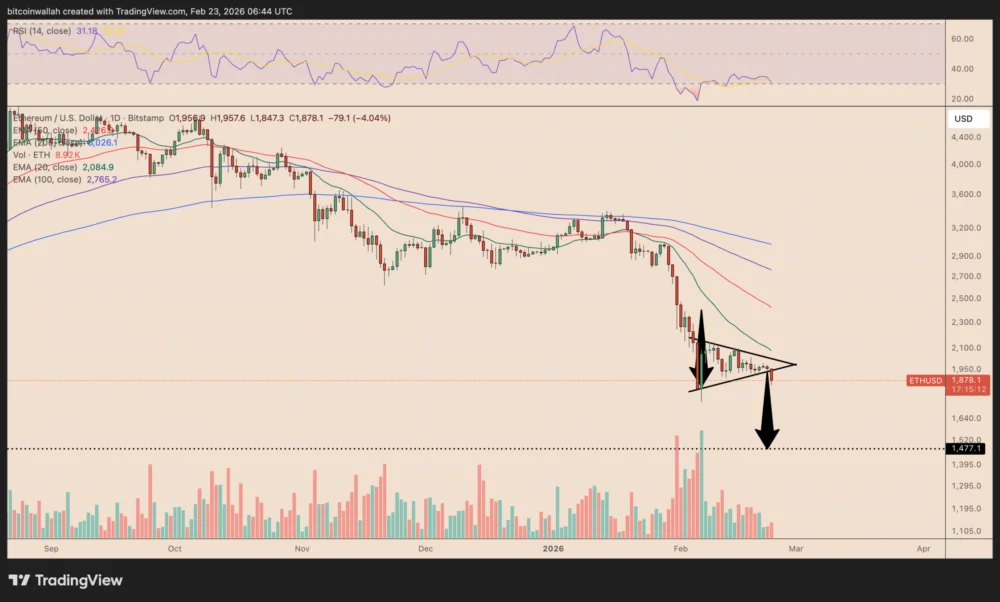
Ethereum’s native token, Ether (ETH), finds itself at a precarious juncture, poised to test and potentially breach the critical $1,500 support level in the coming days, a scenario fueled by a confluence of bearish technical indicators and significant on-chain activity from a key figure within the ecosystem. The current market sentiment, characterized by a broader de-risking trend, has put immense pressure on cryptocurrencies, with ETH bearing the brunt of a noticeable downturn in recent weeks.
ETH Bear Pennant Breakdown Targets $1,475 Amidst Broader Market Weakness
The technical outlook for Ether has deteriorated significantly, with a classic bear pennant pattern signaling further downside. On Monday, ETH’s price experienced a sharp decline of over 5.60%, falling to approximately $1,850. This immediate drop was not an isolated incident but rather a symptom of a more pervasive de-risking sentiment across global markets, largely influenced by mounting nervousness surrounding international trade tariffs and geopolitical uncertainties. This macro-economic backdrop often pushes investors away from speculative assets like cryptocurrencies, leading to capital flight.
Crucially, this price action saw ETH break decisively below the lower trendline of its prevailing bear pennant pattern. A bear pennant is a continuation pattern that forms after a strong downward price movement (the flagpole), followed by a period of consolidation where price action forms a small, symmetrical triangle (the pennant) with converging trendlines. The breakdown below the lower trendline, especially when accompanied by rising trading volumes, is a strong bearish signal. The increased volume signifies that a significant number of traders are executing sell orders, indicating strong conviction behind the downward move and suggesting that the momentum is likely to continue.
According to technical analysis principles, a bear pennant breakdown typically resolves with the price falling by an amount equal to the height of the initial downtrend (the flagpole) that preceded the pennant formation. Applying this measured move principle to ETH’s current charts suggests a downside target of $1,475. This target is particularly significant as it sits perilously close to the psychological support level of $1,500, a round number that often acts as a critical battleground between bulls and bears. A breach of this $1,500 level could trigger further panic selling, as it represents a key psychological barrier that, once broken, can accelerate downward momentum. Analysts project this target could be reached by the end of February or early March, depending on the speed of market capitulation and broader macro trends.
For the bulls to regain control and invalidate this bearish outlook, a significant reversal is required. They must first reclaim the pennant’s lower trendline as a new support level, demonstrating a bounce back into the previous consolidation range. Following this, a sustained rally above the 20-day Exponential Moving Average (EMA), currently positioned around $2,085, would be essential. The 20-day EMA is a short-term trend indicator, and trading above it often suggests renewed buying interest and a potential shift in short-term sentiment. Failure to reclaim these levels would likely confirm the bearish trajectory towards the $1,500 psychological support and potentially lower. Other technical indicators, such as the Relative Strength Index (RSI) showing oversold conditions or the Moving Average Convergence Divergence (MACD) indicating a bullish crossover, would also be needed to provide a more robust case for a trend reversal, but currently, these signals are largely absent or still pointing downwards. Should $1,500 fail to hold, the next significant support levels could be found around $1,400, followed by $1,300, which represented previous areas of consolidation or resistance.
Vitalik Buterin’s Planned ETH Sales Amplify Bearish Pressure

Adding a fundamental layer to Ether’s technical woes is the ongoing and anticipated selling of ETH by Ethereum co-founder Vitalik Buterin. His recent actions and public statements have done little to bolster bullish sentiment in February, instead casting a shadow of uncertainty over the market. On January 30, Buterin publicly announced his intention to withdraw and sell 16,384 ETH through his Kanro entity. The stated purpose of these sales is to fund crucial ecosystem work, support open-source software development, and advance other long-term initiatives, particularly during what he described as an Ethereum Foundation "mild austerity" phase. This "mild austerity" suggests a period of fiscal conservatism within the Ethereum Foundation, indicating that even the core development organization is mindful of its expenditures and potentially facing tighter budgets, which necessitates liquidating assets to maintain operations and fund strategic projects.
Since early February, on-chain analytics platforms like Arkham Intelligence have meticulously tracked Buterin’s movements, flagging approximately 9,000 ETH already sold in various batches. The pace of these liquidations appears to have intensified over the past 48 hours, notably after a significant withdrawal of 3,500 ETH from the decentralized lending protocol Aave. This activity prompted on-chain monitoring resource Lookonchain to highlight on Monday, "Vitalik Buterin is selling ETH faster again," drawing immediate attention from the crypto community.
The timing of these sales has coincided directly with Ethereum’s price depreciation. So far in February, ETH has dropped by an alarming 18.55%, aligning suspiciously with Buterin’s ETH distribution. The concern among investors is that this "overhang" – the potential for more selling pressure – could grow significantly if he proceeds to liquidate the remaining approximately 7,350 ETH from his stated initial amount. While Buterin’s sales are intended for beneficial ecosystem development, the sheer volume and the public nature of these transactions can undeniably create a psychological drag on the market.
Historical Precedent: Founder-Linked Supply and Market Impact
History offers compelling evidence of how founder-linked supply, particularly large transfers from the Ethereum Foundation treasury or prominent developers, can amplify bearish sentiment and trigger significant price corrections. These events are often interpreted by the market as a signal of "smart money" exiting or as an indication of internal financial needs that could imply a less robust outlook for the asset in the short term.
Consider the May 2021 period, for instance. A substantial transfer of 35,000 ETH (valued at approximately $125 million at the time) was tracked from the Ethereum Foundation. This move preceded a staggering 50% drop in ETH’s price within a matter of weeks. While the broader crypto market was experiencing a significant correction during this period, fueled by factors such as Elon Musk’s critical tweets about Bitcoin’s energy consumption, a regulatory crackdown in China, and general market overextension, the foundation’s large transfer acted as an additional catalyst, intensifying selling pressure and exacerbating the decline. It contributed to a narrative that even core stakeholders were de-risking.
Similarly, on November 11, 2021, the Ethereum Foundation transferred another 20,000 ETH (then worth around $95 million) to the Kraken exchange. In hindsight, this transfer almost perfectly coincided with Ether’s price peaking near its all-time high of $4,700. What followed was the onset of a prolonged bear market that saw ETH’s value plummet over the subsequent months. While it’s difficult to definitively label these transfers as the sole cause of the market downturns, their timing suggests a strong correlation. They often act as a psychological trigger, leading investors to question the immediate upside potential and prompting them to secure profits or reduce exposure, thereby adding to selling pressure. Such historical precedents underscore the significant influence that perceived insider selling can have on market dynamics, further increasing ETH’s odds of hitting its pennant target below $1,500 in the coming days.
Broader Market Context and Macroeconomic Headwinds

Beyond the technical patterns and founder-specific selling, the wider macroeconomic landscape continues to pose significant headwinds for Ether and the broader cryptocurrency market. The "broader de-risking sentiment" stems from a complex interplay of factors, including persistent inflation concerns in major economies, the prospect of central banks maintaining higher interest rates for longer, and growing geopolitical tensions. For example, renewed discussions around trade tariffs between major global powers, like the U.S. and China, introduce uncertainty into global supply chains and economic growth forecasts. Such conditions typically favor safe-haven assets over speculative ones, leading to capital flowing out of riskier investments like cryptocurrencies.
Furthermore, regulatory scrutiny remains a persistent threat. The ongoing debate in the United States regarding whether ETH should be classified as a security continues to cast a long shadow. A negative ruling could have profound implications for ETH’s listing on exchanges and its overall market accessibility. Competition from other Layer-1 blockchains, while a long-term factor, also plays a role in overall market sentiment. While Ethereum’s fundamental utility and ongoing upgrades, such as the upcoming Dencun upgrade focusing on scalability and reduced transaction costs, are long-term bullish catalysts, their positive impact is often overshadowed by immediate bearish pressures and macroeconomic concerns in the short term.
Potential Counterarguments and Long-Term Outlook
Despite the immediate bearish outlook, it’s crucial to consider factors that could potentially invalidate this thesis. A sudden, positive shift in macroeconomic conditions, such as an unexpected dovish pivot from central banks or a resolution to geopolitical tensions, could inject liquidity back into risk assets, benefiting ETH. Significant institutional adoption news, or a major positive development within the Ethereum ecosystem that generates widespread excitement, could also provide a strong bullish impetus. Furthermore, Ethereum boasts a robust and dedicated community, continuous technological innovation, and a strong fundamental utility as the leading smart contract platform. The deflationary mechanics introduced by EIP-1559 and the increasing amount of ETH locked in staking for the Proof-of-Stake network contribute to its long-term scarcity and value proposition. These underlying strengths suggest that any short-term price dips, while painful, could be viewed as accumulation opportunities by long-term investors.
In conclusion, the convergence of a confirmed bear pennant breakdown targeting $1,475, amplified by Vitalik Buterin’s ongoing ETH sales and a generally cautious macroeconomic environment, paints a stark picture for Ethereum’s price in the immediate future. The psychological $1,500 support level is now under severe threat, and a breach could pave the way for further declines. While Ethereum’s long-term fundamentals remain strong, short-term traders and investors must closely monitor key technical levels and the continued flow of ETH from prominent ecosystem figures as they navigate this challenging period.
This article does not contain investment advice or recommendations. Every investment and trading move involves risk, and readers should conduct their own research when making a decision. While we strive to provide accurate and timely information, Cointelegraph does not guarantee the accuracy, completeness, or reliability of any information in this article. This article may contain forward-looking statements that are subject to risks and uncertainties. Cointelegraph will not be liable for any loss or damage arising from your reliance on this information.