anjir abdul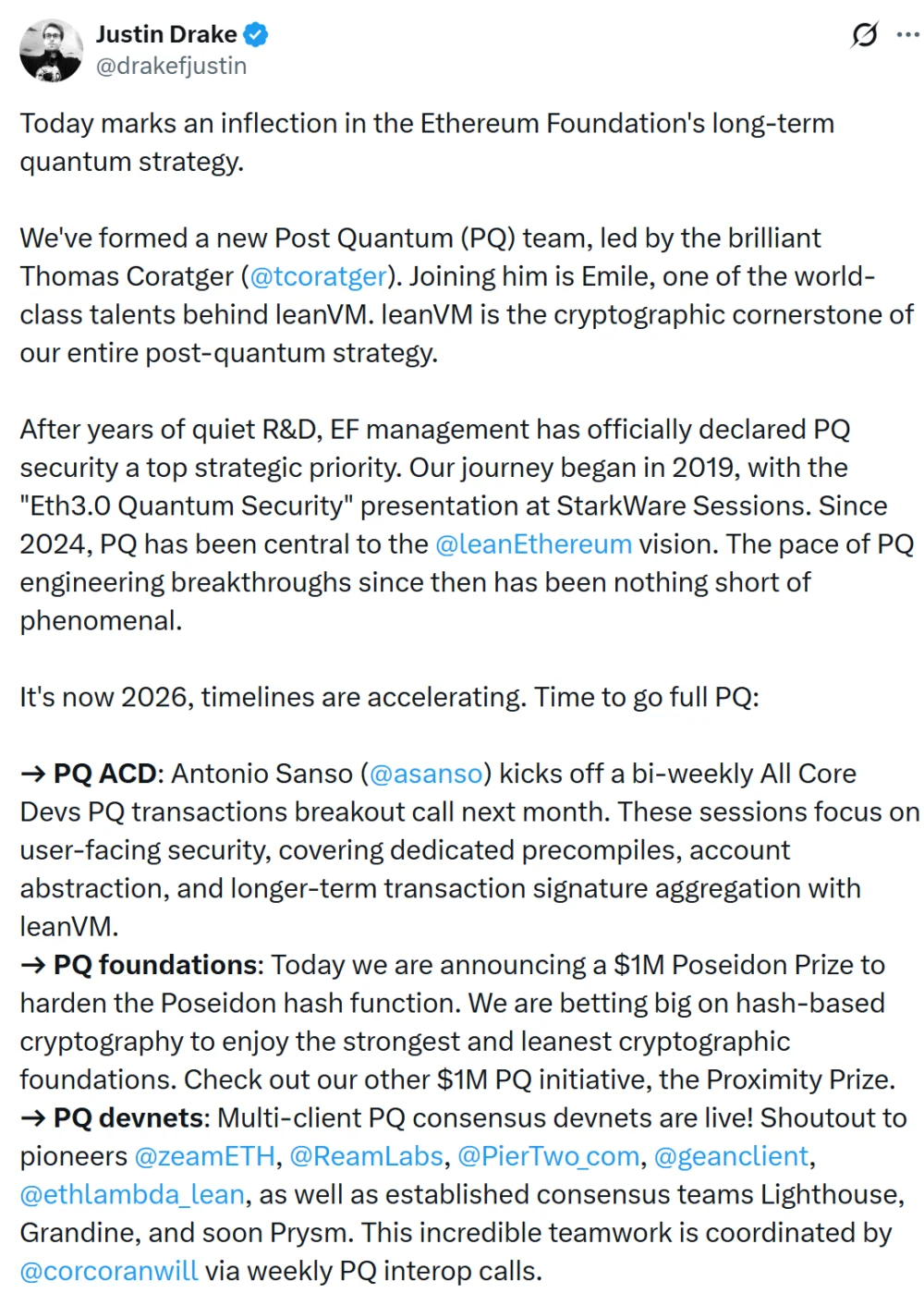
The newly established PQ team represents a significant escalation in Ethereum’s proactive defense strategy. It will be spearheaded by Thomas Coratger, a distinguished cryptographic engineer whose expertise within the Ethereum Foundation has been instrumental in past security advancements. Coratger will receive crucial support from Emile, a cryptographer with close ties to leanVM, as confirmed by respected crypto researcher Justin Drake. Drake’s insights, shared in a recent post on X, highlighted the urgency and strategic importance of this initiative. “After years of quiet R&D, EF management has officially declared PQ security a top strategic priority,” Drake stated, emphasizing a shift from conceptual exploration to urgent, actionable implementation. His stark declaration, “It’s now 2026, timelines are accelerating. Time to go full PQ,” serves as a potent reminder of the perceived imminence of the quantum threat and the need for immediate, comprehensive action.
The reference to leanVM is particularly noteworthy, as Drake further elaborated on its critical role, describing it as a specialized, minimalist zero-knowledge proof virtual machine (zkVM) that will serve as a core building block of Ethereum’s comprehensive post-quantum strategy. Zero-knowledge proofs (ZKPs) are a powerful cryptographic primitive allowing one party to prove to another that a statement is true, without revealing any information beyond the validity of the statement itself. A zkVM takes this concept further, enabling the execution of complex computations with verifiable integrity, all while maintaining privacy and efficiency. The "minimalist" nature of leanVM is crucial, as it reduces the attack surface and simplifies the integration of new, quantum-resistant cryptographic primitives, making it an ideal candidate for anchoring Ethereum’s transition to a post-quantum era. This foundational element is expected to play a pivotal role in enabling secure and verifiable operations under the new cryptographic standards.
The threat posed by quantum computers is multifaceted and profound. Current blockchain security relies heavily on cryptographic algorithms like Elliptic Curve Digital Signature Algorithm (ECDSA) for signing transactions and generating public/private key pairs. These algorithms are considered secure because breaking them with classical computers would take an infeasible amount of time, even with all the computational power on Earth. However, quantum computers, leveraging principles of quantum mechanics, are theorized to be capable of running algorithms like Shor’s algorithm, which can efficiently factor large numbers and solve discrete logarithm problems – the very mathematical problems that secure ECDSA and RSA. This could enable an attacker with a sufficiently powerful quantum computer to derive private keys from public keys, effectively compromising user funds and the integrity of blockchain networks. Another quantum algorithm, Grover’s algorithm, could significantly speed up brute-force attacks on symmetric key cryptography and hash functions, though its impact on the current security parameters of systems like Ethereum is generally considered less immediate and severe than Shor’s. The concept of "harvest now, decrypt later" is also a serious concern, where encrypted communications or transactions are stored today, with the expectation that they can be decrypted once quantum computers become powerful enough. Ethereum’s proactive stance aims to mitigate these risks long before they materialize into practical threats.
Beyond the core team, the Ethereum Foundation is backing its ambitious post-quantum push with a series of concrete steps aimed at preparing the entire ecosystem for the quantum era. A key initiative involves the launch of biweekly developer sessions, scheduled to commence next month. These sessions will be meticulously led by Ethereum researcher Antonio Sanso and will specifically focus on post-quantum transactions. The curriculum will delve into crucial areas such as user-facing protections, exploring how to shield individual users and their assets in a quantum-threatened environment. This includes developing protocol-level cryptographic tools designed to withstand quantum attacks, as well as refining account abstraction pathways to facilitate seamless and secure migration for users. Furthermore, the sessions will tackle the longer-term, complex work of aggregating transaction signatures using leanVM, aiming to achieve both quantum resistance and improved network efficiency. These sessions are vital for educating developers, fostering collaborative solutions, and ensuring that the transition is not only secure but also practical and user-friendly.
Financial incentives are also being strategically deployed to accelerate research and development in post-quantum cryptography. Drake announced the establishment of a $1 million Poseidon Prize, specifically designed to strengthen the Poseidon hash function. Poseidon is a relatively new, highly efficient hash function optimized for zero-knowledge proofs, making it a critical component in the efficiency and security of ZKP-based systems like leanVM. Enhancing its quantum resistance is paramount for the overall integrity of Ethereum’s future ZKP infrastructure. In parallel, another $1 million initiative, dubbed the Proximity Prize, has been launched. While specific details of the Proximity Prize are yet to be fully disclosed, it is understood to be broadly aimed at advancing the field of post-quantum cryptography, likely targeting novel algorithms, cryptographic constructions, or migration strategies that can bolster Ethereum’s defenses. These significant financial commitments underscore the Foundation’s seriousness in attracting top talent and fostering groundbreaking research to overcome the quantum challenge.

On the engineering front, considerable progress has already been made. Drake confirmed that multi-client post-quantum consensus development networks are already live. This is a crucial step, as Ethereum relies on a diverse set of client software (e.g., Geth, Erigon, Nimbus, Lighthouse, Prysm) to maintain decentralization and resilience. Developing and testing post-quantum solutions across multiple clients simultaneously ensures that the new cryptography can be seamlessly integrated without introducing single points of failure or compromising network stability. Multiple teams are actively participating in these development networks, coordinating their efforts through weekly interoperability calls. This collaborative approach is essential for identifying and resolving compatibility issues early, ensuring a smooth and unified transition for the entire network.
Beyond technical development, the Ethereum Foundation is also prioritizing community engagement and education. A dedicated post-quantum event is slated for October, providing a platform for researchers, developers, and stakeholders to converge, share insights, and collaborate on solutions. This will be followed by a focused "post-quantum day" in late March, strategically scheduled ahead of EthCC, one of Ethereum’s largest annual conferences. These events are designed to disseminate knowledge, foster discussion, and accelerate the adoption of post-quantum strategies within the broader Ethereum community. Educational efforts are also underway, encompassing the creation of video content and comprehensive materials specifically tailored for enterprises, recognizing that the quantum threat extends beyond individual users to institutional adopters and blockchain-based businesses.
The Ethereum Foundation’s announcement arrives amidst a burgeoning awareness and growing sensitivity to quantum risk across the broader cryptocurrency markets. Just recently, Coinbase, a leading cryptocurrency exchange, revealed its own strategic response to this emerging threat. The exchange has established an independent advisory board tasked with evaluating how advancements in quantum computing could impact the cryptography securing major blockchain networks, including not only Ethereum but also Bitcoin (BTC). This move by a major centralized entity like Coinbase highlights the industry-wide recognition of the urgency and gravity of the quantum threat.
The Coinbase advisory board brings together a diverse array of experts from academia and industry, spanning quantum computing, cryptography, and blockchain security. This multidisciplinary approach is crucial for understanding the complex interplay between these fields and for formulating robust defensive strategies. The board’s mandate includes publishing public research and guidance, which will serve as invaluable resources for developers, organizations, and users navigating the quantum transition. Their first position paper, anticipated in early 2027, is expected to provide comprehensive insights and recommendations, further shaping the industry’s response to quantum risks. This parallel effort by Coinbase underscores that quantum readiness is not merely a theoretical exercise but a practical imperative for the entire digital asset ecosystem.
It’s also important to contextualize Ethereum’s efforts within the broader crypto landscape, particularly concerning Bitcoin. While Bitcoin also faces quantum risks, especially for "old BTC" held in addresses whose public keys have been exposed, and for transactions that reuse addresses, its conservative development philosophy means that a post-quantum migration might proceed differently. Initiatives like BTQ’s Bitcoin Quantum Testnet are exploring these specific risks. Ethereum’s more agile development culture and its foundational use of more complex cryptographic primitives (like those in ZKPs) necessitate a more proactive and integrated approach to post-quantum security, making its dedicated team a crucial step for its future.
Ultimately, the Ethereum Foundation’s formation of a dedicated Post-Quantum Security Team represents a forward-thinking and essential move for the long-term viability and security of the network. By investing heavily in research, development, and community education, Ethereum is not just reacting to a potential threat but actively shaping a quantum-resistant future for decentralized finance and the broader digital economy. This proactive stance ensures that as quantum computing technology evolves, Ethereum will remain a secure and reliable platform, safeguarding the integrity of its network and the assets of its users for generations to come.