Faris Adani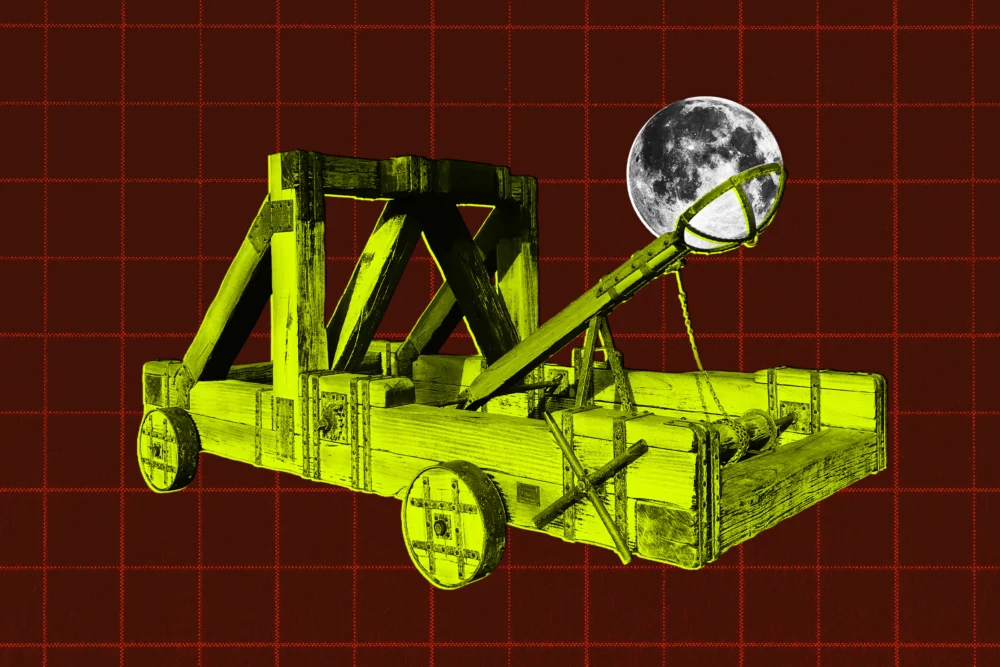
In a dramatic and characteristically audacious pivot, technology titan Elon Musk is reportedly redirecting his boundless ambitions from the Red Planet to Earth’s nearest celestial neighbor, the Moon. According to recent disclosures from a New York Times report dated February 10, 2026, Musk has laid out a staggering vision to employees at xAI, his artificial intelligence venture recently subsumed by SpaceX: the establishment of an advanced manufacturing facility on the lunar surface, dedicated to producing AI satellites, and an colossal electromagnetic catapult to launch them into orbit. This represents a significant reorientation for Musk, who has for years championed Mars as humanity’s definitive next step, often sidelining lunar exploration as a mere distraction.
Musk’s latest pronouncements unveil a plan steeped in science fiction, yet articulated with his characteristic conviction. The proposed electromagnetic catapult is, in essence, a mass driver—a concept long explored in theoretical space engineering. Imagined as a gargantuan coilgun, it would utilize powerful magnetic fields to accelerate payloads, in this case, AI satellites, to escape velocity from the Moon’s low gravity. On Earth, the energy requirements and atmospheric drag make such a system impractical for launching significant payloads into orbit. However, the Moon, with its negligible atmosphere and significantly weaker gravitational pull (roughly one-sixth of Earth’s), presents an ideal environment for a mass driver. This infrastructure, paired with a sophisticated lunar factory, would serve as a critical component in Musk’s burgeoning AI empire, which he believes must transcend terrestrial limitations to achieve its full potential.
"You have to go to the Moon," Musk reportedly declared at an all-hands meeting, as per the NYT. His rationale is clear: the scale of AI development he envisions demands an infrastructure unbound by the finite resources and environmental constraints of Earth. "It’s difficult to imagine what an intelligence of that scale would think about, but it’s going to be incredibly exciting to see it happen," he added, hinting at the profound implications of such a leap.
The acquisition of xAI by SpaceX, preceding what is anticipated to be a landmark IPO, underscores the strategic intertwining of Musk’s space and AI ventures. In the announcement concerning the acquisition, Musk posited that space-based AI represented the "only way to scale" the technology. He articulated a vision extending beyond the lunar factory, proposing vast data centers in Earth’s orbit, where they could theoretically harness practically limitless solar energy. These orbital data centers, coupled with a dense constellation of AI satellites, would form what he evocatively termed a "sentient sun"—a distributed, planet-spanning AI network with unparalleled processing power and energy access.
The shift towards lunar focus is particularly striking given Musk’s long-standing public stance. For years, the SpaceX CEO has been an ardent proponent of Mars colonization, often disparaging lunar missions as a "distraction" from the ultimate goal of making humanity a multiplanetary species. His mantra, "make life multiplanetary" and "extend consciousness to the stars," has consistently underscored his Mars-first philosophy. He frequently provided ambitious, albeit often missed, timelines for reaching the Red Planet, including a 2017 promise of a first Mars mission by 2022 and human arrivals by 2025. He has consistently presented SpaceX employees with detailed roadmaps for establishing a permanent human presence on Mars. The current pivot, therefore, signifies a profound recalibration of his strategic priorities.
However, Musk insists this is not an abandonment of Mars, but rather a tactical realignment. During the recent meeting, he reframed the Moon as a crucial stepping stone towards his ultimate interplanetary aspirations. His revised roadmap now envisions first building "a self-sustaining city on the Moon," followed by travel to Mars, and eventually, a wider search across the galaxy for extraterrestrial intelligence. This sequencing offers a more pragmatic, if still incredibly ambitious, approach to his overarching goals.
He elaborated on this revised timeline in a recent tweet, justifying the pivot: "SpaceX has already shifted focus to building a self-growing city on the Moon, as we can potentially achieve that in less than 10 years, whereas Mars would take 20+ years," Musk explained. "That said, SpaceX will also strive to build a Mars city and begin doing so in about 5 to 7 years, but the overriding priority is securing the future of civilization and the Moon is faster." This statement reveals a strategic prioritization based on perceived feasibility and speed, emphasizing the Moon as a quicker route to establishing a robust off-world presence, deemed essential for the long-term survival of civilization.
The concept of a self-sustaining lunar city is itself a monumental undertaking, requiring revolutionary advancements in resource utilization, energy generation, and closed-loop life support systems. Lunar regolith, the loose soil and dust covering the Moon, could potentially be processed for construction materials, oxygen, and even water if ice deposits at the poles are accessible. The vacuum of space and the low gravity offer unique advantages for certain types of manufacturing and scientific research, potentially enabling the production of materials and components impossible or prohibitively expensive to create on Earth.
The electromagnetic catapult, or mass driver, is a concept with a rich history in space development. Pioneered by figures like Gerard O’Neill in the 1970s, mass drivers were initially conceived for launching lunar materials to orbital processing facilities. The physics are elegant: a series of electromagnets accelerate a projectile along a track, much like a maglev train, until it reaches escape velocity. On the Moon, without atmospheric drag, the efficiency would be extremely high, and the absence of complex rocket engines means less volatile fuel and fewer moving parts, potentially reducing operational costs and increasing reliability for routine payload launches. However, constructing such a massive piece of infrastructure in a vacuum, under extreme temperatures, and with abrasive lunar dust, presents unprecedented engineering challenges. Robotics and autonomous construction would be paramount.
Musk’s vision of a "sentient sun" of AI satellites and orbital data centers speaks to a future where computing power is not just distributed globally, but cosmically. The advantages of space for data centers include passive cooling in the vacuum of space, access to abundant solar energy without atmospheric interference, and potentially enhanced data security away from terrestrial networks. This would require an unparalleled number of satellites and orbital infrastructure, dwarfing existing constellations like Starlink, and raising questions about space debris and orbital traffic management.
The strategic marriage of SpaceX’s launch capabilities and xAI’s artificial intelligence ambitions appears to be the driving force behind this lunar shift. By creating a vertically integrated space-AI ecosystem, Musk aims to control every aspect of his AI expansion, from raw material extraction on the Moon to the deployment and operation of orbital AI networks. This bold new direction underscores a fundamental belief that the future of advanced AI lies beyond Earth, and that humanity’s destiny is inextricably linked with its ability to expand into the cosmos. While the timelines remain characteristically aggressive and the technical hurdles immense, Musk’s latest pronouncements promise to redefine the conversation around space exploration and the future of artificial intelligence.
More on SpaceX: Elon Musk Going Through It After Putting Mars City on Ice