Faris Adani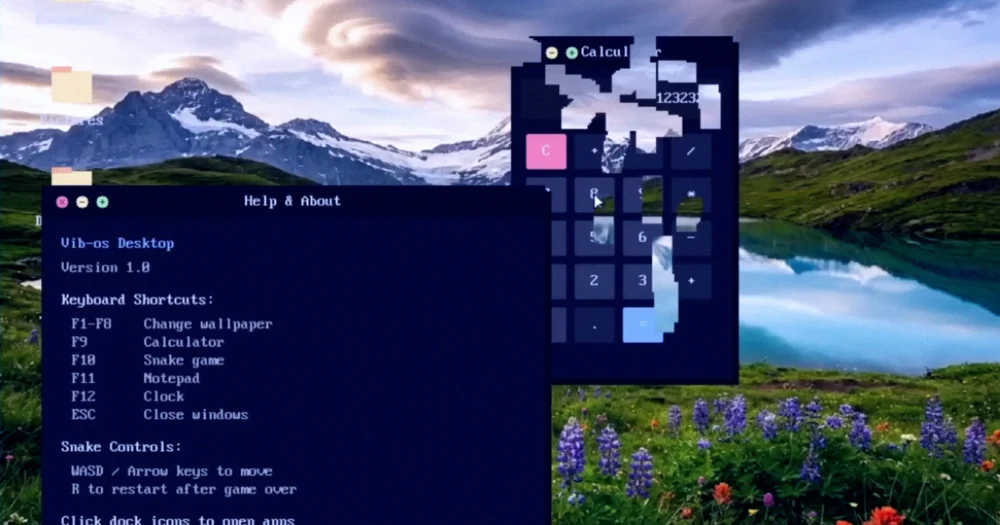
Last year, the tech world buzzed with a fresh term coined by OpenAI cofounder and former executive Andrej Karpathy: “vibe coding.” This novel approach promised a paradigm shift in software development, advocating for the rapid creation of applications by feeding natural language prompts to an AI model. The allure was undeniable: faster prototyping, reduced reliance on intricate coding syntax, and a more intuitive, conversational interface for bringing complex software ideas to life. However, the burgeoning enthusiasm for this AI-driven methodology has recently encountered a stark reality check, as evidenced by the dismal performance of an entirely vibe-coded operating system, appropriately dubbed Vib-OS. This ambitious project, proudly hosted on GitHub, boasts a custom kernel, a sleek macOS-inspired graphical user interface, and a virtual file system, promising a full-fledged computing experience. Yet, as one dedicated YouTuber discovered, the current iteration of Vib-OS serves as a potent reminder of the glaring shortcomings that can arise when relying solely on AI for the creation of intricate, functional software.
The concept of "vibe coding" emerged from a desire to streamline the often laborious and detail-oriented process of traditional software engineering. Karpathy envisioned a future where developers could articulate their software requirements in plain English, allowing advanced AI models to translate these "vibes" into executable code. This approach promised to accelerate development cycles, empower individuals without deep programming expertise to build applications, and potentially unlock unprecedented levels of creativity and iteration speed. Imagine describing a desired feature, a UI element, or even an entire system, and having an AI generate the foundational code, leaving human developers to refine, optimize, and integrate. It’s a vision that aligns perfectly with the current technological zeitgeist, where artificial intelligence is increasingly positioned as the ultimate problem-solver across various domains. The potential for AI to handle the mundane, repetitive aspects of coding, or even to scaffold complex architectures, holds immense appeal for startups looking to innovate quickly and established tech giants aiming for efficiency gains.
Vib-OS positioned itself as a grand testament to this vision. Its GitHub repository detailed an impressive array of features, making bold claims that suggested a robust and user-friendly operating system. The project documentation proudly declared a "custom kernel," hinting at a meticulously crafted core designed from the ground up, rather than a mere repackaging of existing components. A "modern macOS-inspired graphical user interface" suggested a sleek, intuitive, and aesthetically pleasing user experience, aiming for the polished feel associated with Apple’s acclaimed desktop environment. Furthermore, the inclusion of a "virtual file system" indicated a sophisticated approach to data management and organization. Beyond these architectural boasts, the project made a particularly intriguing, if not somewhat audacious, claim: the ability to play Doom. For many in the computing world, running Doom on a new or custom operating system is a time-honored benchmark, a rite of passage that signifies a certain level of foundational stability and graphics capability. The fact that Vib-OS claimed compatibility with both ARM64 and x86-based computers further underscored its ambitious scope, aiming for broad hardware accessibility. These assertions painted a picture of a remarkably competent and feature-rich OS, seemingly a triumphant demonstration of vibe coding’s power.
However, the glossy facade of Vib-OS quickly crumbled under real-world scrutiny. YouTuber Tirimid, known for his in-depth tech explorations, embarked on the arduous task of setting up and testing Vib-OS, documenting his experience in a recent video. What he uncovered was not the seamless, functional system promised by the documentation, but a labyrinth of bugs, non-responsive features, and outright misrepresentations. His journey through Vib-OS became an agonizing testament to the current limitations of AI-driven software generation, revealing a product that was, in its current state, largely unusable. Tirimid’s initial enthusiasm gradually gave way to palpable frustration as he navigated a system rife with fundamental flaws.
The list of operational failures Tirimid meticulously cataloged was extensive and disheartening. One of the most critical issues was the complete inability of Vib-OS to connect to the internet. In an era where connectivity is a cornerstone of virtually all computing tasks, this fundamental flaw rendered a significant portion of the OS’s potential functionality moot. Without internet access, even the most basic tasks like browsing the web, checking email, or downloading updates became impossible, severely crippling its utility. Moving beyond connectivity, the graphical user interface, touted as "modern macOS-inspired," proved to be largely decorative. Buttons within the File Manager, a core component for navigating and managing user data, failed to respond to clicks, transforming basic file operations into an exercise in futility. The Notepad application, a simple text editor, refused to save any documents, effectively making it a temporary scratchpad rather than a functional tool.
The gaming experience fared no better. While the documentation promised the ability to play classic games, including the iconic Snake, Tirimid found that even this simple title was plagued with performance issues, rendering it nearly unplayable. And the much-hyped Doom? A launcher icon for the legendary demon-slaying shooter conspicuously adorned the desktop, but Tirimid’s repeated, hopeful clicks were met with an absolute lack of response. This suggested that the AI responsible for generating the OS, or its documentation, had likely "hallucinated" the feature altogether, promising something that simply didn’t exist within the codebase. Perhaps one of the most glaring examples of functional misdirection was the "Browser" app. Instead of a web browser capable of rendering websites, it astonishingly turned out to be nothing more than an image viewer, a bewildering discrepancy that highlighted a profound disconnect between intended functionality and actual implementation. Adding to the list of disappointments, despite claims of Python script support, Tirimid confirmed that the operating system offered no such capability, further eroding trust in the AI-generated documentation.
These numerous failures underscore the current chasm between AI’s ability to generate code snippets and its capacity to construct a complex, integrated, and stable operating system. The development of an OS requires not just individual functional components, but a deep understanding of system architecture, resource management, inter-process communication, hardware abstraction, and robust error handling – areas where current AI models often fall short. AI "hallucinations," where models confidently present inaccurate or fabricated information, are a well-documented problem, and Vib-OS appears to be a prime example of this phenomenon in the context of software documentation and feature claims. Generating code that merely compiles is one thing; generating code that is secure, efficient, and performs reliably across a multitude of hardware and user interactions is an entirely different beast, typically requiring rigorous human testing, debugging, and iterative refinement. The sheer number of non-functional or misleading features in Vib-OS suggests a lack of comprehensive integration testing, a fundamental step in human-led software development that seems to be missing from the vibe-coding process, at least in this instance.
The public reaction to Tirimid’s video was a mixture of amusement and concern, reflecting broader sentiment within the tech community regarding the relentless push for AI integration. One commenter wryly remarked, "You found an early build of Windows 12," a jab at Microsoft’s aggressive strategy to embed AI throughout its Windows ecosystem, which has faced significant user backlash and criticisms regarding privacy and forced updates. This comment highlights a growing skepticism among users who fear that the current AI hype might lead to rushed, buggy, and ultimately frustrating software experiences, reminiscent of past missteps by major tech players. The rush to integrate AI is not just about innovation; it’s also about massive investments in AI research and development, often accompanied by significant layoffs in other departments, as companies like Block and others streamline their workforces. This economic backdrop adds another layer to the discussion, raising questions about the true cost and benefits of relying heavily on AI for core product development.
In a follow-up note, Tirimid, ever the ethical tech enthusiast, made a crucial plea to his viewers: "I was somewhat negative about many parts of this OS, but please don’t go to the repo and be negative in the issues or whatever." This underscores the experimental and open-source nature of many AI-driven projects, acknowledging that while critical feedback is necessary, harassment is counterproductive. Vib-OS, despite its current state, remains an intriguing experiment, a raw snapshot of what AI can (and cannot yet) achieve in system-level programming.
The saga of Vib-OS serves as a crucial reality check in the midst of overwhelming AI optimism. While "vibe coding" holds immense theoretical promise for democratizing and accelerating software development, the current capabilities of AI models for generating complex, integrated, and reliable operating systems are clearly nascent. The journey from natural language prompts to a fully functional, bug-free OS is fraught with challenges, from ensuring logical coherence and preventing hallucinations to rigorous testing and debugging. Whether advancements in AI will one day bridge this gap and enable models to build truly usable operating systems and other sophisticated software remains to be seen. For now, Vib-OS stands as a powerful, albeit cautionary, tale: a compelling vision of the future of coding, firmly grounded in the buggy, unpredictable present. The path forward for AI in software development will undoubtedly require a more nuanced approach, one that leverages AI’s strengths for rapid prototyping and code generation, but crucially retains human oversight, expert testing, and a deep understanding of system architecture to ensure functionality, reliability, and security.