Faris Adani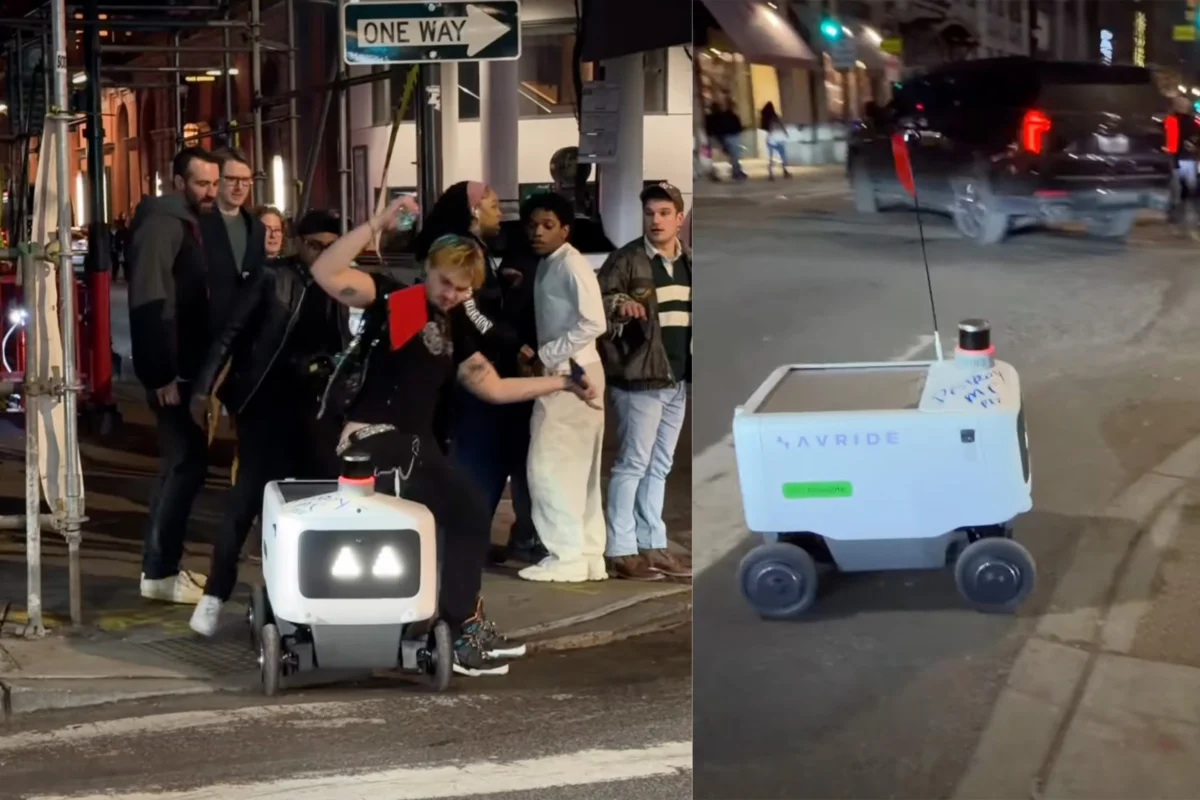
The gritty streets of Philadelphia have once again proven to be an unforgiving crucible for autonomous technology, as a delivery robot from the Uber and Avride partnership became the latest casualty of the city’s infamous "robophobia," captured in a viral video late Saturday night. The unsettling footage, recorded by street photographer Hugh Dillon, depicts a small, white, four-wheeled bot subjected to a barrage of physical and verbal abuse, highlighting a simmering tension between human residents and the encroaching wave of automated services. This incident serves as a stark reminder of the city’s past, specifically the brutal destruction of HitchBOT in 2015, and underscores the complex societal challenges inherent in integrating autonomous entities into urban environments.
Dillon’s 30-second clip paints a vivid picture of the robot’s ordeal. As it trundled along a city sidewalk, presumably on its way to complete a food delivery, a crowd of onlookers surrounded it. The robot, adorned with "AVRIDE" on its side and a digital face displaying simple, triangular eyes, was not met with curiosity or indifference, but with outright hostility. Individuals were seen kicking the unsuspecting machine, while others sat on its chassis, momentarily halting its progress. Laughter and jeers filled the night air, turning the sidewalk into an impromptu arena where human dominance was asserted over the uncomplaining automaton. Most disturbingly, one person was even captured performing a lewd act, humping the robot as if to mock its very presence and purpose. After enduring this gauntlet of abuse, the resilient bot eventually ambled past Dillon, who then captured a close-up shot revealing a stark message scrawled on its plastic exterior: "DESTROY ME PLZ." Dillon’s caption on the video encapsulated the surreal scene: "Honestly thought it was done for. One wanted to throw it, another sat on it. another person wrote destroy me on it… Then it calmly rolled on its merry way."
This latest assault on an autonomous machine in Philadelphia inevitably draws parallels to the ignominious end of HitchBOT in August 2015. HitchBOT, a whimsical, childlike robot designed in Canada to study human-robot trust, embarked on a cross-country hitchhiking journey across the United States. Its mission was to rely solely on the kindness of strangers to reach its destinations, documenting its travels through social media. After successfully navigating parts of Canada and Europe, HitchBOT’s American adventure met a premature and violent end in Philadelphia. Less than two weeks into its journey, the robot was found decapitated and dismembered, its components scattered across a city street. The incident sparked global outrage and became a symbol of humanity’s darker impulses when confronted with technology that challenges traditional social norms. For many, HitchBOT’s demise cemented Philadelphia’s reputation as a hotbed of "robophobia," a city where technological innovation, particularly when embodied in a vulnerable, human-like form, is met with suspicion and aggression rather than brotherly love. The Avride robot’s recent experience suggests that this cultural predisposition has not waned.
The delivery robots themselves are a product of a partnership between ride-sharing giant Uber and robotics company Avride. These autonomous vehicles are designed to tackle the "last-mile delivery" challenge, an industry term referring to the final, often most inefficient and costly, leg of a delivery process. With a maximum speed of five miles per hour and a limited operational radius of one to two miles, these bots are intended to navigate urban sidewalks, delivering food and other goods directly to customers’ doors, thereby reducing labor costs and increasing efficiency for gig economy platforms. However, their integration into the dense, dynamic environment of a city like Philadelphia is proving to be far from seamless.
The verbal abuse hurled at the robot, captured in other shared videos, further illuminates the underlying societal anxieties. One resident hollers, "He doesn’t even know where the f he’s going bro," followed by a derogatory slur, "Fing re***d." This reflects a common frustration with nascent technology – its perceived clumsiness, its inability to perfectly replicate human intuition, and its intrusion into established social spaces. More tellingly, another "enterprising Philadelphian" commented, "ROB HIM OF HIS COPPER IMMEDIATELY." This particular remark cuts to the core of a significant societal apprehension: economic anxiety. These robots, silent and tireless, symbolize the automation of jobs, particularly those in the service and delivery sectors, which are often occupied by working-class individuals. The suggestion to "rob" the robot implies not just an opportunistic desire for scrap metal, but perhaps a deeper, more primal urge to reclaim perceived resources or to lash out at the perceived cause of economic insecurity. It transforms the robot from a mere delivery mechanism into a tangible, albeit symbolic, competitor for livelihoods.
Philadelphia’s "infamously short fuse" and its unique cultural identity contribute significantly to this resistance. Known for its tough, independent, and working-class spirit, the city has a long history of distrusting external forces and embracing a certain gritty authenticity. The deployment of silent, impersonal robots navigating their sidewalks can be seen as an intrusion, an unwelcome harbinger of a future that threatens familiar routines and human connections. This sentiment echoes a modern form of Luddism, a resistance to technological change that, historically, has been driven by fears of job displacement and the erosion of traditional crafts and livelihoods. For many residents, public sidewalks are communal spaces, governed by unspoken rules of pedestrian flow and human interaction. A robot, moving at its own pace, sometimes obstructing paths, and devoid of the social cues that govern human-to-human interaction, disrupts this established order, leading to irritation and, in some cases, outright hostility.
The challenges faced by Avride and Uber in Philadelphia are not isolated incidents. Similar robotics companies have encountered significant pushback in other major US cities. In Los Angeles, residents have complained about delivery bots hogging sidewalks, creating congestion and frustration for pedestrians. Chicago, too, has seen its share of issues, with reports of robots injuring residents by bumping into them, particularly the elderly or children, and even "rampaging" through private gardens. These incidents led to significant resident outcry and, in some areas of Chicago, outright bans on delivery robots. The common threads in these complaints are the disruption of public space, safety concerns, and a general sense of annoyance from a technology that, while promising efficiency, often fails to seamlessly integrate into the unpredictable human landscape.
The psychology behind human-robot interaction in these scenarios is complex. On one hand, the "DESTROY ME PLZ" graffiti, while dark, implies a form of anthropomorphism – a recognition of the robot as something more than just a piece of machinery, almost a sentient being capable of expressing a wish. On the other hand, the physical and verbal abuse suggests a complete objectification, treating the robot as a disposable, non-feeling entity. This paradox highlights the "uncanny valley" effect, where robots that are almost, but not quite, human can evoke feelings of discomfort, unease, or even revulsion. There’s also an element of power dynamics at play; humans asserting dominance over a non-human entity performing a task traditionally done by humans. The anonymity of a crowd can further embolden individuals to act out in ways they might not if alone, fostering a mob mentality that amplifies aggression.
Looking ahead, the future of human-robot coexistence in urban environments remains uncertain. For companies like Uber and Avride, achieving social acceptance is as critical as technical proficiency. This may involve redesigning robots to be less intrusive, more aesthetically pleasing, or even incorporating interactive elements that foster a sense of community engagement rather than alienation. Public education campaigns could help demystify the technology and address anxieties about job displacement. Cities, meanwhile, face the daunting task of establishing clear regulatory frameworks for these new autonomous agents, potentially including designated lanes, restricted operating hours, or liability protocols for accidents and damages. The ongoing tension between the relentless march of technological advancement and the deeply ingrained social dynamics and anxieties of human populations will continue to play out on city streets. Philadelphia, with its unique blend of working-class grit and historical resistance, will undoubtedly remain a crucial barometer for how well, or how poorly, humanity adapts to the automated future unfolding at its sidewalks.