Faris Adani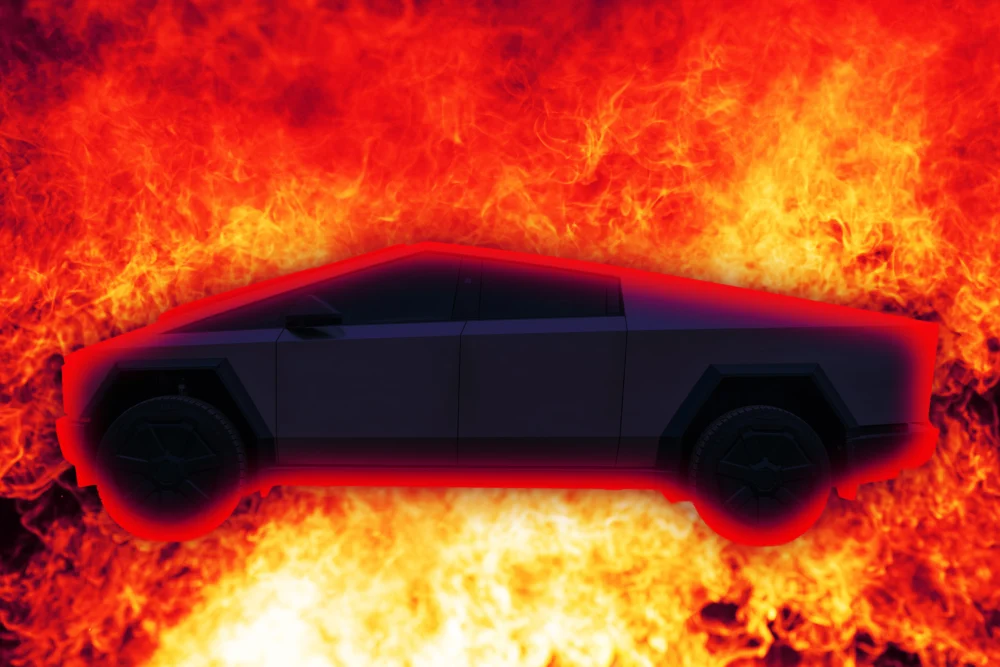
The Tesla Cybertruck, often hailed as a futuristic marvel and marketed as "apocalypse-proof," is rapidly gaining a reputation not for its innovative design, but for potentially being a deadly trap, particularly in emergency situations. New reporting from The Washington Post has cast a stark light on the vehicle’s unorthodox construction and electronic features, revealing how they can critically impede emergency responders and prevent occupants from escaping after a crash. This isn’t just an inconvenience; it’s a matter of life and death, with at least two documented cases where individuals tragically perished inside a Cybertruck because rescue efforts were thwarted by the vehicle’s very design.
The most horrific illustration of this danger emerged from a 2024 crash in Piedmont, California. In a harrowing account, a bystander desperately attempted to free three friends trapped inside a burning Cybertruck. The vehicle’s electronic doors, lacking conventional handles and operated by hidden push buttons, refused to open. By the time the bystander managed to breach the supposedly "bulletproof" glass windows, it was too late. Three occupants – 20-year-old Jack Nelson, 19-year-old Krysta Tsukahara, and another individual – had succumbed either to the flames or smoke inhalation. Only one person managed to escape the inferno. The families of Nelson and Tsukahara have since initiated lawsuits against Tesla, arguing that the truck’s design directly contributed to their loved ones’ untimely deaths. This tragic incident underscores a growing concern: Tesla’s pursuit of a "futuristic" aesthetic may be coming at the unacceptable cost of passenger safety and the effectiveness of emergency response.
A primary culprit in these life-threatening scenarios is the Cybertruck’s unique door mechanism, a feature shared with other Tesla models. Unlike traditional vehicles, Cybertruck doors are electrically powered, relying on a central touchscreen, a smartphone app, or subtle capacitive buttons embedded in the exterior. Critically, there are no visible external door handles. While innovative in theory, this system becomes a profound liability in the chaotic aftermath of a collision. A loss of power, damage to the vehicle’s electrical system, or even simple structural deformation can render these electronic controls useless, effectively sealing occupants inside.
Tesla does incorporate emergency release mechanisms, but critics argue they are so unintuitive and obscure as to be practically useless in a high-stress situation. For instance, to open a passenger door from the inside of a Cybertruck, one must locate and pull a cord hidden beneath a liner in the bottom storage compartment. This cord is typically unlabeled, meaning a passenger would need prior, intimate knowledge of the truck’s internal workings to find and activate it – a near impossibility for someone unfamiliar with the vehicle, let alone for anyone panicking as a vehicle fills with smoke or erupts in flames. As Phil Koopman, an automotive safety expert and professor emeritus at Carnegie Mellon University, bluntly told The Washington Post, "It is more obvious how to get out of a trunk than it is the back seat of a Tesla after a crash." This statement gains significant weight when considering that trunks are legally mandated to have an illuminated internal release latch, a basic safety feature seemingly overlooked in the Cybertruck’s passenger compartment.
Beyond the doors, the Cybertruck’s much-touted "apocalypse-proof" construction presents an equally formidable challenge for emergency services. Elon Musk has frequently boasted about the truck’s thick, ultra-hard stainless steel exoskeleton, claiming it can stop bullets, and its robust "bulletproof" glass. While these features might appeal to those seeking ultimate durability or even a sense of invulnerability, they create an impenetrable fortress for both trapped occupants and would-be rescuers. In the aftermath of the Piedmont accident, the official report explicitly cited "poor access for firefighter" as a significant factor in the difficulty of extinguishing the blaze and reaching the victims. Photographs from the scene grimly display pry marks on the vehicle’s body, a testament to the firefighters’ futile attempts to force open the cabin. This seemingly indestructible design, intended to protect, inadvertently prevents crucial life-saving intervention. Attorney Merick Lewin, managing partner of personal injury law firm Good Guys Law, articulated this dilemma to WaPo: "When you have a car that you specifically market as being almost invulnerable, bulletproof glass, [a] ball and hammer… when you’re marketing that, obviously something that should come to mind is: How does a rescuer get in in the event of a crash?" The answer, disturbingly, appears to be: with extreme difficulty, if at all.
The issues highlighted by the Cybertruck are not entirely isolated to this single model. The Washington Post investigation unearthed at least a dozen instances since 2019 where Tesla drivers and passengers found themselves trapped in their vehicles during life-threatening emergencies. This pattern suggests a broader systemic issue within Tesla’s design philosophy, where novelty and aesthetic minimalism may be prioritized over conventional, fail-safe mechanisms critical for occupant safety and emergency access. In traditional vehicle design, engineers meticulously plan for crash scenarios, ensuring that doors can be manually opened and that structural components can be safely cut or peeled away by rescue tools. The "golden hour" in emergency medicine – the critical window after trauma where prompt medical intervention significantly improves survival rates – is directly jeopardized when vehicle design hinders swift extrication. Every minute spent struggling with an unconventional door or an impenetrable body panel chips away at a victim’s chances.
This raises serious questions about the adequacy of current regulatory frameworks for emerging vehicle designs, particularly electric vehicles (EVs) constructed with unconventional materials. While the National Highway Traffic Safety Administration (NHTSA) sets safety standards, the rapid pace of automotive innovation, especially in the EV sector, often outstrips the ability of regulations to keep pace. Should there be specific, updated requirements for emergency access and egress in EVs, especially those employing unique materials like stainless steel exoskeletons or complex electronic door systems? Traditional automotive glass, for instance, is designed to be shattered by rescue tools, a stark contrast to the Cybertruck’s "bulletproof" panes. Furthermore, the fire risks associated with EVs, particularly the intense and prolonged thermal runaway events in battery packs, demand that first responders have immediate access to the interior and high-voltage components, which is severely complicated by the Cybertruck’s design. Firefighters require specialized training and tools for EV fires, but even the best training can be rendered moot if the vehicle itself acts as an insurmountable barrier.
Tesla’s official response to these pervasive safety concerns has often been characterized by silence or a steadfast defense of their design choices, reflecting Elon Musk’s well-known philosophy of disruptive innovation. While the company’s ambition to push technological boundaries is commendable, it must be balanced against the paramount responsibility for human life. The potential for software updates or design revisions to address some issues, such as clearer labeling for emergency releases or the development of remote unlock features for first responders, remains largely unexplored publicly. However, fundamental design choices, like the stainless steel body and electronic doors, represent significant structural challenges that cannot be easily remedied.
The implications for emergency services are profound. Firefighters, paramedics, and other first responders must constantly adapt to new vehicle technologies, but the Cybertruck presents a uniquely difficult challenge. It necessitates specialized and expensive tools, extensive training specific to its idiosyncratic design, and the development of entirely new extrication protocols. This not only strains the resources of emergency departments but also places first responders themselves at increased risk when attempting to operate on a vehicle with unpredictable behavior, hidden high-voltage components, and an impenetrable shell. The psychological toll on these brave individuals, when confronted with a situation where their expertise and courage are rendered ineffective by a vehicle’s design, cannot be overstated.
In conclusion, the Tesla Cybertruck, despite its futuristic allure, embodies a perilous conflict between innovation and safety. Its unconventional design, from electronic doors to an "apocalypse-proof" exterior, creates significant hurdles for emergency responders and traps occupants in life-threatening situations. The tragic deaths and numerous trapping incidents underscore the urgent need for greater scrutiny from regulatory bodies and a fundamental re-evaluation of design priorities by manufacturers like Tesla. While the vision of an "invulnerable" vehicle might appeal to a niche market, the human cost of a design that is also "rescue-proof" is simply too high. True progress in automotive technology must always prioritize the safety and survivability of its occupants, ensuring that cutting-edge design never compromises the ability to save lives when disaster strikes.