anjir abdul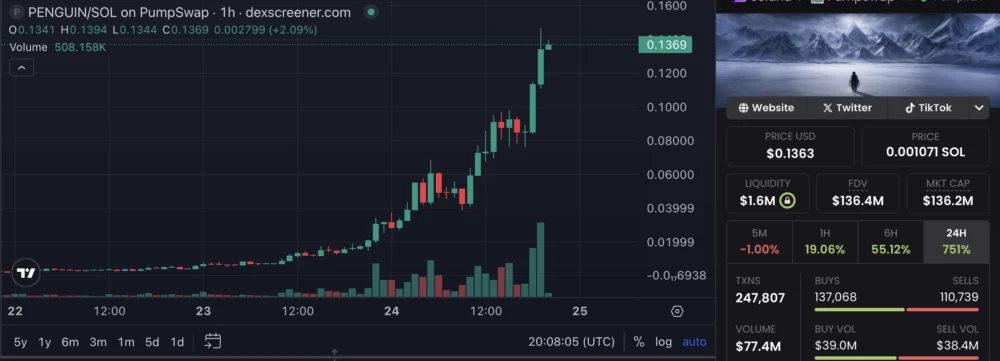
Today’s cryptocurrency landscape presents a fascinating dichotomy, showcasing both the steady march of institutional adoption into digital assets and the persistent, often unpredictable, volatility driven by speculative forces and social media trends. While Colombia’s second-largest private pension fund, AFP Protección, makes significant strides by announcing plans for a Bitcoin-exposed investment fund, signaling increasing legitimacy for crypto in traditional finance, the US market sees spot Bitcoin ETFs extending a notable outflow streak. Simultaneously, the highly speculative memecoin sector witnessed an astonishing surge in PENGUIN, fueled by a seemingly innocuous White House social media post, reminding investors of the market’s enduring appetite for high-risk, high-reward plays. These contrasting narratives underscore the complex and multi-faceted nature of the crypto economy, where long-term investment strategies intersect with short-term speculative frenzies, all while the asset class continues its journey toward broader mainstream integration.
Colombia’s Second-Largest Pension Fund to Offer Bitcoin Exposure: A Landmark Move for Institutional Adoption
In a significant development for the burgeoning institutional acceptance of digital assets, AFP Protección, Colombia’s second-largest private pension and severance fund manager, has confirmed its intention to launch an investment fund offering exposure to Bitcoin. This strategic move is not merely an isolated incident but rather a powerful indicator of the growing confidence among traditional financial institutions in the long-term viability and diversification benefits of cryptocurrencies. With substantial assets under management and serving a vast number of Colombian citizens, Protección’s foray into Bitcoin marks a pivotal moment, potentially influencing other pension funds across Latin America and beyond.
Juan David Correa, president of Protección SA, articulated the rationale behind this initiative during an interview with local outlet Valora Analitik, emphasizing the paramount importance of diversification within investment portfolios. He clarified that access to this pioneering product would be carefully managed, necessitating a personalized advisory process. This rigorous approach is designed to thoroughly assess each investor’s unique risk profile, ensuring that only clients who meet specific, predetermined criteria will be able to allocate a portion of their hard-earned savings to Bitcoin (BTC). This cautious and controlled entry reflects a responsible approach to introducing a volatile asset class into pension funds, prioritizing member protection while still offering exposure to a new growth frontier. The exact nature of this "exposure" – whether through direct Bitcoin holdings, regulated Bitcoin ETFs, or other crypto-linked financial instruments – remains a detail to be further elucidated, but the commitment to the asset class is clear.
Protección’s decision follows a similar, trailblazing step taken by Skandia Administradora de Fondos de Pensiones y Cesantías, which began offering Bitcoin exposure within one of its portfolios in September of the previous year. This establishes a clear trend within Colombia’s pension sector, positioning the nation as a progressive leader in integrating digital assets into traditional retirement planning. The fact that two major pension fund administrators in Colombia are now venturing into the digital asset space suggests a deeper, underlying shift in how these institutions perceive and evaluate Bitcoin. It speaks to a recognition of Bitcoin’s potential as a hedge against inflation, a store of value, and a source of uncorrelated returns – attributes that are particularly attractive for long-term investment vehicles like pension funds.

The implications of Protección’s move extend far beyond Colombia’s borders. It sends a strong signal to regulatory bodies and financial institutions worldwide, particularly in emerging markets, that Bitcoin is increasingly being considered a legitimate, albeit carefully managed, component of a diversified investment strategy. As more pension funds explore similar avenues, it could accelerate the development of clearer regulatory frameworks, sophisticated risk management tools, and enhanced educational resources for both advisors and clients. This institutional embrace helps to de-risk and normalize Bitcoin in the eyes of the broader public, bridging the gap between the nascent crypto economy and established financial systems. However, challenges remain, including navigating Bitcoin’s inherent price volatility, ensuring robust security measures, and continually educating both advisors and beneficiaries on the nuances of digital asset investing. Nevertheless, Protección’s bold step represents a significant stride towards the mainstream adoption of Bitcoin as a foundational element in future financial planning.
US Bitcoin ETFs Bleed $1.72B in Five-Day Outflow Streak: A Market Correction Amidst Shifting Sentiment
While institutional adoption makes headlines in Colombia, the United States spot Bitcoin Exchange-Traded Funds (ETFs) have experienced a notable downturn, extending their outflow streak to five consecutive days. This period saw approximately $1.72 billion exit these investment vehicles, prompting discussions about the current state of crypto market sentiment and the factors influencing investor behavior. This recent trend contrasts sharply with the initial fervor and record inflows observed immediately following the groundbreaking launch of these ETFs, underscoring the dynamic and often volatile nature of the cryptocurrency market.
On Friday alone, US-based spot Bitcoin ETFs recorded $103.5 million in net outflows, continuing a pattern that began the previous Friday. Over the five-day period, which included a four-day trading week in the US due to the Martin Luther King Jr. Day holiday, the total cumulative outflows reached a substantial $1.72 billion, according to data compiled by Farside. This sustained withdrawal of capital from what were initially hailed as game-changing investment products has naturally drawn scrutiny from market analysts and investors alike.
Several factors are likely contributing to this outflow streak. One significant driver is almost certainly profit-taking. Bitcoin experienced a remarkable rally leading up to and immediately following the ETF launches, pushing its price to significant highs. Many early investors and those who bought into the initial ETF excitement might now be cashing out to realize gains, especially if they perceive the market as entering a period of consolidation or correction. Another major contributing factor, widely acknowledged in previous outflow periods, is the Grayscale Bitcoin Trust (GBTC). As GBTC transitioned from a trust to an ETF, it unlocked significant arbitrage opportunities and allowed investors who had previously been locked in with high fees to exit. Furthermore, outflows from GBTC have been linked to bankruptcy proceedings involving entities like Genesis and FTX, which are liquidating assets, including GBTC shares, to repay creditors. This forced selling can exert downward pressure on overall ETF flows and the spot price of Bitcoin.
Beyond these specific mechanics, broader macroeconomic concerns and a general "waning crypto market sentiment" also play a role. Uncertainty surrounding global economic conditions, interest rate policies, and geopolitical events can prompt investors to de-risk their portfolios, leading to withdrawals from more volatile assets like Bitcoin. The spot price of Bitcoin, currently hovering around $89,160 at the time of publication, has not breached the psychologically significant $100,000 price level since November 13th, according to CoinMarketCap. This inability to reclaim higher price points may contribute to a perception of stalled momentum, further encouraging outflows. While these outflows represent a temporary setback for the ETF market, they are also a natural part of market cycles, indicating a period of adjustment after a significant run-up. The long-term impact of spot Bitcoin ETFs on market liquidity, price discovery, and institutional participation is still expected to be profoundly positive, even amidst these short-term fluctuations.

PENGUIN Memecoin Surges 564%, Traders Attribute It to White House Social Media Post: The Wild West of Speculation
In stark contrast to the institutional moves and market corrections seen elsewhere, the highly speculative memecoin sector delivered another reminder of its unpredictable nature, with the Nietzschean Penguin (PENGUIN) memecoin experiencing an astronomical surge of approximately 564% in just 24 hours. This extraordinary spike was widely attributed by traders to a viral social media post from the United States White House, highlighting the potent and often irrational influence of internet culture and public figures on the valuations of these community-driven digital assets.
Memecoins, characterized by their often whimsical origins, lack of intrinsic utility, and reliance on community sentiment and virality, represent the more speculative frontier of the cryptocurrency market. They are highly susceptible to sudden pumps and dumps, driven by social media trends, celebrity endorsements, or even seemingly unrelated public commentary. In this instance, the catalyst was a post on the White House X (formerly Twitter) account. The post featured a curious image of former US President Donald Trump alongside a penguin, holding hands and walking through a snowy landscape, accompanied by the concise and cryptic message: "Embrace the penguin."
While the actual intent behind the White House post remains unknown – it could have been an internal meme, a cultural reference, or even an accidental upload – the crypto community swiftly interpreted it as a signal, a digital endorsement for anything penguin-related. The market’s response was immediate and dramatic. Prior to the White House post, PENGUIN traded with a modest market capitalization of about $387,000, according to SolanaFloor. Following the viral tweet, its value skyrocketed, pushing its market capitalization to over $135 million, with its price reaching approximately $0.13, as data from DEXScreener vividly illustrates. This meteoric rise exemplifies the power of collective belief and viral marketing in the memecoin space, where perception often trumps fundamental value.
However, such explosive growth in memecoins is invariably accompanied by extreme risks. The surge in PENGUIN follows what has been a challenging period for many memecoins in recent times, often marked by significant downturns. For instance, the past year saw the implosion in value of a token endorsed by Argentina’s President Javier Milei and another memecoin reportedly linked to former US President Donald Trump, both of which collapsed within days of their respective launches. These cautionary tales underscore the inherent volatility and lack of sustainability often associated with memecoins, which are prone to pump-and-dump schemes and rapid losses of investor capital. While the "Nietzschean" aspect of PENGUIN’s name might suggest a philosophical depth, in the context of memecoins, it is more likely an ironic or whimsical nod, rather than an indicator of any underlying project utility or robust tokenomics. Investors venturing into this segment of the market are consistently reminded that these are highly speculative assets, where capital can be lost as quickly as it is gained, making thorough due diligence and a clear understanding of the associated risks absolutely paramount.
In summary, today’s crypto news paints a comprehensive picture of a market in constant flux. The measured and strategic entry of AFP Protección into Bitcoin exposure highlights a growing maturity and institutional confidence in digital assets as a legitimate component of long-term financial planning. Conversely, the outflows from US Bitcoin ETFs suggest a period of market correction and profit-taking, underscoring the cyclical nature of asset markets. Finally, the dramatic surge of the PENGUIN memecoin, driven by a viral social media post, serves as a stark reminder of the highly speculative, often irrational, yet undeniably captivating segment of the crypto world. These disparate events collectively underscore the multifaceted evolution of cryptocurrency, where robust financial innovation coexists with the unpredictable dynamics of retail speculation, all contributing to its ongoing, complex journey toward global integration and mainstream acceptance. For all participants, from pension fund managers to individual memecoin traders, navigating this dynamic landscape requires a blend of foresight, caution, and a keen understanding of both fundamental shifts and fleeting trends.