anjir abdul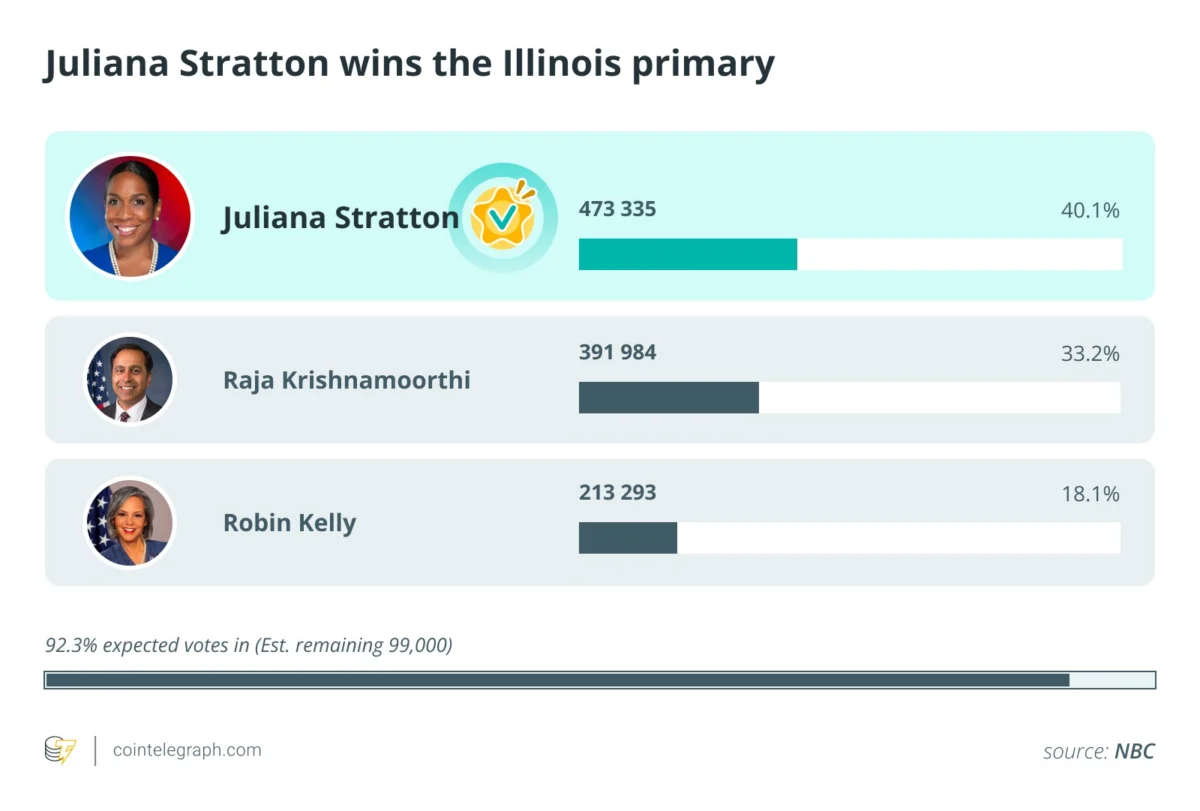
On Tuesday, March 17, 2026, Lieutenant Governor Juliana Stratton emerged victorious in the Democratic primary for a rare open US Senate seat in Illinois. This victory positions her as the strong favorite to win the general election and succeed the retiring Democratic stalwart, Senator Dick Durbin, marking a significant shift in the state’s political landscape. Stratton, a prominent figure in Illinois politics, overcame two formidable opponents: Representative Raja Krishnamoorthi, who currently represents Illinois’ 8th Congressional district, and Representative Robin Kelly from Illinois’ 2nd. Her win was a testament to a robust progressive campaign and a strategic advantage in framing her opponents’ financial backing.
The narrative surrounding Krishnamoorthi’s campaign was heavily influenced by the substantial financial support he received from the cryptocurrency industry. PACs like Fairshake and Protect Progress poured millions into the Illinois primary, primarily in support of Krishnamoorthi. These groups, fueled by a desire to secure crypto-friendly voices in Washington, saw Krishnamoorthi as an ideal candidate due to his established legislative record. He had been a vocal proponent of digital asset innovation, notably supporting the GENIUS Act, which aimed to provide favorable regulations for stablecoins. Furthermore, he voted in favor of the CLARITY Act and the Financial Innovation and Technology for the 21st Century (FIT21) Act, key pieces of legislation designed to bring regulatory clarity to the crypto space. His consistent advocacy earned him an "A" rating from Stand With Crypto, a leading cryptocurrency advocacy organization that tracks politicians’ legislative stances and attitudes toward the industry. For the crypto lobby, securing a seat for a candidate like Krishnamoorthi was seen as crucial for advancing their agenda in the Senate, especially as the CLARITY Act continued its journey through Congress.
However, what the crypto industry intended as a powerful endorsement ultimately became a potent weapon for Stratton’s campaign. In the months leading up to the primary, Stratton distinguished herself with a staunchly progressive platform. She openly opposed former US President Donald Trump and his policies, took a firm stance against Immigration and Customs Enforcement (ICE)—a position unique among the primary candidates, according to the Chicago Sun-Times—and advocated for a higher minimum wage than either Krishnamoorthi or Kelly. As the primary race intensified, Stratton’s campaign shrewdly pivoted to highlight the source of her opponent’s funding.
In the final weeks of the election, Stratton directly attacked Krishnamoorthi’s crypto backing. The Chicago Sun-Times estimated that Fairshake alone spent over $8 million in the race. Stratton’s campaign drew a direct line between these crypto dollars and the controversial "MAGA" movement associated with Donald Trump. In a March 3 video posted to X (formerly Twitter), Stratton declared that Krishnamoorthi was "relying on his Trump-aligned allies" to undermine her with millions in attack ads. "His MAGA-backed crypto bros are dumping $7 million into this race to try to stop me. Illinoisans aren’t buying it," she asserted, tapping into a deep vein of anti-Trump sentiment prevalent among Democratic voters in Illinois.
This connection of the crypto industry with Trump and the broader Republican party is not without basis. Marc Andreesen, a co-founder and major donor to Fairshake, has publicly expressed his support for Trump and stated his intention to vote for him in 2024. Trump himself, along with members of his family, has been involved in various crypto investment schemes, further solidifying the perception of an alliance. While Fairshake technically operates as a non-partisan PAC, its expenditure data, as tracked by Open Secrets, reveals a clear lean: approximately 62% of its funds have gone to support Republican candidates and oppose Democrats, while only 37% have supported Democrats and opposed Republicans. This spending pattern, combined with the public statements of its key backers, made it easy for Stratton to paint the crypto lobby as a right-leaning, pro-Trump force.

The "MAGA-backed crypto bros" narrative resonated strongly with Illinois voters and even drew criticism from other prominent state officials. Senator Tammy Duckworth, a fellow Democrat from Illinois, publicly expressed concerns that Krishnamoorthi could be "compromised" by industry interests, an accusation the representative vehemently denied. The political environment in Illinois, a solidly blue state with a strong progressive base, proved inhospitable to a candidate perceived as financially beholden to a Republican-aligned industry. While a 2025 poll had indicated that Illinois voters generally held favorable opinions about cryptocurrencies, it also revealed a significant caveat: many supported restrictions. Specifically, 47% of Democratic voters expressed support for "policies restricting the growth of cryptocurrency and blockchain technology," and overall, 36% of Illinois voters stated they "would be more likely to support elected officials who support restrictions on cryptocurrency and blockchain technology." This nuanced public opinion provided fertile ground for Stratton’s anti-crypto-lobby messaging.
The counter-argument regarding Stratton’s own financial backing, specifically significant donations from current Illinois Governor JB Pritzker, failed to gain traction. As one Chicago voter explained to The Washington Post, distinguishing between a governor supporting his own lieutenant governor and "billionaires supporting Raja" was a "nonissue." The public perceived a fundamental difference in the nature and intent of the financial support, favoring the established political ties within the state over outside industry influence.
The Illinois primary serves as a crucial test case for the crypto lobby’s strategy as the 2026 midterms approach. The industry has amassed massive war chests; Fairshake alone reported $190 million in cash on hand at the end of 2025, with $131 million raised in the latter half of the year. This financial firepower is intended to shape election outcomes across the country. However, the Illinois results highlight the potential for significant backlash. Lawmakers and activists are increasingly concerned about the "undue influence" this level of spending could exert on the democratic process. Senator Elizabeth Warren, a noted skeptic of the crypto industry, had explicitly framed the Illinois primary as "the test case for whether or not they can buy whatever candidate they want for Senate in Illinois and many of the congressional seats." Saurav Ghosh, director of the Campaign Legal Center, echoed these concerns, telling Cointelegraph that "this kind of influence buying ultimately undermines the democratic process by marginalizing everyday Americans, ensuring that their voices and interests take a backseat to the crypto industry’s deregulatory desires."
The increasing association of crypto with "MAGA" and Trump could prove particularly problematic for the industry’s long-term influence in Washington. Donald Trump currently holds negative approval ratings in the vast majority of US states, and Republicans generally face predominant disapproval in national polls. If crypto becomes synonymous with a partisan Republican economic agenda, it risks alienating a broad swath of the electorate and limiting its appeal across the political spectrum. Political operatives have long advised industries seeking influence to maintain a bipartisan approach. Democratic Representative Sam Liccardo warned Politico last year, "I don’t think anybody in this town would recommend that an industry put their eggs in one party’s basket."
Indeed, there remains a significant number of Democrats in Congress who are either pro-crypto or, at the very least, open to the blockchain industry’s potential. Marta Belcher, chair of the Filecoin Foundation, emphasized this point, stating, "Many policymakers on both sides of the aisle support crypto. I don’t think crypto is a partisan issue, just like ‘the internet’ isn’t a partisan issue. I don’t think, in 2025, either party can be ‘anti’ an entire technology if they’re thinking seriously about America’s future."
The Illinois primary, therefore, stands as a critical lesson. While financial backing is undoubtedly powerful, the source and perceived political alignment of that money can carry significant weight, particularly in ideologically charged races. For the crypto industry, the challenge now is to navigate the complex political landscape, demonstrating its broader appeal and commitment to bipartisan engagement, rather than risking further alienation by being branded as a partisan, "MAGA-backed" special interest. The midterms will reveal whether this message has been heeded.