anjir abdul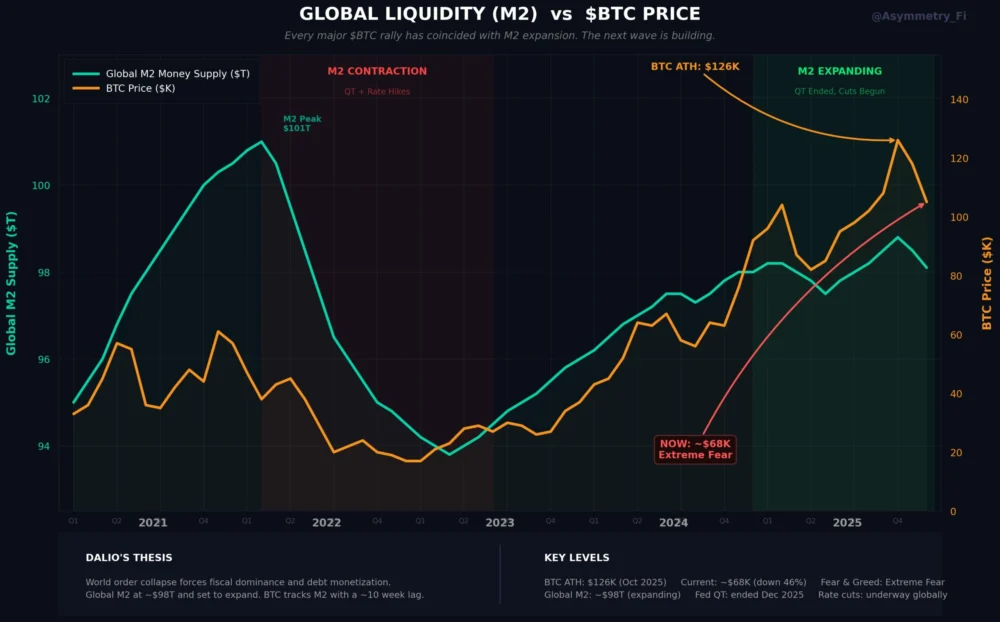
Ray Dalio, the esteemed founder of Bridgewater Associates and one of the most respected voices in macroeconomics, has issued a stark warning: the post-World War II global order has "officially broken down," plunging the world into what he unreservedly terms a "law of the jungle" phase. In this new era, outcomes are dictated not by established rules and international norms, but by raw power dynamics. Against this backdrop of escalating geopolitical and economic instability, proponents of cryptocurrencies are seizing the moment to forcefully renew the case for assets explicitly designed to operate beyond the reach and control of state authorities. This profound shift, Dalio argues, casts a blinding spotlight on the inherent value and necessity of permissionless money like Bitcoin and gold, positioning them as critical hedges in an increasingly fragmented and unpredictable world.
In his latest extensive article, widely shared on platforms like X, Dalio meticulously dissects the multifaceted nature of this unfolding disorder, identifying both acute internal and external pressures. On the international stage, he posits that great powers are now ensnared in a persistent "prisoner’s dilemma." This strategic predicament forces nations into a constant state of escalation across critical domains – trade, technology, capital flows, and alarmingly, military flashpoints – lest they be perceived as weak. The consequence is a perilous environment where what Dalio describes as "stupid wars" become frighteningly easy to trigger, carrying immense human and economic costs, and fundamentally altering the landscape of global trust and cooperation. The implications for international trade, supply chains, and the stability of traditional financial instruments are nothing short of seismic. As alliances fray and rivalries intensify, the very foundations of the multilateral system are under unprecedented strain, compelling investors and ordinary citizens alike to seek sanctuary in assets that transcend national borders and political whims.
This external geopolitical turbulence, Dalio observes, invariably collides with severe internal stresses within nations. When economies grapple with significant strain, characterized by slowing growth, rising debt, and widening wealth gaps, governments reliably resort to two primary mechanisms to manage the crisis: higher taxes and "big increases in the supply of money." The latter, a euphemism for quantitative easing and monetary expansion, effectively devalues existing claims and savings rather than pushing explicit defaults, which are politically unpalatable. This insidious form of financial repression erodes purchasing power and disproportionately impacts those holding traditional, state-issued currencies. It’s a subtle but potent confiscation of wealth, pushing individuals and institutions to seek refuge in assets that cannot be debased or inflated away at the stroke of a central bank’s pen.

This toxic combination of external disorder and internal financial repression creates precisely the environment in which apolitical assets, particularly Bitcoin (BTC) and gold, have historically thrived. The pitch from crypto advocates is compellingly straightforward: as governments increasingly lean on coercive measures such as sanctions, asset freezes, and the incessant creation of new money, the demand for assets that can be held, transferred, and transacted without reliance on a centralized bank or a state-backed payments system will inevitably surge. Bitcoin, with its decentralized network, fixed supply, and censorship-resistant properties, presents itself as a digital gold, offering a modern, programmable alternative to traditional safe havens. Gold, with its millennia-long history as a store of value, continues to serve as a physical bulwark against monetary debasement and geopolitical uncertainty. Both offer a crucial escape valve from the vulnerabilities inherent in state-controlled financial systems.
Liquidity Data Fuels Hard Assets’ Ascent
The macro environment provides robust data to support the growing appeal of hard, permissionless assets. Analysis from Econovis vividly illustrates the dramatic expansion of global broad money supply. Their data indicates a staggering climb from approximately $26 trillion in 2000 to an estimated $142 trillion in 2025. This exponential growth in global liquidity highlights the relentless trend of monetary expansion by central banks worldwide, directly correlating with Dalio’s observation of governments resorting to "big increases in the supply of money." Such an environment inherently favors assets with scarce or fixed supplies, as their value tends to appreciate relative to the depreciating purchasing power of rapidly expanding fiat currencies.
This surge in global liquidity has a discernible impact on the valuations of permissionless assets. According to insights from ex-fund manager Asymmetry, a keen observer of macro trends, every major Bitcoin rally in its relatively short history has coincided with significant expansions in the M2 money supply. Their analysis suggests that "the next wave is building," implying that the current trajectory of monetary expansion is setting the stage for further appreciation in Bitcoin’s value. The correlation is not coincidental; as more fiat money chases a finite supply of Bitcoin, its price naturally rises. This dynamic underscores Bitcoin’s role as a direct beneficiary of quantitative easing and a hedge against the inflationary consequences of excessive money printing.

Similarly, gold prices have consistently tracked the expansion of the US M2 money supply over decades. This long-standing correlation firmly cements the precious metal’s status as a traditional and reliable hedge against monetary expansion and currency debasement. The historical performance of gold demonstrates its enduring appeal during periods of economic uncertainty and inflationary pressures, serving as a tangible store of wealth when confidence in fiat currencies wanes. The confluence of these trends—global broad money supply growth, M2 expansion, and the corresponding price movements of Bitcoin and gold—paints a clear picture: the macroeconomic forces unleashed by a fracturing world order are creating an unprecedentedly bullish backdrop for assets that offer protection from state-driven financial manipulation.
A Bull Case for Neutral Money in a Fractured World
Dalio’s comprehensive framework also meticulously details how states routinely employ asset freezes, capital market bans, and embargoes as standard tools of foreign policy and economic warfare. These tactics starkly reveal the profound dependency of traditional savings and payments on political discretion and jurisdictional risk. An individual’s or entity’s wealth, held within the conventional financial system, can be frozen, seized, or rendered inaccessible at the whim of a government, often with little recourse. This inherent vulnerability places the case for an apolitical, borderless, and censorship-resistant money squarely at the forefront of global financial discourse. The ability to hold and transfer value without permission, free from the threat of governmental intervention, becomes not just a convenience but a strategic imperative.
The crypto community has keenly absorbed Dalio’s warnings, recognizing the profound implications for their foundational thesis. Hunter Horsley, CEO of Bitwise, eloquently captured this sentiment in a widely shared comment, posing the rhetorical yet poignant question: "Is anyone working on global, permissionless, apolitical monetary assets and financial rails?? Could be important." His statement perfectly encapsulates the urgent need for alternative financial infrastructure in a world where traditional systems are increasingly weaponized. It highlights the core value proposition of cryptocurrencies like Bitcoin, which are designed precisely to fulfill this role as neutral, permissionless financial rails.

Asymmetry, from a portfolio construction perspective, further articulates this bullish outlook. They contend that the confluence of factors described by Dalio—a fracturing world order overlaid with what astute macro analysts such as Lyn Alden or Luke Gromen term "fiscal dominance"—creates one of the "most structurally bullish backdrops for hard assets in 80 years." Fiscal dominance refers to a scenario where government borrowing needs and fiscal policy effectively dictate central bank policy, forcing monetary authorities to keep interest rates low or engage in quantitative easing to facilitate government debt financing. This dynamic further entrenches the inflationary pressures and monetary debasement that permissionless assets are designed to counteract. In such an environment, the appeal of assets immune to political maneuvering and arbitrary seizure becomes overwhelmingly strong, offering a crucial layer of financial sovereignty to individuals and institutions alike.
However, it is crucial to temper this optimism with a clear understanding: Dalio’s warning, while profoundly insightful and highly relevant, is not a direct, explicit forecast for Bitcoin’s price trajectory. The investment case for cryptocurrencies remains sensitive to a complex array of factors, including prevailing interest rates, evolving regulatory frameworks, overall market liquidity, and the broader risk appetite among investors. Bitcoin, despite its resilience, is not immune to these forces, and its path forward will undoubtedly involve volatility. What Dalio’s latest comments unequivocally provide, however, is a clear, compelling macro narrative. This narrative, centered on global fragmentation, monetary debasement, and the weaponization of finance, is being powerfully leveraged by many within the crypto market to argue that the fundamental demand for "neutral money"—money that stands apart from state control and political influence—is poised to increase dramatically as the world continues its inexorable slide into a more fractured and uncertain geopolitical landscape. The demand for financial autonomy and censorship resistance is no longer a niche concern but a burgeoning global imperative, making permissionless money a central feature of the coming financial paradigm.