Faris Adani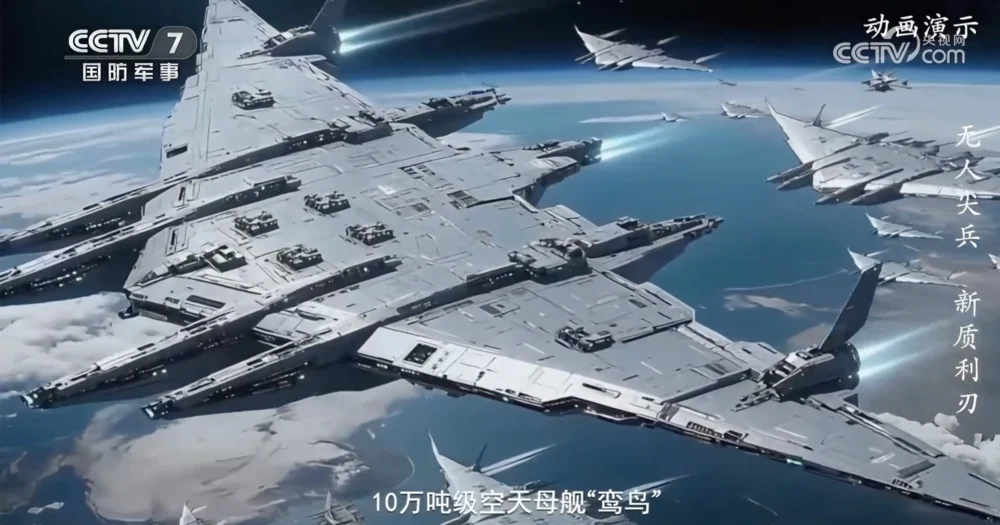
China Unveils Audacious Vision for a Colossal Orbital Aircraft Carrier, Signaling a New Era in Space Power Projection.
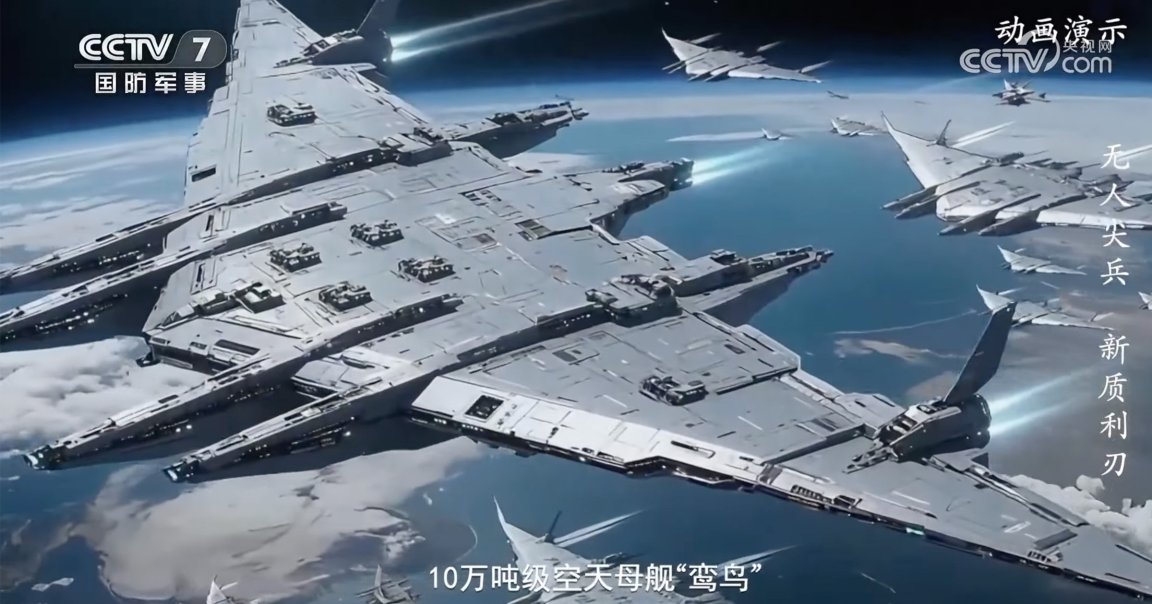
In a striking demonstration of its burgeoning technological ambitions, a China Central Television YouTube channel recently offered a tantalizing glimpse into the nation’s advanced — and often speculative — aerospace developments. While the presentation featured an array of conventional autonomous aerial vehicles, such as the formidable Wing Loong II Long Range Drone and the innovative Lanying R6000 Tiltrotor, which themselves represent significant strides for a nation that has rapidly transformed from a semi-feudal society to a global technological powerhouse within a century, it was a particular conceptual spacecraft that truly captured international attention. This groundbreaking revelation focused on the Luan Niao, an envisioned orbital mothership designed with the unprecedented capability to deploy uncrewed fighter drones and “hyper-ballistic missiles” from the strategic vantage point of low Earth orbit, essentially the very edge of space. This concept pushes the boundaries of conventional military thought, suggesting a future where global power projection could emanate from above the atmosphere.
The Luan Niao concept, whose name translates to “mythical bird” or “phoenix,” is not merely an incremental advancement but a monumental leap in aerospace engineering and strategic thinking. According to detailed design specifications reported by The Telegraph, this behemoth spacecraft would stretch nearly 800 feet from nose to tail, boasting an astonishing wingspan of approximately 2,244 feet. To put this into perspective, it would dwarf any aircraft carrier currently in service on Earth’s oceans, making it a true titan of the cosmos. Such immense dimensions would translate into an estimated operational weight of 120,000 tons, a mass that presents colossal challenges for launch and orbital maneuvering. Its primary payload would consist of a fleet of 88 “Xuan Nu” autonomous fighter drones, designed to operate in the extreme conditions of the upper limits of the stratosphere, alongside an unspecified number of hyper-ballistic missiles. This dual capability suggests a system designed for both atmospheric and potentially sub-orbital offensive operations, granting unprecedented reach and speed.
The Xuan Nu fighters themselves are equally conceptual, representing a hypothetical 6th-generation jet aircraft. These unmanned aerial vehicles (UAVs) are depicted as sleek, advanced craft, showcased at various tech exhibitions to ignite public interest and inspire future generations to pursue careers in engineering and science. While the Luan Niao concept has roots tracing back a full decade, and the Xuan Nu fighter idea has been circulating at aerospace trade shows since at least 2019, their recent revival as audacious 3D renders signals a coordinated strategic push. This initiative, dubbed the “South Heaven Gate Project,” aims to unify China’s vast aerospace and defense sectors around a common, albeit extraordinarily ambitious and “far-fetched,” long-term objective. The project’s announcement by state media immediately sparked a flurry of enthusiastic responses from Chinese netizens, including the proliferation of fictional stories envisioning a near future where the People’s Republic of China commands a formidable fleet of Luan Niao carriers circling the globe, underscoring the powerful cultural and nationalistic appeal of such grand visions.
Should the Luan Niao ever transition from conceptual design to tangible reality, its strategic implications would be profound. Peter Layton, a distinguished defense expert and fellow at Australia’s Griffith Asia Institute, articulated this impact to The Telegraph, stating unequivocally that such a craft would “outclass pretty much everyone.” Layton elaborated on the transformative advantages the Luan Niao would confer upon China’s military. An orbital mothership positioned at the edge of space would grant China the unprecedented ability to deploy military assets with unparalleled global reach, targeting virtually any point on Earth. Furthermore, operating in orbit provides inherent operational advantages: “You’re also out of range of the weather, generally speaking – and you’re out of range of most defensive systems.” This statement highlights the strategic invulnerability and operational flexibility that space-based platforms offer, bypassing terrestrial atmospheric disturbances and largely circumventing existing anti-aircraft or missile defense networks. The sheer altitude and velocity of deployment from orbit would drastically reduce response times for any engagement, fundamentally altering the calculus of global power projection and potentially rendering traditional defense doctrines obsolete.
However, the journey from audacious concept to operational reality is fraught with immense, perhaps insurmountable, engineering and logistical hurdles. The most immediate and staggering challenge lies in the “tremendous energy required to launch a 120,000-ton craft” into orbit. Current rocket technology, even the most powerful heavy-lift launchers, is designed for payloads measured in tens of tons, not hundreds of thousands. Achieving the necessary lift capacity for the Luan Niao would necessitate breakthroughs in propulsion systems far beyond anything currently conceived, possibly involving advanced nuclear propulsion, antimatter drives, or other exotic technologies. Beyond launch, maintaining such a colossal structure in orbit, maneuvering it, and providing power for its operations and its drone fleet would demand revolutionary advancements in materials science, closed-loop life support (if crewed, though drones suggest it may be uncrewed for operations), power generation (potentially large-scale orbital solar arrays or compact fusion reactors), and autonomous systems for drone deployment and retrieval. The structural integrity required to withstand launch stresses and orbital dynamics for a craft of its proposed dimensions also presents unprecedented material science challenges.
Despite these monumental obstacles, dismissing the Luan Niao as a mere pipe dream would be premature, given China’s astonishing rapid pace of technological development in recent years. The nation has consistently demonstrated an ability to achieve what once seemed impossible, from constructing massive infrastructure projects at breakneck speed to leading the world in areas like artificial intelligence, quantum computing, and renewable energy. Its space program, once nascent, now regularly sends missions to the Moon and Mars, operates its own Tiangong space station, and is aggressively developing advanced reusable rocket technologies. Furthermore, China’s significant investments in cutting-edge research, including fusion energy and advanced manufacturing, suggest a long-term strategy aimed at overcoming precisely the kind of energy and material constraints that currently render the Luan Niao a “distant fantasy.” What seems impossible today may well be within reach tomorrow, fueled by sustained national commitment and unparalleled resource allocation.
The geopolitical ramifications of a functional Luan Niao fleet would be nothing short of revolutionary. It would fundamentally reshape the global balance of power, granting China an unchallenged strategic advantage in space and, by extension, on Earth. Such a development would inevitably trigger a new and potentially destabilizing space arms race, as other major powers would feel compelled to develop similar capabilities or countermeasures. It would also raise critical questions regarding the militarization of space and the interpretation of international treaties, such as the Outer Space Treaty, which prohibits weapons of mass destruction in orbit but leaves room for conventional military assets. The dual-use nature of many space technologies means that a platform designed for “defense” could easily be perceived as an offensive weapon, leading to increased global tension and the potential for conflict extending into the final frontier. The Luan Niao, therefore, is not just a technological concept; it is a profound statement about China’s long-term strategic vision and its intent to assert dominance across all domains, including the orbital realm.
Ultimately, the Luan Niao and the broader “South Heaven Gate Project” serve as a powerful symbol of China’s aspirational future. While the conceptual renders and the ambitious timelines may appear to belong more to science fiction than immediate reality, they reflect a deep-seated national commitment to technological supremacy and strategic independence. This vision is deeply intertwined with China’s broader space strategy, which encompasses everything from lunar bases and asteroid mining to a robust satellite network and advanced space launch capabilities. By publicly showcasing such a grandiose and technologically challenging concept, China communicates to both its domestic audience and the international community its long-term strategic objectives and its unwavering confidence in its capacity for innovation. The Luan Niao, even as a distant dream, casts a long shadow over the future of space exploration, militarization, and the evolving dynamics of global power, signaling a potential new chapter where the heavens themselves become a stage for geopolitical competition.