anjir abdul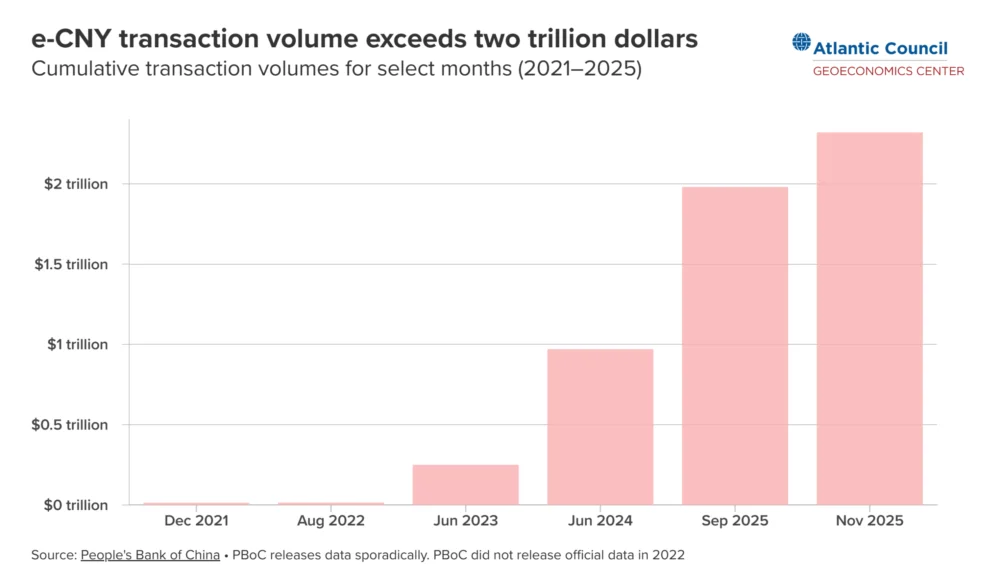
The China-led cross-border digital currency platform, mBridge, has achieved a significant milestone, processing over $55 billion in transactions as global efforts intensify to construct payment infrastructures that operate independently of traditional dollar-based financial systems. This burgeoning platform underscores a pivotal shift in the landscape of international finance, signaling a growing momentum towards sovereign digital currencies and their potential to reshape global trade and settlements.
Project mBridge, a collaborative multi-central bank digital currency (CBDC) platform, has now facilitated more than 4,000 cross-border transactions, culminating in a cumulative value of approximately $55.5 billion. This remarkable figure, meticulously compiled by the Washington-based Atlantic Council, represents an astronomical nearly 2,500-fold increase since the project’s nascent pilot phase in 2022. Such rapid scaling highlights not only the technical robustness of the platform but also the strong political and economic impetus driving its adoption among participating nations. The sheer volume and value of transactions processed in such a short span indicate a successful proof-of-concept for its viability as an alternative or complementary system to existing SWIFT-based mechanisms.
Currently, the platform is undergoing rigorous testing and operational deployment by the central banks of several key economies, including mainland China, Hong Kong, Thailand, the United Arab Emirates, and Saudi Arabia. Notably, China’s digital yuan, or e-CNY, accounts for an estimated 95% of the total settlement volume on mBridge. This dominance underscores Beijing’s strategic intent to internationalize its currency through digital infrastructure, providing a tangible pathway for the e-CNY to gain traction in cross-border trade and investment, even as it navigates the complex global financial architecture traditionally dominated by the U.S. dollar. The involvement of these diverse economies, spanning East Asia, Southeast Asia, and the Middle East, suggests a broad regional interest in exploring more efficient and potentially less geopolitically constrained payment rails.
mBridge’s rapid expansion is intrinsically linked to China’s parallel efforts to scale its domestic CBDC infrastructure. Recent data released by the People’s Bank of China (PBOC) illustrates the colossal growth of the e-CNY within its borders. The digital yuan has processed more than 3.4 billion transactions, with a cumulative value reaching approximately 16.7 trillion yuan, equivalent to about $2.4 trillion. This figure marks an astounding increase of over 800% compared to 2023, showcasing the e-CNY’s accelerating integration into the daily economic fabric of China, from retail payments to wholesale transactions. This domestic success provides a robust foundation and a testing ground for the technology and operational protocols that are subsequently being adapted and deployed in the international mBridge platform.
Further underscoring its evolving role, China’s central bank is introducing a new framework for the digital yuan that will allow commercial banks to pay interest on e-CNY wallet balances. This strategic move is designed to propel the digital yuan beyond its initial function as a mere cash-like payment tool. By enabling interest-bearing capabilities, the PBOC aims to enhance the e-CNY’s appeal as a store of value, encouraging broader adoption and deeper integration into the financial system. According to Lu Lei, Deputy Governor of the People’s Bank of China, this framework will empower commercial banks to incorporate the digital yuan into their asset and liability management, transforming the e-CNY into a "digital deposit currency." This expansion of its utility is crucial for its long-term viability and its role in facilitating value storage and cross-border payments, alongside its existing function in everyday transactions.
This confluence of domestic and international digital currency initiatives points towards a gradual yet determined expansion of the yuan’s internationalization through sophisticated digital infrastructure, as highlighted by Atlantic Council analyst Alisha Chhangani. Chhangani notes that rather than directly confronting the U.S. dollar’s global supremacy, China and its collaborating partners are strategically constructing parallel settlement rails. This approach is designed to incrementally reduce their dependence on existing dollar-centric systems, which can be susceptible to geopolitical pressures and sanctions. The aim is to create a more diversified and resilient global financial network, offering alternatives for nations seeking greater autonomy in their cross-border transactions.

The journey of mBridge, initially known as Project Inthanon-LionRock before evolving into the Multiple CBDC Bridge (mBridge), began under the auspices of the Bank for International Settlements (BIS) Innovation Hub. The BIS, often referred to as the central bank of central banks, played a crucial role in the early development and conceptualization of this platform, fostering collaboration among participating central banks. However, in 2024, the BIS announced its decision to step back from mBridge, describing the move as a "graduation" rather than a direct withdrawal. This characterization aimed to convey that the project had matured sufficiently to proceed independently under the stewardship of its central bank participants.
Despite the BIS’s framing, the timing of its "graduation" coincided with heightened international scrutiny and debate surrounding mBridge’s potential geopolitical implications, particularly concerning sanctions evasion. Agustín Carstens, General Manager of the BIS, made concerted efforts to distance the institution from speculation that mBridge could be leveraged by BRICS nations (Brazil, Russia, India, China, South Africa, and now others) to circumvent international sanctions. Carstens explicitly stated that "mBridge is not the BRICS bridge" and emphasized that BIS systems are not accessible to sanctioned countries. Nevertheless, the significant overlap between mBridge participants and BRICS members, combined with the stated goal of creating alternative payment systems, continued to fuel discussions about the project’s strategic objectives and its role in a fracturing global financial order. The move by BIS was seen by many as a careful geopolitical maneuver to maintain neutrality while still supporting innovation in digital payments.
Following its departure from mBridge, the BIS has strategically redirected its focus and resources towards Project Agorá, a distinct initiative involving several major Western central banks. Project Agorá, which recently announced expanded testing, aims to explore the tokenization of wholesale central bank money and commercial bank deposits for cross-border payments, with an emphasis on regulatory compliance and collaboration within established financial frameworks. This shift by the BIS highlights a divergence in approaches to cross-border CBDC development, with mBridge representing a more regionally focused, potentially challenger system, and Project Agorá aiming for broader integration within existing Western-aligned financial structures.
The broader global landscape of CBDCs is characterized by intense exploration and development. Numerous countries, including those in the European Union with the Digital Euro project, India with its e-Rupee, and many others, are actively researching or piloting their own central bank digital currencies. The challenges associated with cross-border CBDC interoperability are significant, encompassing issues such as regulatory harmonization, robust cybersecurity, data privacy, and the seamless integration of diverse national payment systems. However, the potential benefits, including increased efficiency, reduced transaction costs, enhanced transparency, and improved financial inclusion, continue to drive this global push.
mBridge’s success thus far positions it as a significant player in the evolving global financial architecture. Its growth signals a future where multiple, interoperable digital payment systems could coexist, offering diverse options for international trade and finance. While it may not directly dismantle the U.S. dollar’s dominance in the immediate future, mBridge undeniably contributes to building a more multipolar financial world, where nations have greater choice and resilience in their cross-border payment mechanisms. The project’s continued development and the strategic decisions made by its participants will undoubtedly have profound implications for global financial power dynamics and the future of international economic relations. The ongoing narrative surrounding mBridge underscores the intricate interplay of technological innovation, economic strategy, and geopolitical ambition in the quest to redefine the future of money.