Imroatul Nasiyah
In a groundbreaking stride toward realizing this ambitious vision, a team of physicists at the California Institute of Technology (Caltech) has achieved a monumental feat: the creation of the largest neutral-atom qubit array ever assembled, comprising an astonishing 6,100 qubits meticulously trapped in a precise grid by an intricate network of lasers. This remarkable achievement shatters previous benchmarks, as prior arrays of this type typically contained only a few hundred qubits, underscoring the rapid progress in scaling up neutral-atom quantum computing technology. This significant milestone arrives amidst a fiercely competitive global race to develop increasingly powerful and scalable quantum computers, with diverse technological approaches vying for dominance. Alongside superconducting circuits and trapped ions, neutral-atom platforms have emerged as a particularly promising avenue, and the Caltech team’s work significantly bolsters their prospects.
"This is an exciting moment for neutral-atom quantum computing," exclaims Manuel Endres, a distinguished professor of physics at Caltech and the principal investigator of the research. "We can now clearly see a viable pathway toward building large, error-corrected quantum computers. The essential building blocks are definitively in place." The groundbreaking research, detailing this pivotal advancement, was published on September 24th in the prestigious scientific journal Nature. The study was spearheaded by three talented Caltech graduate students: Hannah Manetsch, Gyohei Nomura, and Elie Bataille, who demonstrated exceptional leadership and scientific acumen.
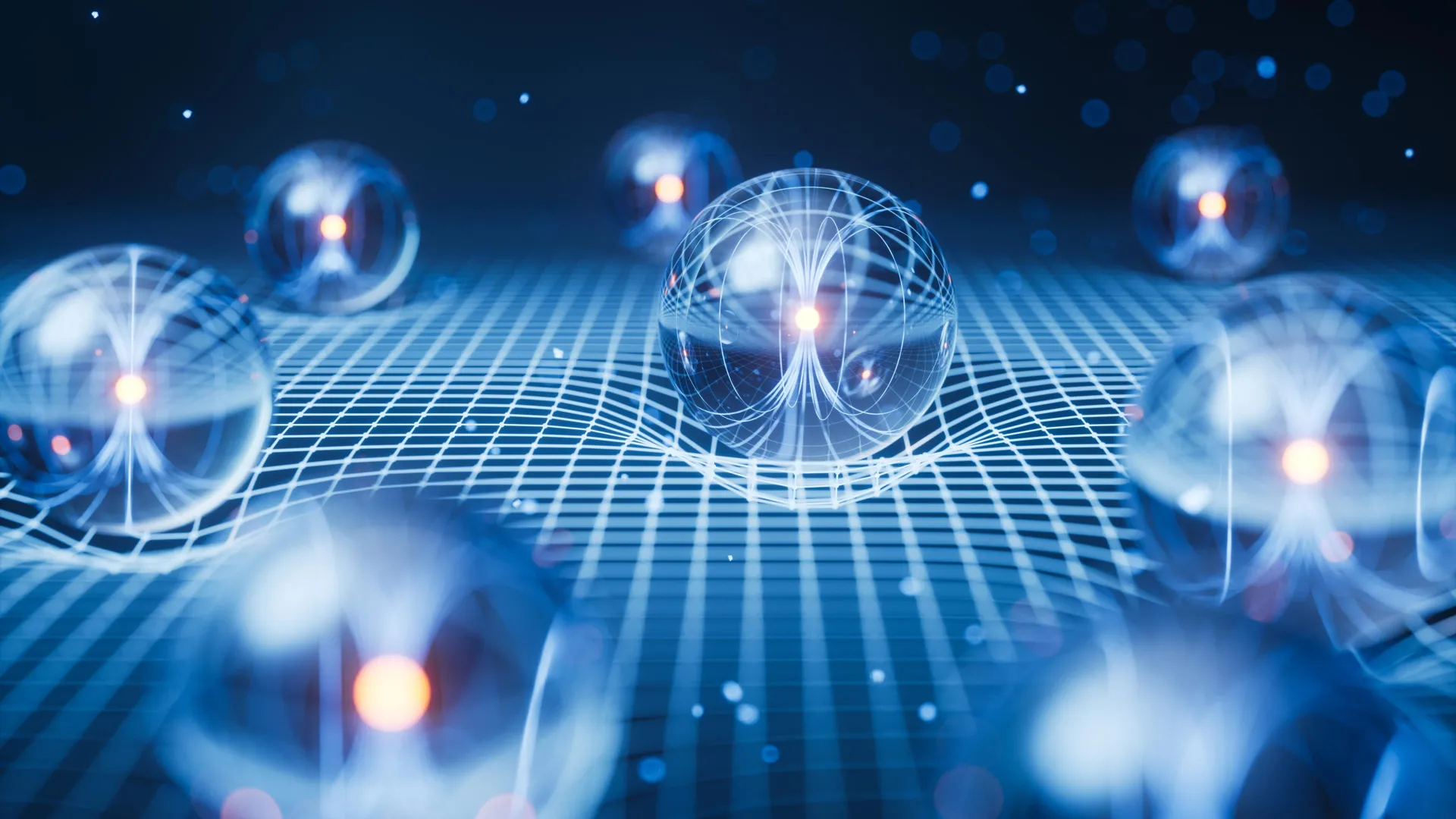
The innovative approach employed by the Caltech team involves the ingenious use of optical tweezers – highly focused laser beams capable of exerting precise forces – to trap thousands of individual cesium atoms within a carefully constructed grid. To achieve the unprecedented scale of 6,100 qubits, the researchers meticulously engineered a complex system by splitting a single laser beam into an astonishing 12,000 individual optical tweezers. These precisely positioned tweezers collectively held the 6,100 cesium atoms in a highly controlled vacuum chamber, creating an exquisitely arranged quantum register. "On the screen, we can actually see each individual qubit as a distinct pinpoint of light," shares Manetsch, vividly describing the visual spectacle of this quantum hardware at such a grand scale. "It’s a truly striking image, representing quantum hardware at an unprecedented scale."
A critical aspect of this breakthrough lies not only in the sheer number of qubits but also in the remarkable quality maintained at this expanded scale. The team successfully demonstrated that increasing the number of qubits did not come at the expense of their coherence or controllability. Even with over 6,000 qubits in a single array, they managed to maintain the atoms in a state of superposition for approximately 13 seconds – a duration nearly ten times longer than what was previously achievable in comparable neutral-atom arrays. Furthermore, they achieved an astonishing individual qubit manipulation accuracy of 99.98 percent. "Large scale, with more atoms, is often perceived to come at the expense of accuracy," notes Nomura, highlighting a common misconception in the field. "However, our results unequivocally demonstrate that we can achieve both impressive scale and high quality simultaneously. Qubits are fundamentally useless without quality. Now, we have both quantity and quality."
Adding another crucial layer of capability, the team also showcased their ability to precisely move individual atoms across the array over distances of hundreds of micrometers, all while preserving their delicate superposition states. This "shuttling" capability is a defining advantage of neutral-atom quantum computers. It enables more efficient and flexible error correction schemes compared to traditional, hard-wired quantum platforms, such as those based on superconducting qubits, where qubit connectivity is fixed.
Manetsch eloquently illustrates the challenge of moving individual atoms while maintaining superposition by drawing an analogy to the precarious act of balancing a glass of water while running. "Trying to hold an atom while moving it is akin to trying to keep a glass of water from tipping over," she explains. "The added complexity of trying to simultaneously keep the atom in a state of superposition is like being incredibly careful not to run so fast that the water splashes out of the glass." This analogy effectively conveys the immense precision and control required.
The next paramount milestone for the entire quantum computing field is the successful implementation of quantum error correction at the scale of thousands of physical qubits. The Caltech team’s work strongly suggests that neutral atoms are exceptionally well-suited to achieving this critical goal. "For quantum computers to perform calculations of genuine value, they will absolutely need to encode information in ways that are inherently tolerant to errors," emphasizes Bataille. "Unlike in classical computers, qubits cannot simply be copied due to the fundamental ‘no-cloning theorem’ in quantum mechanics. Therefore, error correction must rely on far more sophisticated and subtle strategies."
Looking towards the horizon, the researchers have ambitious plans to further enhance their quantum system by linking the qubits within their array into a state of entanglement. Entanglement is a profound quantum phenomenon where particles become intrinsically correlated, behaving as a single, unified entity regardless of the distance separating them. This capability is not merely an enhancement; it is an essential prerequisite for quantum computers to transcend simple information storage in superposition and begin executing complex quantum computations. Entanglement is, in fact, the very source of quantum computers’ ultimate power – their capacity to simulate the intricate workings of nature itself, where entanglement dictates the behavior of matter at every conceivable scale. The overarching ambition is clear: to harness the power of entanglement to unlock groundbreaking scientific discoveries, from revealing exotic new phases of matter to guiding the rational design of novel materials with unprecedented properties and accurately modeling the fundamental quantum fields that govern the very fabric of space-time.
"It is profoundly exciting that we are in the process of creating machines that will enable us to learn about the universe in ways that only the principles of quantum mechanics can reveal," Manetsch concludes with a sense of wonder and anticipation.
The groundbreaking research, titled "A tweezer array with 6100 highly coherent atomic qubits," received substantial funding from a diverse array of esteemed organizations. These include the Gordon and Betty Moore Foundation, the Weston Havens Foundation, the National Science Foundation through its Graduate Research Fellowship Program and the Institute for Quantum Information and Matter (IQIM) at Caltech, the Army Research Office, the U.S. Department of Energy including its Quantum Systems Accelerator initiative, the Defense Advanced Research Projects Agency, the Air Force Office for Scientific Research, the Heising-Simons Foundation, and the AWS Quantum Postdoctoral Fellowship. The publication also acknowledges the contributions of other key researchers, including Kon H. Leung, an AWS Quantum senior postdoctoral scholar research associate in physics at Caltech, and former Caltech postdoctoral scholar Xudong Lv, who is now affiliated with the Chinese Academy of Sciences.