Imroatul Nasiyah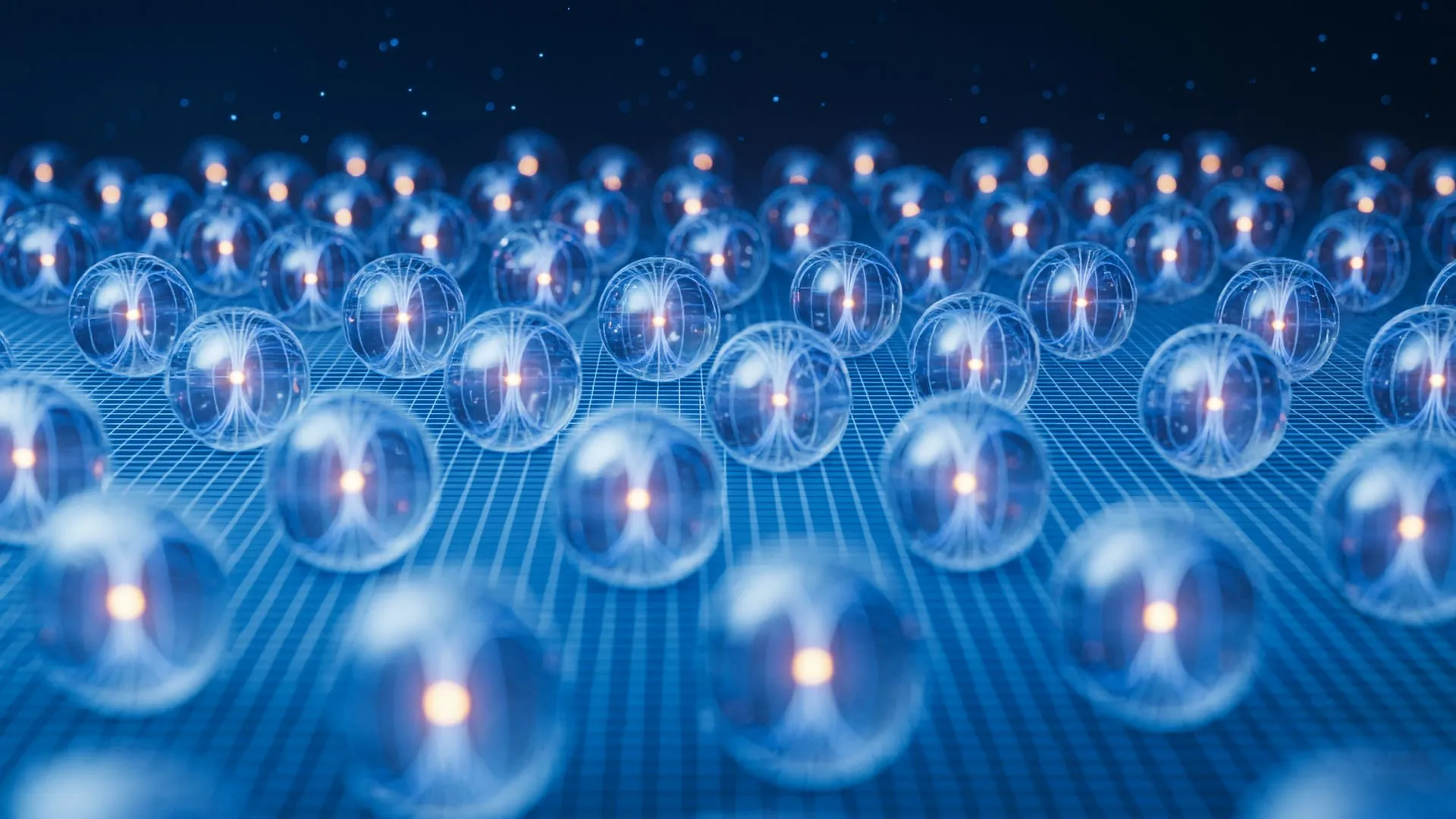
The inherent fragility of qubits, the fundamental building blocks of quantum computers, necessitates the development of sophisticated error correction mechanisms. Unlike classical bits that represent either a 0 or a 1, qubits leverage the principle of superposition, allowing them to exist in both states simultaneously. This quantum quirk endows quantum computers with the potential for exponential speedups over their classical counterparts for specific computations. However, this same quantum mechanical property makes qubits highly susceptible to environmental noise and decoherence, leading to errors. To combat this, researchers are exploring architectures that incorporate a significant number of redundant qubits, working in concert to detect and correct errors, ultimately aiming for robust quantum computers with hundreds of thousands of physical qubits to achieve fault tolerance.
This recent breakthrough from Caltech represents a significant stride towards that ambitious goal. The newly constructed array, a marvel of precision engineering, surpasses previous neutral-atom arrays by an order of magnitude, which typically contained only hundreds of qubits. This development arrives amidst an accelerating global race to scale up quantum computing capabilities, with various promising technologies vying for dominance, including those based on superconducting circuits, trapped ions, and the neutral-atom approach pioneered by the Caltech team.
Manuel Endres, a professor of physics at Caltech and the principal investigator of the research published in the prestigious journal Nature on September 24th, expressed palpable excitement about the implications of this work. "This is an exciting moment for neutral-atom quantum computing," Endres stated. "We can now see a pathway to large error-corrected quantum computers. The building blocks are in place." The study was spearheaded by three dedicated Caltech graduate students: Hannah Manetsch, Gyohei Nomura, and Elie Bataille, whose innovative work has propelled the field forward.
The ingenious method employed by the Caltech team involved utilizing optical tweezers – highly focused laser beams – to precisely trap individual cesium atoms within a meticulously designed grid. To achieve the unprecedented scale of 6,100 qubits, the researchers ingeniously split a single laser beam into an array of 12,000 optical tweezers, each capable of holding and manipulating a single atom within a high-vacuum chamber. Manetsch vividly described the visual spectacle, noting, "On the screen, we can actually see each qubit as a pinpoint of light. It’s a striking image of quantum hardware at a large scale."
A crucial aspect of this research was demonstrating that the significant increase in qubit count did not compromise the quality of individual qubits. Even with over 6,000 atoms meticulously arranged, the team managed to maintain their delicate superposition states for an impressive 13 seconds, a nearly tenfold improvement over previous comparable arrays. Furthermore, they achieved a remarkable 99.98 percent accuracy in manipulating individual qubits. "Large scale, with more atoms, is often thought to come at the expense of accuracy, but our results show that we can do both," Nomura highlighted. "Qubits aren’t useful without quality. Now we have quantity and quality." This dual achievement of both scale and fidelity is a critical enabler for the future development of quantum computers.
Beyond maintaining qubit coherence and accuracy, the team also showcased their ability to dynamically move individual atoms across the array over distances of hundreds of micrometers, all while preserving their quantum superposition. This dynamic reconfigurability is a significant advantage of neutral-atom quantum computers. It enables more efficient and flexible error correction strategies compared to the fixed interconnections found in many other quantum computing architectures, such as those based on superconducting qubits.
Manetsch drew an evocative analogy to explain the complexity of manipulating atoms while preserving their superposition. She compared the task to balancing a glass of water while running. "Trying to hold an atom while moving is like trying to not let the glass of water tip over. Trying to also keep the atom in a state of superposition is like being careful to not run so fast that water splashes over," she elaborated. This highlights the delicate precision required to control these quantum systems.
The immediate next frontier for the field is the practical implementation of quantum error correction at the scale of thousands of physical qubits. The Caltech team’s success strongly positions neutral atoms as a leading candidate technology to achieve this critical milestone. "Quantum computers will have to encode information in a way that’s tolerant to errors, so we can actually do calculations of value," Bataille emphasized. He further explained a fundamental challenge unique to quantum computing: "Unlike in classical computers, qubits can’t simply be copied due to the so-called no-cloning theorem, so error correction has to rely on more subtle strategies." This necessitates the development of sophisticated quantum codes and algorithms to safeguard quantum information.
Looking towards the horizon, the researchers plan to imbue their massive qubit array with entanglement. Entanglement, a profound quantum phenomenon where particles become intrinsically linked and share a common fate regardless of distance, is a cornerstone of quantum computation. It is the key that unlocks the power of quantum computers to move beyond merely storing information in superposition and to perform complex quantum operations. Ultimately, entanglement is the phenomenon that will empower quantum computers to simulate the intricate quantum mechanics that govern the natural world, from the behavior of subatomic particles to the vast expanse of the cosmos. The overarching goal is to harness this power to drive scientific discovery, uncovering new phases of matter, facilitating the design of advanced materials with unprecedented properties, and deepening our understanding of the fundamental quantum fields that shape space-time.
"It’s exciting that we are creating machines to help us learn about the universe in ways that only quantum mechanics can teach us," Manetsch concluded, underscoring the profound scientific implications of their work.
The groundbreaking research, titled "A tweezer array with 6100 highly coherent atomic qubits," received generous funding from a consortium of leading scientific organizations, including the Gordon and Betty Moore Foundation, the Weston Havens Foundation, the National Science Foundation (through its Graduate Research Fellowship Program and the Institute for Quantum Information and Matter at Caltech), the Army Research Office, the U.S. Department of Energy (including its Quantum Systems Accelerator), the Defense Advanced Research Projects Agency, the Air Force Office for Scientific Research, the Heising-Simons Foundation, and the AWS Quantum Postdoctoral Fellowship. The study’s authorship also includes Caltech’s Kon H. Leung, an AWS Quantum senior postdoctoral scholar research associate in physics, and former Caltech postdoctoral scholar Xudong Lv, now affiliated with the Chinese Academy of Sciences.