Faris Adani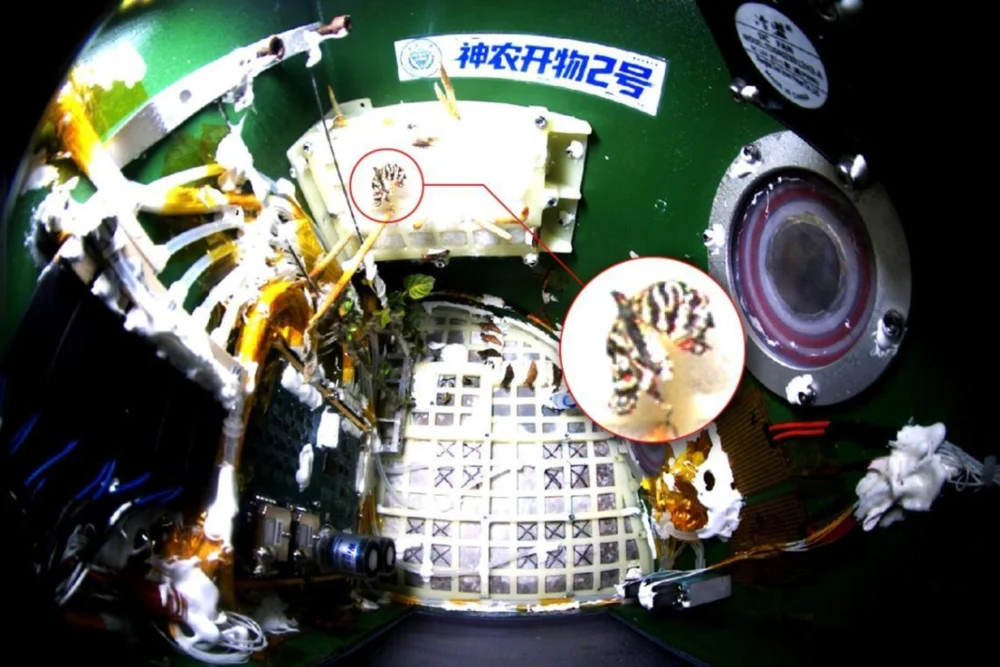
The Tiangong space station, China’s permanent orbital outpost, has rapidly become a hub for ambitious scientific endeavors, pushing the boundaries of what is possible in space. While the station’s taikonauts have previously enjoyed terrestrial comforts like succulent BBQ wings, freshly grown vegetables, and traditional mooncakes, their latest “consignment” was purely for scientific exploration rather than culinary delight. In December, a Kuaizhou 11Y8 cargo spacecraft delivered a specialized module containing a butterfly pupa, initiating an experiment designed to test the limits of life’s adaptation to the harsh space environment.
Encased within a meticulously engineered, self-sustaining capsule, the chrysalis was maintained at a steady 86 degrees Fahrenheit (30 degrees Celsius). This 14.2-liter chamber was a miniature ecosystem, complete with plants and microorganisms carefully selected to provide a stable and nourishing environment for the delicate insect. The experiment’s lead designer, Xie Gengxin, director of Chongqing University’s Space Science and Technology Research Institute, and his team eagerly anticipated the results, though uncertainty lingered about how the insect would fare without the familiar pull of Earth’s gravity.
Against these odds, the butterfly emerged from its cocoon, a vibrant testament to nature’s adaptability. For several days, the chamber sustained the newly hatched insect, allowing researchers to observe its behavior. What they witnessed defied some expectations: the butterfly, rather than struggling, quickly adapted to its new microgravity environment. It navigated the chamber with surprising ease, fluttering its wings and perching on leaves, much as it would on its home planet. “Many people thought the butterfly wouldn’t be able to fly in microgravity, but what we observed was that it quickly adapted to the new environment,” Xie Gengxin proudly stated, highlighting the unexpected success of the endeavor.
While this is not the first instance of a butterfly undergoing metamorphosis in space – that distinction belongs to a monarch butterfly aboard the International Space Station (ISS) in 2009 – the Tiangong experiment introduced a crucial difference that makes it particularly noteworthy. Xie Gengxin’s team deliberately designed this experiment to maximize the chrysalis’s exposure to the unshielded realities of space. Unlike previous attempts, this butterfly pod lacked crucial protective elements such as radiation shielding, active temperature control beyond the initial heating, or full-spectrum lighting. Furthermore, the entire transformation process was entirely unmanned, minimizing any human interference. “The transformation process was entirely unmanned, unlike previous experiments (of other countries) aboard the International Space Station,” Xie explained, emphasizing the experiment’s unique rigor.
This deliberate absence of intervention and shielding makes the Tiangong butterfly arguably the “most stressed” insect to undergo metamorphosis in space. The data gathered from such an exposed experiment provides a more realistic understanding of the challenges biological systems face in future long-duration space missions, particularly for potential off-world colonies where extensive shielding might be impractical or costly. It offers a raw look at how organisms cope with the combined stresses of microgravity, radiation, and more variable thermal conditions, informing the design of more robust bioregenerative life support systems (BLSS).
The journey of life into space has a rich history, beginning with early pioneers like fruit flies aboard V-2 rockets in the late 1940s, followed by dogs, monkeys, and eventually humans. Biological experiments have been a cornerstone of space research, aiming to understand the fundamental impacts of microgravity and radiation on everything from cellular processes and gene expression to growth, development, reproduction, and behavior across various species, including plants, insects, fish, rodents, and even hardy extremophiles like tardigrades. Each experiment, from the simple sprouting of a seed to the complex metamorphosis of an insect, adds another piece to the intricate puzzle of sustaining life beyond Earth.
Xie Gengxin’s prior accomplishments further underscore the significance of this butterfly experiment. He was also the lead designer behind the groundbreaking achievement of growing the first-ever plants to sprout leaves on the Moon, as part of China’s Chang’e 4 robotic mission. These pioneering efforts in cultivating life in extraterrestrial environments are not merely scientific curiosities; they are foundational steps toward realizing humanity’s long-term aspirations in space.
Looking ahead, Xie envisions these experiments as crucial building blocks for future “space farming.” The concept of utilizing extraterrestrial resources for agricultural production is central to sustainable space exploration and colonization. In this grand vision, butterflies could play a vital role as pollinators within closed-loop ecosystems designed for lunar or Martian farms. Just as on Earth, pollinators are indispensable for the reproduction of many plant species, and introducing them into artificial space habitats could enhance the efficiency and diversity of food production systems.
The implications extend far beyond simply growing food. Establishing self-sustaining ecosystems with a degree of biodiversity, even in a controlled environment, is critical for the psychological well-being of long-term space residents and for creating stable, resilient habitats. The successful adaptation of a butterfly in microgravity suggests that complex biological interactions, including those essential for agriculture, might be achievable in space with careful planning and engineering.
As Xie Gengxin confidently asserts, “Lunar and Martian farms will become a reality in the future.” This butterfly’s emergence on Tiangong is a vibrant symbol of that future, a tiny creature whose journey in zero gravity offers monumental insights into how humanity might one day cultivate new homes among the stars. China’s growing prowess in space, exemplified by its independent space station and ambitious lunar missions, continues to push the boundaries of scientific discovery, demonstrating a clear commitment to mastering the art of living and thriving beyond our terrestrial cradle. This small butterfly, fluttering in its orbital enclosure, represents not just a successful experiment, but a hopeful glimpse into a future where life, in all its forms, flourishes across the cosmos.