anjir abdul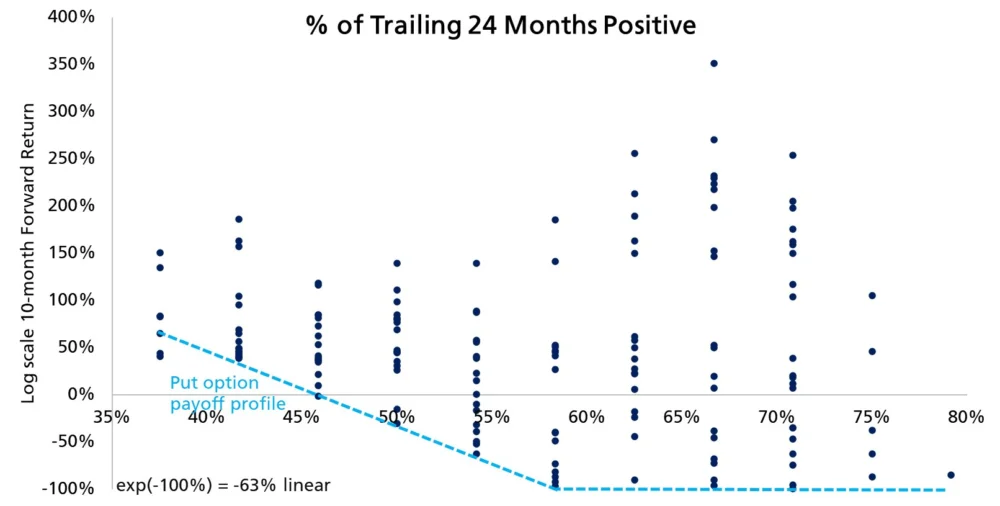
Bitcoin’s historical performance, when meticulously analyzed, strongly indicates an 88% probability of significantly higher prices by early 2027, marking the latest in a series of increasingly bullish BTC price predictions that leverage long-term market patterns and institutional interest. A notable projection suggests Bitcoin (BTC) could reach $122,000 within the next ten months, a figure deemed an "average return" if historical precedents hold true. This robust outlook emerges despite recent periods of market consolidation, reinforcing a deeply embedded belief among quantitative analysts and institutional players in Bitcoin’s inherent long-term growth trajectory.
Key Points:
- Historical Precedent: Bitcoin’s past monthly price movements offer an 88% statistical probability of higher prices by early 2027, according to network economist Timothy Peterson.
- Quantitative Projection: Based on average historical returns, a price target of $122,000 is projected within the next ten months.
- Resilience Amidst Underperformance: Despite Bitcoin’s perceived "underperformance" since late 2025, historical data continues to fuel bullish forecasts, suggesting a temporary dip rather than a sustained downturn.
- Institutional Confidence: Major financial institutions like Bernstein and Wells Fargo are echoing strong bullish sentiments, with targets up to $150,000 and significant capital inflow predictions.
- Contrasting Sentiment: While some market participants express bearish sentiment, quantitative models and institutional analyses paint a decidedly optimistic picture for Bitcoin’s future.
BTC Price Ended Half of Past 24 Months Higher, Signaling Strong Recovery Potential
Fresh analysis from prominent network economist Timothy Peterson, widely known as @nsquaredvalue on X, presents an almost 90% likelihood of Bitcoin’s price being substantially higher by early 2027. This finding is particularly compelling given that Bitcoin’s market performance since the fourth quarter of 2025 has not deterred a wave of bullish BTC price predictions rooted in a rigorous examination of historical data. Peterson’s methodology, which delves into monthly price action over the past two years, points unequivocally towards a significant recovery and upward trend through the remainder of the current year and beyond.

Peterson’s analysis reveals a crucial pattern: "50% of the past 24 months have been positive. This implies an 88% chance that Bitcoin will be higher 10 months from now," he articulated on X. This observation isn’t merely a casual correlation but a statistically significant indicator when viewed through the lens of Bitcoin’s decade-plus market history. He further elaborated on the potential magnitude of this growth, stating, "The average return is exp(60%)-1 = 82% => $122,000. Data goes back to 2011." This calculation, derived from the exponential growth rate observed historically, underscores the potential for an 82% average return from current levels, propelling Bitcoin well into six-figure territory. The fact that this data spans back to 2011 lends immense credibility, encompassing multiple market cycles, halvings, and significant macroeconomic events, consistently demonstrating Bitcoin’s capacity for recovery and sustained appreciation.
The graphical representation of this trend, often depicted as "Trailing positive BTC price months with put option payoff data," visually reinforces Peterson’s claims. While the specific put option payoff data can be complex, its inclusion suggests that even professional traders are hedging against downside risks, implicitly acknowledging a potential floor for Bitcoin’s price and anticipating a future rebound. The second illustrative chart, "Trailing positive BTC price months," typically showcases the frequency of positive monthly closes, and a consistent trend here, even if not indicating parabolic growth, still signifies underlying strength and accumulation phases.
It is important to note Peterson’s own acknowledgment regarding the utility of trailing price performance. He previously clarified that this metric is "more useful for identifying trend inflection points than price targets." He explained, "This metric measures frequency, not magnitude. So Bitcoin could trend sideways for months and this metric could still go down. But it is still very useful for identifying inflection points," labeling the tool as "informal." This nuance highlights that while the exact price point might vary, the direction and probability of an upward shift are strongly indicated, suggesting a market turning point is imminent or already underway.
Interestingly, a recent survey conducted by Peterson himself on a Sunday underscored the prevailing bearish sentiment within the broader crypto market. This divergence between popular sentiment and quantitative analysis is a classic market indicator, often suggesting that extreme pessimism can precede significant upward reversals, as the "smart money" begins to accumulate while the crowd is fearful. The sentiment expressed in the survey, hinting at a potential "Bitcoin crash to $60k" or a "halfway point in a crypto bear market," stands in stark contrast to the historical probabilities Peterson’s own data presents, creating a fascinating backdrop for the impending bullish move.
Bitcoin Bulls Double Down: Institutional Confidence Soars

The optimistic outlook isn’t confined to independent analysts. As Cointelegraph has extensively reported, a growing chorus of other influential market sources continues to champion a major BTC price recovery throughout 2026 and into 2027. This widespread confidence from diverse segments of the financial world adds significant weight to the projections.
Among the most prominent voices is that of Bernstein, a global asset management firm, which this month reiterated its conviction in a $150,000 target for Bitcoin by 2026. Their analysis is particularly noteworthy as they characterized Bitcoin’s recent price comedown as its "weakest bear case" in history. This perspective implies that unlike previous market downturns, the fundamental drivers for Bitcoin’s growth—such as increasing institutional adoption, the success of spot Bitcoin ETFs, and its growing acceptance as a legitimate asset class—remain robust and largely unaffected by short-term price fluctuations. Bernstein’s argument suggests that the current dip is more of a healthy market correction within a broader bull cycle rather than a harbinger of a prolonged bear market, fundamentally different from the speculative-driven crashes of earlier eras.
Adding to this institutional optimism, US banking giant Wells Fargo projects a staggering $150 billion in capital inflows into Bitcoin and related stocks by the end of March. Analyst Ohsung Kwon, in a recent note, highlighted this impending surge, stating, "Speculation picks up with bigger savings…we expect YOLO to return." The term "YOLO" (You Only Live Once) is often associated with retail investor exuberance and the "fear of missing out" (FOMO) phenomenon, suggesting that a significant portion of these inflows could stem from individual investors re-engaging with the market, potentially fueled by tax refunds and increased disposable income. This anticipated wave of capital, both institutional and retail, acts as a powerful catalyst, providing substantial liquidity and demand that can drive prices higher.
Beyond the Numbers: Underlying Drivers for Bitcoin’s Ascent
The projections from Peterson, Bernstein, and Wells Fargo are not isolated forecasts but are underpinned by several fundamental and cyclical factors that bolster Bitcoin’s long-term growth narrative:

- Halving Cycle Impact: Bitcoin’s programmatic supply shock, known as the halving event (which occurred most recently in April 2024), historically precedes significant bull runs. By reducing the rate at which new Bitcoin enters circulation, the halving intensifies supply scarcity against potentially growing demand, creating upward price pressure. The current market phase is consistent with post-halving accumulation before a more explosive price discovery phase.
- Spot Bitcoin ETFs: The approval and subsequent success of spot Bitcoin Exchange-Traded Funds (ETFs) in the United States have been transformative. These ETFs have democratized access to Bitcoin for institutional investors and traditional financial advisors, allowing them to gain exposure without directly holding the asset. This has opened the floodgates for billions of dollars in new capital, providing a regulated and familiar investment vehicle for a much wider audience, solidifying Bitcoin’s position as a mainstream asset.
- Macroeconomic Environment: The global economic landscape, characterized by persistent inflation concerns and potential interest rate cuts by central banks, enhances Bitcoin’s appeal as a digital store of value and an inflation hedge. As traditional currencies face devaluation pressures, investors increasingly seek alternative assets that offer scarcity and a hedge against economic uncertainty.
- Technological Advancements and Ecosystem Growth: Beyond its role as a digital gold, Bitcoin’s ecosystem is continually evolving. Developments in Layer 2 solutions (like the Lightning Network), decentralized finance (DeFi) protocols, and even NFTs on Bitcoin (e.g., Ordinals) are expanding its utility and potential use cases, further driving demand and network value.
- Increasing Global Adoption: From sovereign nations adopting Bitcoin as legal tender (e.g., El Salvador) to corporations holding BTC on their balance sheets, its global acceptance is steadily growing. This increasing integration into national and corporate financial frameworks provides a robust foundation for long-term price appreciation.
While Peterson’s analysis, as he himself admits, is "informal" and focuses on probabilities rather than precise targets, its alignment with other sophisticated institutional models and fundamental market drivers paints an overwhelmingly bullish picture. The convergence of historical data, institutional capital, and evolving market infrastructure suggests that the path for Bitcoin to reach new all-time highs and beyond by early 2027 is not just probable, but highly likely. Investors looking at the bigger picture, beyond short-term market fluctuations, will find compelling evidence to support the thesis that Bitcoin is poised for significant upward movement in the coming years.
This article does not contain investment advice or recommendations. Every investment and trading move involves risk, and readers should conduct their own research when making a decision. While we strive to provide accurate and timely information, Cointelegraph does not guarantee the accuracy, completeness, or reliability of any information in this article. This article may contain forward-looking statements that are subject to risks and uncertainties. Cointelegraph will not be liable for any loss or damage arising from your reliance on this information.