Faris Adani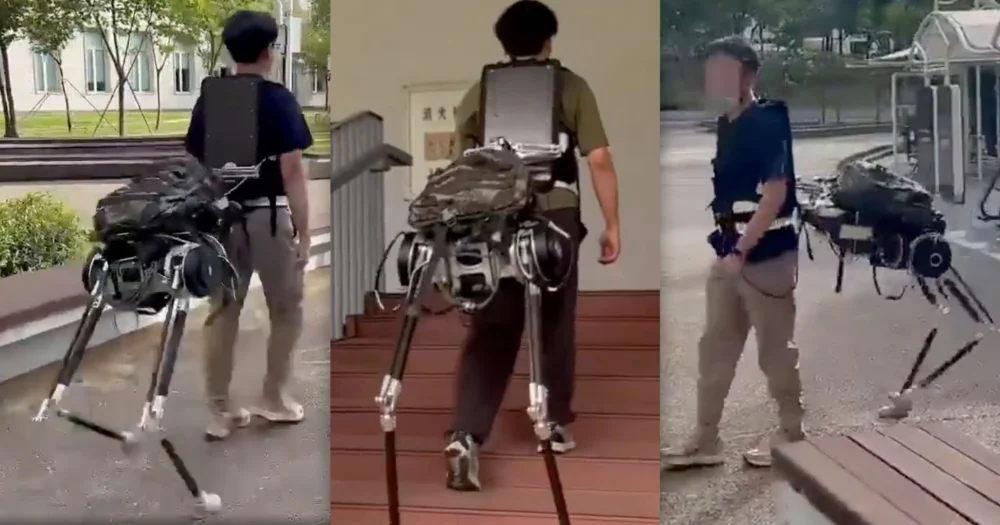
Body Horror Robot Turns Human Into Centaur
Sign up to see the future, today. Can’t-miss innovations from the bleeding edge of science and tech. The realm of human augmentation and assistive robotics has long been a fertile ground for both groundbreaking innovation and peculiar concepts. While much research focuses on streamlining tasks or enhancing individual physical capabilities, a recent development from Shenzhen, China, has taken a decidedly unconventional path, drawing inspiration from ancient mythology and sparking a lively debate across the scientific and online communities. This isn’t just another robot designed to lighten the load; it’s an attempt to fundamentally alter the human form for practical purposes, transforming its wearer into a modern-day centaur.
The Evolution of Exoskeletons and Assistive Devices
For years, engineers worldwide have been tirelessly striving to decrease human exertion and enhance physical prowess through sophisticated mechanical means. We’ve witnessed the remarkable rise of futuristic exoskeletons, which, depending on their design and purpose, can offer a spectrum of benefits. Some advanced suits enable individuals to ascend thousands of steps without expending significant energy, essentially granting them super-human endurance for climbing. Others, like specialized arm braces, are meticulously designed for industrial settings, taking the debilitating load off workers’ shoulders during repetitive overhead tasks in bustling car factories, thereby reducing fatigue and preventing long-term injuries. These innovations typically operate by augmenting existing human limbs or providing direct, localized support to specific body parts, aiming to reduce metabolic cost, prevent strain, or amplify natural strength.
The underlying principle of most assistive robotic devices revolves around direct mechanical assistance, where the machine works in intelligent tandem with the human body’s natural biomechanics. The goal is to create a seamless extension of the wearer, amplifying their capabilities or mitigating inherent physical weaknesses. However, these traditional approaches, while demonstrably effective, often grapple with challenges such as intricate integration requirements, leading to potentially bulky designs, restricted natural range of motion, or complex control interfaces. The ongoing quest in this field is to strike an optimal balance between power delivery, agile maneuverability, user comfort, and intuitive control, ensuring that the assistive device truly serves as an unobtrusive yet powerful extension of the human, rather than a cumbersome and alien addition.
A Mythological Leap: The Centaur Robot Unveiled
In a bold departure from these established paradigms, a pioneering team of engineers at the Southern University of Science and Technology in Shenzhen, China, has unveiled a dramatically different concept for load-carrying assistance. Their innovation eschews the conventional exoskeleton model for something far more radical and, to some, visually unsettling. The inspiration for this groundbreaking system is drawn not from contemporary engineering blueprints or ergonomic studies, but from the ancient annals of Greek mythology – specifically, the centaur. This mythical creature, with the powerful quadrupedal body of a horse fused with the intellectual, bipedal torso of a human, has been reinterpreted through a modern robotic lens, creating a wearable system that fundamentally reconfigures the human gait and load-carrying capacity.
The team’s innovative work, meticulously detailed in a comprehensive paper published last month in the esteemed International Journal of Robotics Research, introduces what they term a “human-Centaur system.” The publication is accompanied by compelling video demonstrations, offering a first glimpse into this audacious new paradigm. In these visuals, an engineer is seen navigating a university campus, not with a standard backpack or an integrated exoskeleton, but with a two-legged, centaur-inspired robotic appendage trailing behind him, mimicking his stride. The sight is both intellectually intriguing and aesthetically unsettling, representing a stark departure from the familiar, often more subtle, aesthetics of modern robotics.
The conceptual framework also playfully — or perhaps critically — nods to an “unflattering Cory Doctorow metaphor” that builds upon the same folklore. This reference suggests a layered understanding of the centaur concept, extending beyond mere physical replication to encompass broader societal or technological implications, hinting at the potential for both empowerment and awkwardness inherent in such a radical human-machine interface.
Navigating New Terrains: The Centaur’s Core Advantage
Upon first observation, the robot’s two spindly legs, seemingly a separate entity, appear to struggle, presenting a somewhat awkward mechanical shadow attempting to keep precise pace with the marching human at the front. On flat, even ground, the immediate, overwhelming advantage over simpler solutions like wheeled carts or even traditional backpacks isn’t immediately apparent. Indeed, an observer might reasonably question the necessity of such complex and seemingly ungainly locomotion for mundane tasks. However, the true genius — or perhaps the highly specialized utility — of this centaur approach becomes strikingly clear the moment the wearer encounters a significant environmental obstacle: a flight of stairs.
Where a conventional wheeled solution would inevitably falter, requiring cumbersome ramps, manual lifting, or a complete detour, the centaur robot’s articulated legs effortlessly ascend, adapting with remarkable fluidity to the changing elevation. This inherent ability to seamlessly and dynamically traverse diverse and uneven terrains, ranging from flat pathways to steep inclines and complex staircases, marks its key differentiator and potential advantage over less sophisticated load-carrying mechanisms. It is precisely in these challenging environments that the researchers’ vision for an adaptive, collaborative human-robot system truly begins to materialize, demonstrating a niche yet powerful capability that traditional methods struggle to replicate.

The Researchers’ Vision: Efficiency and Collaboration
The team from Southern University of Science and Technology articulates the system’s benefits with conviction and scientific rigor. In their published paper, they emphatically state: “Experimental evaluation results demonstrate that the Centaur robot effectively adapts to varying human walking directions and speeds while seamlessly collaborating with the human to traverse diverse terrains.” This profound emphasis on seamless collaboration highlights a core design philosophy: the robot is conceived not merely as a passive, unintelligent carrier of cargo, but as an active, responsive participant in the human’s locomotion, dynamically adapting its movements in real-time to match the wearer’s intent, gait, and the ever-changing demands of the environment.
Crucially, the researchers quantified the tangible energy savings, or “metabolic cost,” associated with using their innovative system. They discovered that wearers experienced a significant reduction in energy expenditure compared to simply carrying a traditional backpack weighing approximately 44 pounds (20 kg) – a weight eerily similar to that of the centaur robot itself. This metabolic saving isn’t just about enhanced comfort; it directly translates into extended human endurance, substantially reduced fatigue over prolonged periods, and potentially greater operational efficiency for tasks requiring sustained load carriage in demanding conditions, such as military patrols, search and rescue operations, or long-distance expeditions.
Beyond simply bearing passive weight, the Centaur robot is meticulously designed to actively assist the human. “The proposed human-Centaur system can optimize the load distribution to reduce the load pressure on the human,” the paper further explains. This implies that the robot doesn’t merely carry its own mass and the additional payload; it intelligently senses and shifts weight, applying precisely calculated forces to minimize the burden on the human spine, joints, and musculature. Furthermore, a truly remarkable feature is its capacity to provide propulsive assistance. “Additionally, the Centaur robot can be controlled to interact with the human at the human-robot interface, generating horizontal interaction force in the sagittal plane to provide forward assistance during human walking,” the researchers wrote. This means the robot can literally impart a continuous, subtle push to its human wearer, further reducing the physical effort required for locomotion, especially when ascending inclines or traversing challenging terrain with heavy loads.
Addressing the Limitations of Autonomous Load Carriers
The Shenzhen team strategically positions their innovation within the broader landscape of modern load-transport solutions, specifically contrasting it with fully autonomous robots, such as the widely publicized “robodogs” or various wheeled autonomous delivery platforms. While these independent robots are “being actively explored as load-transport solutions without direct human involvement,” the researchers are quick to point out their inherent and often significant drawbacks. The primary challenge cited is the critical need for such robots to “navigate reliably in complex environments where a prior map is unavailable.” Imagine the chaotic, unpredictable terrain of a disaster zone, the uncharted wilderness of a scientific expedition, or a dynamic construction site – autonomous navigation becomes immensely difficult, unreliable, and often energy-inefficient without pre-programmed maps or extensive real-time mapping capabilities.
Furthermore, the payload capacity of purely autonomous robots is frequently limited by their own locomotion requirements and battery life. Carrying significant weight can drastically cut into their operational endurance and available power, creating a difficult trade-off between carrying capacity and mission duration. “Under current limitations in autonomous navigation, endurance, and payload capacity, autonomous robots still face challenges in fully performing load-carriage tasks,” the researchers argue convincingly. Their centaur approach, by contrast, ingeniously leverages human intelligence for superior navigation, adaptive decision-making, and obstacle avoidance, effectively offloading this complex cognitive burden from the robotic system. This allows the robot to concentrate its energy and computational resources on its primary functions: locomotion and robust load support, thereby offering a solution that, they contend, overcomes many of the current limitations faced by purely autonomous load-carrying systems.
The Skeptics Weigh In: Practicality and Perceptions
Despite the researchers’ compelling scientific arguments and the undeniable ingenuity of the engineering, the public reception, particularly across various online platforms like Reddit, has been a profoundly mixed bag, often leaning heavily towards skepticism, humorous critique, and even outright mockery. The centaur robot, for many, evokes a sense of the uncanny or the absurd, challenging deeply ingrained conventional notions of utility, ergonomic design, and what constitutes a “helpful” piece of technology.
One Redditor, for instance, humorously questioned its everyday practicality: “I feel like a shopping cart would almost always be a better solution,” they wrote, adding a sarcastic note that quickly went viral, “The next time I’m carrying a light sacrifice to a dormant volcano that has frequent charging stations in good weather this might be handy.” This comment encapsulates a common initial reaction: is this elaborate and seemingly over-engineered device truly superior to simpler, more accessible, and decidedly less intrusive tools for common load-carrying tasks? While the researchers meticulously highlight its terrain adaptability, many users instinctively compare it to the most ubiquitous and straightforward load-bearing devices they know.
Significant safety concerns also quickly surfaced, a critical point for any device designed to be intimately worn. Another user powerfully argued, “Imaging running with that thing carrying a load and then tripping and breaking your back as it collapses on to you with force. It’s like driving a car from the hood.” This highlights a paramount challenge for any human-robot collaboration involving substantial loads: the terrifying potential for catastrophic mechanical failure and severe user injury. The interface between human and machine must be engineered with robust fail-safes, capable of gracefully handling unexpected events like trips, sudden movements, or system malfunctions without endangering the wearer. The prospect of a 44-pound robotic appendage collapsing onto one’s back is indeed a chilling thought, raising legitimate and urgent questions about stability control, emergency detachment mechanisms, kinetic energy management during falls, and comprehensive risk assessment protocols.
Perhaps the most pointed and widespread criticism revolved around the perceived “reinvention of the wheel.” Several astute users pointed out that gadgets and systems designed to help carry heavy loads while walking have a “long, storied history already,” spanning millennia of human ingenuity. One user succinctly inquired, “Have you guys heard of the rickshaw?” This line of critique suggests that while the underlying robotic technology is undoubtedly new and complex, the fundamental problem it seeks to solve – human load carriage – has been addressed for centuries with simpler, more elegant, and often significantly more cost-effective solutions. From rudimentary carrying poles and ergonomic backpacks to highly efficient wheelbarrows, handcarts, and rickshaws, humanity has long devised ingenious ways to move heavy objects with minimal effort. The centaur robot, in this broader historical context, might appear to some as an overly complex, high-tech solution to an already solved problem, at least for many common, well-trodden scenarios.
Beyond the Hype: Practical Applications and Future Directions
Despite the initial wave of skepticism and the valid practical concerns, it is crucial to consider the specific, highly demanding niches where such an innovation might genuinely thrive and prove indispensable. While a simple shopping cart or a rickshaw might suffice for urban environments, paved paths, or well-maintained roads, the centaur robot’s distinct strength lies precisely in its unparalleled ability to navigate highly uneven, unstructured, and challenging terrains where wheels are entirely impractical and fully autonomous navigation remains unreliable. This could include critical military operations in rugged, off-road landscapes, crucial disaster relief efforts where existing infrastructure is destroyed and pathways are hazardous, long-distance wilderness expeditions with heavy scientific or survival gear, or even specialized industrial applications within complex, multi-level facilities with frequent staircases and obstacles.
Furthermore, the “forward assistance” feature, which actively propels the wearer, could be genuinely transformative for individuals with certain physical limitations, or for tasks requiring sustained exertion over long periods, providing a continuous, dynamic boost that a traditional static backpack simply cannot. Imagine rescue workers needing to transport heavy medical supplies or specialized equipment over treacherous rubble, or field researchers traversing remote, mountainous wilderness with delicate scientific instruments; in such high-stakes scenarios, the quantified metabolic cost savings and the unmatched terrain adaptability could be not just beneficial, but absolutely invaluable.
The next steps for this pioneering research will undoubtedly involve rigorously addressing the very concerns so vocally raised by critics. Engineers will need to refine the robot’s intrinsic stability, significantly enhance its safety protocols to mitigate injury risks, improve its human-robot interface for even more intuitive and natural control, and critically, work towards reducing its overall bulk, weight, and manufacturing cost to increase its accessibility. Further research might also explore different, more comfortable and secure attachment mechanisms, develop more advanced gait synchronization algorithms for truly seamless integration, and devise robust, long-lasting power solutions to extend its operational duration in the field. Addressing these challenges will be paramount to its transition from an academic curiosity to a truly practical and deployable tool.
Conclusion: A Glimpse into an Unconventional Future
The centaur robot from Shenzhen stands as a compelling testament to humanity’s relentless and often audacious pursuit of innovation, even when that pursuit leads to designs that profoundly challenge our preconceived notions of form, function, and what constitutes an acceptable human-machine interface. It represents a bold, perhaps audacious, attempt to merge human and machine in a way that is both ancient in its mythological inspiration and distinctly futuristic in its robotic execution. While its immediate widespread practicality for everyday use is certainly a subject of intense debate, and its somewhat “body horror” aesthetic might initially deter broad acceptance, it undeniably pushes the very boundaries of human-robot collaboration and assistive technology.
Whether this groundbreaking research ultimately evolves into a widely adopted tool for specific, highly demanding tasks or remains an intriguing, thought-provoking academic curiosity, this centaur-inspired robot nonetheless forces us to fundamentally reconsider what “wearable technology” truly means and how far we, as a species, are willing to go in redesigning our physical interaction with the world around us. It serves as a potent reminder that the future of robotics will likely be filled with both elegantly refined solutions and wonderfully strange, boundary-pushing experiments, all contributing in their own unique ways to our ever-expanding understanding of what’s truly possible at the bleeding edge of science and technology.
More on exoskeletons: Nike’s New Sneaker Contains an Exoskeleton to Boost Your Leg Performance