anjir abdul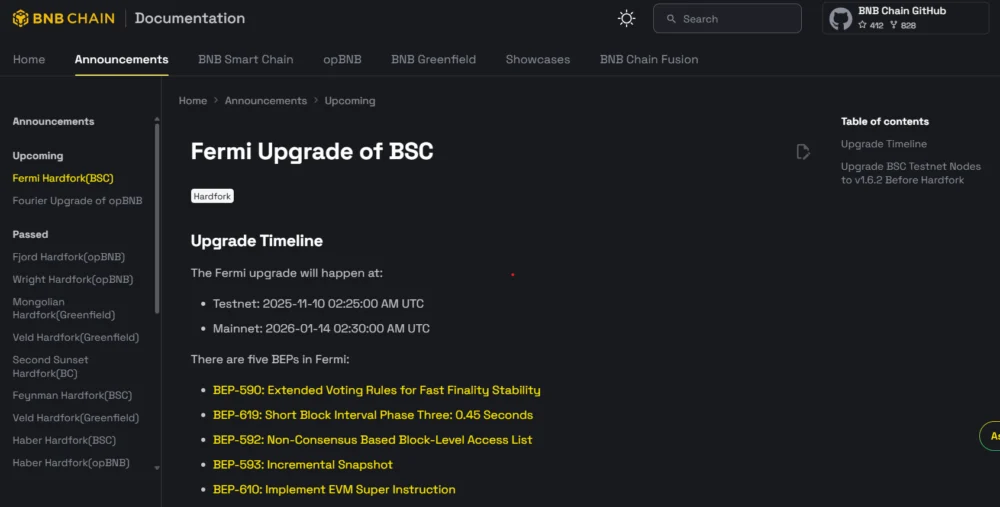
The Fermi upgrade is delivered through a hard fork, a fundamental change to the blockchain’s protocol that is not backward-compatible, requiring all network participants (especially validators) to upgrade their software to comply with the new rules. This ensures the entire network operates under the enhanced parameters, enabling BSC validators to produce new blocks every 0.45 seconds. This nearly halves the time required for transactions to be confirmed on-chain, dramatically improving the speed at which users can expect their operations to be finalized. The core philosophy behind this aggressive optimization, as articulated by Nina Rong, executive director at BNB Chain, to Cointelegraph, is "faster without compromising reliability." This involves meticulously pairing shorter block intervals with significantly strengthened fast-finality rules, guaranteeing that confirmation assurances remain robust and predictable, even during periods of intense network activity and congestion.
At a technical level, the Fermi upgrade meticulously refines the network’s consensus rules. This sophisticated adjustment ensures that validators remain perfectly synchronized despite the significantly tighter and more demanding block production schedule. According to detailed BNB Chain documentation, Fermi also introduces stricter propagation and voting parameters. These new rules are specifically engineered to mitigate and reduce finality delays, a crucial improvement for maintaining network responsiveness and user experience when the network is under heavy load. The underlying Proof of Staked Authority (PoSA) consensus mechanism, a hybrid model combining elements of Proof of Authority and Delegated Proof of Stake, is further optimized to handle the increased throughput and rapid block production while maintaining security and decentralization within its validator set. This fine-tuning of the consensus mechanism is paramount to achieving sub-second finality without introducing instability or increasing the risk of orphaned blocks.

The implications of this speed enhancement are profound, especially for latency-sensitive use cases. BNB Chain is explicitly pitching Fermi as the ideal infrastructure for applications that demand near-instant transaction processing and confirmation. This includes, but is not limited to, high-frequency on-chain trading, where every millisecond can impact profitability and market opportunities. Decentralized finance (DeFi) protocols, which rely heavily on real-time data and rapid execution for lending, borrowing, liquidations, and automated market maker (AMM) operations, will also see substantial benefits. Interactive gaming decentralized applications (DApps) stand to gain immensely, as quick in-game transactions, seamless NFT minting, and responsive user experiences are critical for player engagement and retention. Imagine trading items, placing bids, or executing spells in a game with virtually no lag—Fermi makes this a reality.
Rong further clarified that the upgrade is meticulously designed to improve "real-world performance, not just peak throughput." This distinction is vital. While many blockchains can tout high theoretical throughput under ideal conditions, Fermi specifically targets scenarios where network activity spikes unpredictably, ensuring that confirmation times remain consistently stable and predictable for both end-users and professional traders. This focus on consistent, reliable performance under duress is a direct response to historical challenges faced by high-throughput blockchains. For most DApps and smart contracts currently deployed on BSC, the transition is expected to be largely seamless, requiring no significant code changes. This minimizes the burden on developers and accelerates the adoption of the enhanced network capabilities. However, teams whose applications rely on precise block timing, perhaps for randomness generation based on block numbers or time-sensitive logic, are advised to re-evaluate their assumptions, as blocks will now arrive significantly faster than before, potentially altering their application’s behavior if not accounted for.
BNB Chain, like many other high-throughput chains, has previously encountered periods of network congestion and degraded user experience, particularly during speculative surges, memecoin frenzies, or high-volume trading events. These "growing pains" have been openly acknowledged and have played a crucial role in informing Fermi’s design philosophy. Rong emphasizes that these past episodes directly influenced the upgrade’s architecture, leading to the tightening of fast-finality voting rules and bolstering validator coordination. These measures are specifically implemented to ensure the chain remains responsive and confirmation times stay predictable even under the heaviest loads. The aim is to ensure that validators "stay in sync to keep the network stable," even as block production accelerates to unprecedented speeds. Furthermore, BNB Chain has proactively planned for robust post-fork monitoring and a subsequent release dedicated to cleanup and stabilization. This comprehensive approach provides validators with advanced tools to quickly detect and address any potential issues that might arise, demonstrating a commitment to proactive network health and resilience.

BNB Chain’s strategic enhancements come on the heels of a remarkably successful year. In 2025, BNB Chain solidified its position as one of the busiest blockchains by both transaction volume and user activity, second only to Solana in total on-chain transactions, recording approximately 3.89 billion transactions. This impressive growth was fueled by a potent combination of consistently low transaction fees, aggressive performance optimizations, and a vibrant, rapidly expanding ecosystem encompassing DeFi, NFTs, and memecoins. With Fermi pushing block times to 0.45 seconds and targeting a finality of "around one second," BNB Chain is now operating in a distinct performance bracket compared to the Ethereum base layer. While Ethereum offers superior decentralization guarantees, its significantly slower throughput and confirmation speed, with a block produced approximately every 12 seconds, present a different trade-off.
Crucially, BNB Chain maintains its commitment to providing an Ethereum Virtual Machine (EVM)-compatible environment. This differentiates it from non-EVM, ultra-high-throughput rivals such as Solana. Solana, while known for its impressive transaction speeds, operates on a different architectural paradigm, requiring developers to adapt to a new ecosystem and programming language (Rust). BNB Chain’s EVM compatibility is a massive draw for developers, offering the familiarity of Solidity, a vast existing developer toolkit, and the ease of porting applications from Ethereum or other EVM chains. This strategic choice allows developers to leverage cutting-edge speed without abandoning the established, well-understood, and widely adopted EVM ecosystem.
The Fermi upgrade is also a pivotal component of BNB Chain’s broader 2026 tech roadmap. This ambitious roadmap focuses on developing high-performance infrastructure, ensuring predictable latency, and systematically scaling the base layer to accommodate heavier and more complex workloads. Beyond just speed, the roadmap likely includes continuous efforts towards greater decentralization, enhanced security measures, potential integrations with Layer 2 solutions to further offload computational burden, and specific module upgrades to support emerging use cases like Web3 social or fully on-chain gaming. By consistently pushing the boundaries of what’s possible on an EVM-compatible chain, BNB Chain aims to solidify its status as a leading platform for innovation, catering to the evolving demands of developers and users in the rapidly expanding decentralized digital landscape. The Fermi upgrade is not just an incremental improvement; it’s a bold statement of intent, signaling BNB Chain’s unwavering commitment to speed, reliability, and user-centric development.