anjir abdul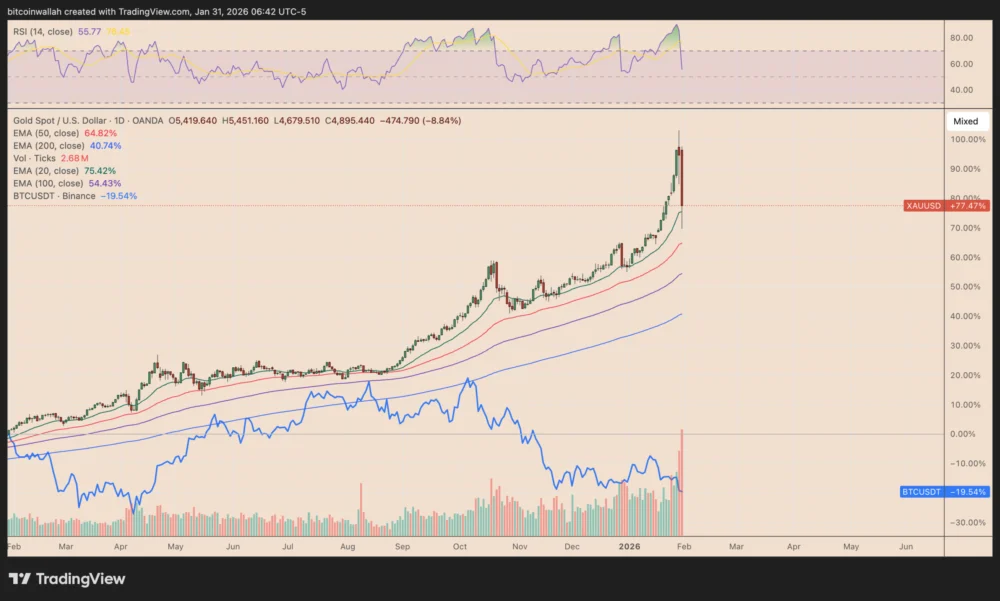
Bitcoin (BTC) recently plunged to a historic low when measured against gold (XAU) in January, a downturn that some prominent analysts are now characterizing as an even more compelling buying opportunity than the one observed prior to the monumental 2015–2017 bull market. This provocative assertion stems from a deep dive into the relative valuation of these two dominant stores of value, suggesting that the current market dynamics could be setting the stage for a significant rebound in Bitcoin’s price. The debate between these two assets, often dubbed "digital gold" versus "traditional gold," continues to evolve, with recent data tilting the scales in favor of Bitcoin for long-term accumulation, despite its short-term volatility.
Key Takeaways from the Recent Market Movements:
- Record Low BTC/XAU Ratio: Bitcoin’s value relative to gold, particularly when adjusted for global money supply, reached its lowest point ever in January.
- Historical Precedent: This extreme undervaluation against gold mirrors conditions seen in 2015, which notoriously preceded an astronomical 11,800% surge in BTC prices.
- Anticipated Rotation: Several analysts are forecasting a significant capital rotation from gold into Bitcoin, potentially commencing as early as February or March.
- Divergent Views: While many see an imminent shift, some experts caution that such a rotation may not occur rapidly, emphasizing gold’s sustained strength and Bitcoin’s potential for extended consolidation.
- Long-Term Holder Accumulation: Despite the price drop, on-chain data reveals that long-term Bitcoin holders are actively accumulating, a historical indicator of market bottoms and future price appreciation.
Gold-to-Bitcoin Rotation Could Start in February
The core of this optimistic outlook for Bitcoin lies in its valuation against gold. On a recent Saturday in January, Bitcoin’s perceived value, meticulously compared to gold and further adjusted for the global money supply, plummeted to an unprecedented low. This critical insight was brought to light by data from Bitwise Europe, a firm known for its robust market analysis in the digital asset space.
This specific indicator, which quantifies when Bitcoin exhibits unusual strength or weakness relative to gold, has now dipped perilously close to an "extreme zone," specifically the -2 level on its Z-score chart. Historically, such extreme readings have consistently coincided with significant Bitcoin market bottoms, marking periods of profound undervaluation before substantial price rallies.

The last instance this band descended to comparable depths was in 2015. At that time, Bitcoin was trading around $165, largely overlooked by mainstream investors. This period of extreme undervaluation against gold, however, proved to be a harbinger of extraordinary gains. Over the subsequent two years, Bitcoin embarked on an epic bull run, skyrocketing by an astonishing 11,800% to reach a then-unimaginable peak of $20,000. This historical parallel forms the bedrock of current bullish sentiment.
Drawing on this powerful historical context, respected analyst Michaël van de Poppe articulated a compelling view in a Saturday X post, declaring, "Today represents a better opportunity to be buying Bitcoin than 2017." His statement resonates deeply with a growing chorus of analysts who anticipate a significant rotation of capital from traditional safe-haven assets like gold into the burgeoning digital asset space, specifically Bitcoin, over the course of the year.
This expectation of a forthcoming rotation is not a solitary voice but a chorus of well-regarded experts. André Dragosch, the head of research for Bitwise Europe, has been a vocal proponent of this thesis. Similarly, Pav Hundal, the lead analyst at Swyftx, a prominent cryptocurrency exchange, has echoed these sentiments, even going so far as to pinpoint February or March as potential starting points for such a capital shift. The underlying rationale for this anticipated rotation often centers on Bitcoin’s increasingly recognized attributes as a scarce, decentralized, and censorship-resistant asset, which many argue makes it a superior long-term store of value compared to gold in the digital age. Furthermore, the growing institutional adoption, exemplified by the proliferation of spot Bitcoin ETFs, is expected to provide easier access and greater liquidity for traditional investors looking to diversify into digital assets.
Capital Rotation “Might Not Happen Quickly”
Despite the compelling arguments for an impending Bitcoin surge and a capital rotation from gold, not all market participants are convinced that such a shift will occur swiftly or without significant headwinds. These bullish views emerged against a backdrop where gold prices had impressively doubled over the preceding year, while Bitcoin had experienced an 18% decline during the same period, illustrating a significant divergence in performance. This contrast underscores the perceived safety and stability of gold in uncertain times versus the higher volatility often associated with Bitcoin.
Among the dissenting voices is analyst Benjamin Cowen, who has urged caution regarding the speed and magnitude of any potential rotation from precious metals into Bitcoin. Cowen suggests that Bitcoin’s current downtrend, particularly against broader equity markets, might persist longer than many holders anticipate. He argues that the fervent hopes for a "massive rotation" out of established safe-havens like gold and silver could be misplaced, at least in the short to medium term. His perspective highlights the deep-seated investor psychology and the inertia that often characterizes large-scale capital movements, particularly between asset classes with such fundamentally different risk profiles and historical track records.

Furthermore, other financial institutions continue to express bullish sentiments for precious metals, indicating that capital might remain committed to these traditional assets for the foreseeable future. Citi, for instance, has predicted that silver could extend its gains in the coming months, buoyed by robust demand from China and a projected weakening of the US dollar. A weaker dollar typically makes dollar-denominated commodities like gold and silver more attractive to international buyers. Similarly, RBC Capital Markets has issued an optimistic forecast for gold, projecting its price to reach an impressive $7,000 by the end of 2026. These predictions suggest that the narrative of gold’s enduring value and its role as an inflation hedge remains strong within traditional finance circles.
Cowen’s ultimate takeaway is that even if precious metals maintain their strength or continue to appreciate, the eventual move of capital into Bitcoin is "probably not going to happen" quickly. This implies a more gradual, perhaps multi-year, transition rather than an abrupt market-wide pivot. Investors expecting an immediate and dramatic shift might be setting themselves up for disappointment, and instead, should prepare for a period of continued price discovery and potential consolidation for Bitcoin. The "digital gold" narrative, while gaining traction, still contends with gold’s millennia-long history as a universally recognized store of value and its proven resilience across countless economic cycles.
Bitcoin Long-Term Holders Absorb January Sell-Off
Despite Bitcoin’s noticeable pullback in January, a deeper look into on-chain data reveals a quietly bullish trend: long-term holders (LTHs) are not only staying put but are actively rebuilding their positions. This behavior is often considered a critical indicator of underlying market strength and conviction among the most experienced investors.
Long-Term Holders are typically defined as entities that retain their Bitcoin for a minimum of 155 days, signifying a strong belief in Bitcoin’s long-term value proposition rather than short-term speculative trading. Analysis of the supply held by these LTHs shows a clear recovery trend during the January sell-off. This suggests that as prices dipped, these patient investors saw an opportunity to accumulate more Bitcoin at a discount, effectively absorbing selling pressure from newer or weaker hands.
Complementing this, the LTH Spent Binary metric—an indicator that tracks whether long-term Bitcoin holders are actively selling their coins or remaining inactive—continued its decline during this period. A declining LTH Spent Binary indicates that fewer long-term holders are moving their Bitcoin, signifying a strong holding sentiment and a reluctance to sell even amidst price volatility. This reduction in selling pressure from the most steadfast cohort of investors is a crucial component for market stability and future growth.

Historically, the confluence of recovering LTH supply and a declining LTH Spent Binary has consistently preceded the formation of durable Bitcoin bottoms. As analyst Anil pointed out, these patterns have been reliable precursors to significant upward price movements. A compelling recent example occurred after the April 2025 lows: the supply held by long-term holders began to recover first, laying the groundwork for a subsequent sharp rebound in BTC prices. Roughly a month after this LTH accumulation began, Bitcoin rallied approximately 60% from its lows, validating the predictive power of these on-chain metrics.
These observable trends unequivocally suggest that the more patient and conviction-driven holders are strategically leveraging Bitcoin’s price drop in January. This behavior is often characteristic of the kind of market "reset" that is essential for Bitcoin to build a stronger, more sustainable base for future gains. It indicates a weeding out of short-term speculative interest and a consolidation of supply in the hands of those with a long-term vision, thereby strengthening the asset’s overall market structure. This accumulation by LTHs during periods of price weakness acts as a natural floor, preventing steeper declines and setting the stage for future appreciation as demand eventually outstrips this increasingly tightly held supply.
Broader Market Context and Future Outlook
Beyond the specific metrics comparing Bitcoin to gold and the behavior of long-term holders, the broader market context further informs the potential trajectory of BTC. The ongoing institutionalization of Bitcoin, exemplified by the launch and growing popularity of spot Bitcoin ETFs, is providing unprecedented access for traditional investors. This influx of institutional capital, coupled with increasing regulatory clarity in various jurisdictions, is expected to enhance market liquidity and stability over time. Furthermore, the inherent scarcity of Bitcoin, reinforced by its programmatic halving events (which reduce the supply of new BTC entering the market), continues to underpin its long-term value proposition, especially in an environment of increasing global money supply and potential inflationary pressures.
The debate surrounding Bitcoin versus gold as a store of value is far from settled, but the recent market movements and on-chain data present a compelling narrative for Bitcoin. While gold continues to play its traditional role as a safe haven, Bitcoin’s unique attributes and its current undervaluation against gold, reminiscent of its pre-2017 breakout, suggest a significant opportunity for investors with a long-term horizon. The prudent accumulation by long-term holders during the January dip further strengthens this outlook, signaling that the market’s foundational elements are being reinforced. However, investors must remain cognizant of the dissenting views and the potential for a slower, more gradual capital rotation, necessitating patience and a robust risk management strategy. As the financial landscape continues to evolve, the interplay between these two powerful assets will undoubtedly remain a focal point for global investors, with Bitcoin increasingly asserting its claim as a dominant store of value for the digital age.