anjir abdul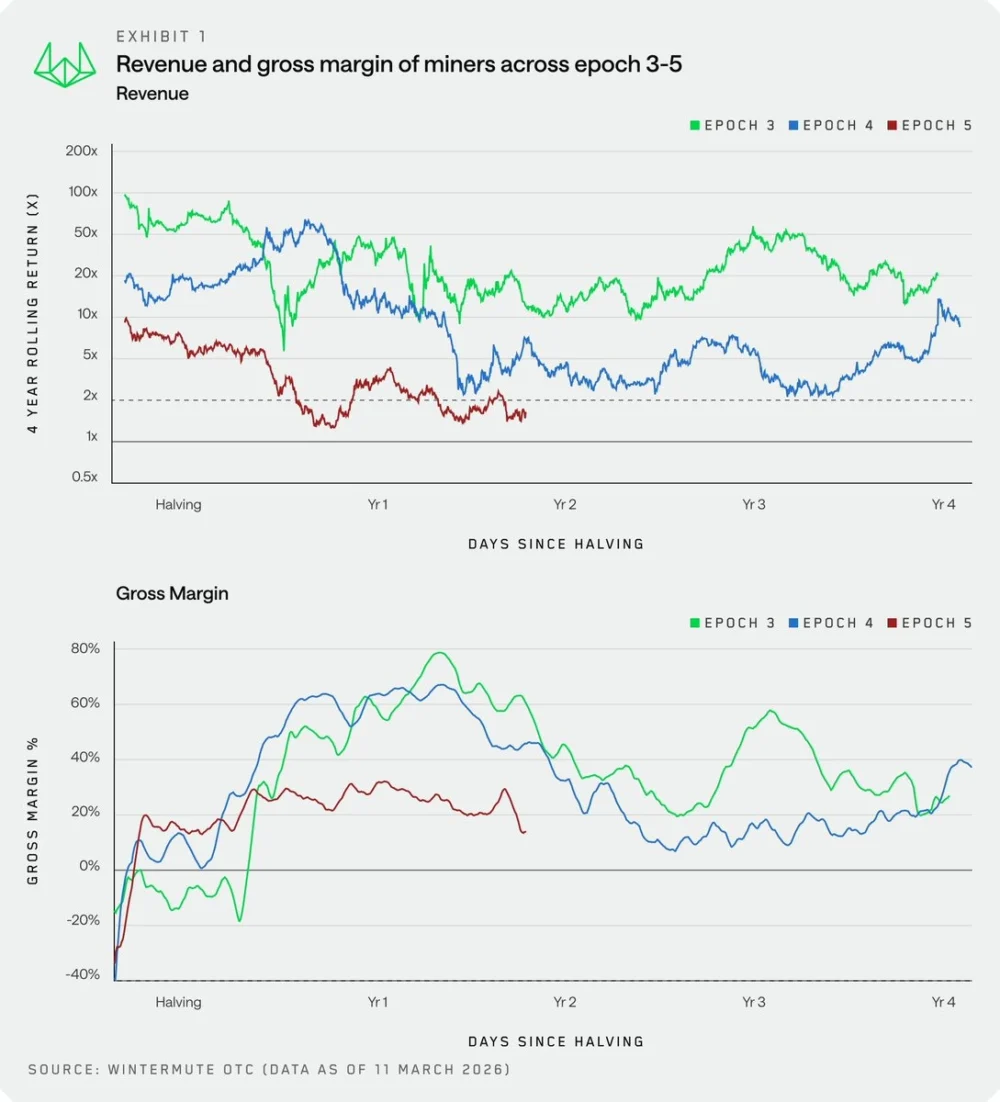
The Mining Predicament: Diminishing Returns and Structural Rigidity
For years, Bitcoin miners have invested heavily in building out vast, energy-intensive computational infrastructure, strategically locating their facilities in regions offering the lowest electricity costs globally. This capital-intensive build-out was predicated on the expectation of consistent block rewards and appreciating Bitcoin prices, allowing for profitable operations despite the inherent volatility of the crypto market. However, the dynamics have fundamentally changed. The quadrennial Bitcoin halving events, designed to gradually reduce the supply of new BTC, drastically cut the block reward for miners. While previous halvings were often followed by significant price rallies that offset the reduction in rewards, the current cycle has presented a more complex scenario. Wintermute highlights that, for the first time in a four-year market cycle, Bitcoin has failed to deliver the two-times price return typically needed to compensate for these halving-driven revenue cuts. This failure to meet historical price benchmarks, coupled with an ever-increasing network difficulty driven by expanding global hash rate, means that the same amount of computational effort yields fewer Bitcoin, which in turn are not appreciating at the rates seen in prior cycles.
Adding to this pressure cooker environment are the escalating energy costs worldwide. Geopolitical tensions, supply chain disruptions, and a broader global push towards decarbonization have driven up electricity prices, directly impacting the primary operational expenditure for miners. Wintermute’s analysis, detailed in a recent blog post, reveals that gross margins, a critical indicator of profitability, have peaked at levels that historically marked bear market floors, not bull market phases. This suggests a fundamental shift in the economic viability of traditional mining, as graphically depicted in their own figures showing a sharp decline in Bitcoin revenue and gross margins from previous cycles.
The market maker characterizes Bitcoin mining as a "structurally rigid business model." This rigidity stems from its reliance on highly specialized Application-Specific Integrated Circuit (ASIC) hardware, significant upfront capital investment in infrastructure, and a largely fixed operational cost structure dominated by energy. This lack of flexibility makes it challenging for miners to quickly adapt to adverse market conditions or sudden shifts in profitability, locking them into a business model that is now experiencing unprecedented strain. The transaction fee market, once hoped to supplement dwindling block rewards, has proven to be "episodic" rather than a structural, reliable revenue stream. While events like the rise of Ordinals have temporarily boosted transaction fees, these spikes are often short-lived and unpredictable, failing to provide the consistent financial buffer miners desperately need. The combined effect of reduced block rewards, high energy costs, increasing difficulty, and insufficient transaction fees is squeezing miners’ margins to an unsustainable degree.
The AI Imperative: A New Frontier for Power Infrastructure
In this challenging climate, a compelling new opportunity has emerged: pivoting to Artificial Intelligence (AI) hosting. Wintermute astutely points out that Bitcoin miners, by virtue of their years of investment, are "sitting on exactly what the AI industry needs most urgently and cannot easily replicate." The synergy is undeniable. AI and High-Performance Computing (HPC) require massive amounts of stable, high-density power infrastructure, sophisticated cooling systems, and often, locations with access to affordable energy – precisely the assets Bitcoin miners have painstakingly developed.
The AI industry, particularly with the rapid advancements in large language models and generative AI, is experiencing an insatiable demand for computational power, specifically from specialized Graphics Processing Units (GPUs). Data centers are struggling to keep up with this demand, facing constraints in power availability, physical space, and cooling capacity. Bitcoin mining facilities, with their robust electrical grids, substantial power purchase agreements, and often remote locations suitable for large-scale energy consumption, are uniquely positioned to meet this burgeoning need. Instead of processing SHA-256 hashes, these facilities could host racks of GPUs for AI workloads, effectively repurposing their core competency in high-density computing and power management. Their expertise in managing vast arrays of power-hungry machines, optimizing cooling, and ensuring uptime is directly transferable to the demands of AI data centers.
However, Wintermute cautions that this AI pivot, while "compelling," is also a "drastic and capital-intensive step." It’s not a simple flick of a switch. Repurposing a mining facility for AI involves significant investment in new hardware (switching from ASICs to high-end GPUs, which are far more expensive and specialized), upgrading network infrastructure to handle the massive data transfer demands of AI models, adapting cooling systems for different heat profiles generated by GPUs, and potentially hiring new talent with expertise in AI and HPC operations, including data scientists and specialized engineers. Regulatory hurdles, the complexity of securing long-term AI contracts, and the need to establish new business relationships within the tech sector also add layers of challenge. Despite these obstacles, major players are already making moves. MARA Holdings, one of the largest publicly traded Bitcoin miners, recently signaled its intent to sell some of its BTC holdings to facilitate a pivot towards AI, filing with the SEC on March 3rd. This strategic shift by a leading industry player underscores the seriousness and potential viability of this new direction. Other miners like Core Scientific and Hut 8 have also publicly announced their intentions to expand into HPC and AI hosting, recognizing the strategic advantage of their existing infrastructure. The market for AI compute is projected to grow exponentially, offering a potentially more stable and diverse revenue stream compared to the cyclical nature of Bitcoin mining rewards. This move allows miners to leverage their core competencies in energy management and large-scale infrastructure, transitioning from a single-purpose operation to a multi-faceted computing service provider.
Beyond HODL: Unlocking Value Through Active Treasury Management
The second critical survival strategy identified by Wintermute involves a fundamental rethinking of how miners manage their accumulated Bitcoin holdings. Traditionally, many miners adopted a "HODL" (hold on for dear life) philosophy, accumulating and retaining their mined BTC in anticipation of future price appreciation. Wintermute labels this approach a "legacy of the HODL era," arguing that "the full toolkit of treasury management remains largely untapped." Bitcoin miners collectively hold close to 1% of the total BTC supply, a significant asset base that, if actively managed, could generate substantial additional revenue and enhance operational resilience. This amounts to hundreds of thousands of Bitcoin, representing billions of dollars in dormant capital.
The traditional methods of crypto yield generation have often been confined to basic staking or decentralized finance (DeFi) protocols. However, Wintermute proposes a more sophisticated and institutional-grade approach, urging miners to treat their BTC holdings not as passive reserves, but as "working assets." This entails leveraging the growing sophistication of crypto financial markets to generate yield through active balance sheet management.
One such avenue is monetizing market risk through derivatives structures. This includes strategies like covered calls and cash-secured puts.
- Covered Calls: A miner holding BTC can sell a call option on their Bitcoin. This grants the buyer the right, but not the obligation, to purchase the miner’s Bitcoin at a predetermined "strike" price on or before a certain expiration date. In return for selling this right, the miner receives a premium (the yield). For example, a miner holding 100 BTC might sell a call option for a strike price of $75,000, expiring in three months, receiving a premium of $500 per BTC. If BTC stays below $75,000, the option expires worthless, and the miner keeps the $50,000 premium and their 100 BTC. If the price rises to $80,000, the miner may have to sell their 100 BTC at $75,000, capping their upside but still retaining the $50,000 premium, which can be a significant boost to their operating capital. This strategy allows miners to generate income from their existing holdings, effectively reducing their cost basis, while potentially foregoing some upside in a strongly bullish market. It’s a trade-off between unlimited upside and consistent income.
- Cash-Secured Puts: Conversely, a miner can sell a put option, agreeing to buy Bitcoin at a specific strike price if the price falls below it by expiration. In exchange for this obligation, they receive a premium. For instance, a miner might sell a put option for a strike price of $60,000, expiring in three months, receiving a premium of $300 per BTC. If the price stays above $60,000, the option expires worthless, and they keep the premium. If the price falls to $55,000, they are obligated to buy Bitcoin at the higher strike price of $60,000, potentially acquiring more BTC at a discount from current market rates while still having earned the premium. This can be a strategic way to acquire more Bitcoin at a favorable price while generating income, or to increase their BTC holdings during market downturns.
These strategies, while more complex than simply holding, offer sophisticated ways to generate income, hedge against price volatility, and optimize capital efficiency. They require a deeper understanding of market dynamics and risk management but are becoming increasingly accessible through institutional-grade platforms and market makers like Wintermute, who facilitate these complex trades.

Beyond derivatives, passive management options include deploying BTC into lending protocols to earn interest. Miners can lend their Bitcoin to institutional borrowers or through decentralized lending platforms, earning a yield on their assets. While generally simpler, this still carries risks, including smart contract risk in DeFi protocols, or counterparty risk with centralized lenders. However, with robust risk management frameworks, these can provide a relatively stable income stream, turning idle Bitcoin into a revenue-generating asset.
Wintermute unequivocally states, "We believe active balance sheet management is the most underutilized lever available to miners and one that deserves far greater strategic attention." They project that "The miners who treat their BTC holdings as a working asset rather than a passive reserve will carry a structural edge into the next halving." This paradigm shift from a purely operational, HODL-centric model to a more financially sophisticated, actively managed one is presented as a critical differentiator for long-term success. The trend of publicly listed miners selling significant portions of their monthly Bitcoin output – with over 15,000 BTC sold since October – is a clear indicator that the industry is already moving away from strict HODL and towards more active treasury management, whether for operational expenses, re-investment, or strategic pivots like AI. This represents a mature approach to financial management, acknowledging that capital, even in the form of Bitcoin, must be actively deployed to maximize returns and ensure sustainability.
Why This Cycle is Different: A Wintermute Perspective
Wintermute’s analysis provides a sobering perspective on the unique challenges of the current market cycle, or "epoch," as they term it. Unlike previous cycles where the halving was typically followed by an exponential surge in Bitcoin’s price, the present situation is marked by a failure to deliver the expected 2x price return to offset revenue cuts. This fundamental divergence from historical patterns implies that the traditional "buy the dip, HODL through the halving" strategy is no longer a guaranteed path to profitability. Macroeconomic factors, including persistent inflation, higher interest rates, and broader global economic uncertainty, may be dampening the typical post-halving exuberance, making it harder for Bitcoin to achieve the explosive growth seen in prior cycles.
Furthermore, gross margins for miners have plateaued at levels previously observed only during severe bear markets. This indicates a sustained squeeze on profitability that is not merely cyclical but potentially structural, driven by a combination of high fixed costs, increasing network difficulty, and insufficient price appreciation. The energy cost squeeze, a constant battle for miners, is now exacerbated by global inflationary pressures and increased demand for electricity from other sectors, making low-cost energy increasingly difficult to secure and maintain. Many miners are locked into long-term power purchase agreements, but even these are subject to market forces and the rising cost of energy generation.
The "episodic" nature of transaction fees, while offering occasional relief, cannot be relied upon as a consistent revenue stream. This means that miners cannot simply depend on network usage to compensate for reduced block rewards; they must find other, more predictable income sources. The transient nature of fee spikes, often driven by specific events like new token standards or network congestion, highlights the need for diversified revenue streams.
Despite these formidable headwinds, Wintermute frames this period as a "healthy shakeup" that aligns with Bitcoin’s design principles. The inherent scarcity mechanism of Bitcoin, reinforced by halvings, is designed to stress-test the network and its participants. This squeeze, unlike those in 2018 or 2022, is forcing the mining industry to become "more efficient as a result." It will undoubtedly lead to consolidation, with less efficient or less adaptable miners being forced out, and the survivors emerging as more robust, diversified, and financially savvy operations. This process of natural selection within the industry ensures that only the most innovative and well-managed companies endure, ultimately strengthening the network’s security and efficiency.
The Path Forward: Adaptation and Efficiency
The future of Bitcoin mining is thus poised at a critical juncture. The days of simply plugging in ASICs and passively HODLing mined Bitcoin are rapidly fading. The successful miner of tomorrow will be a sophisticated enterprise, adept at managing complex energy infrastructure, evaluating diverse revenue streams, and implementing advanced financial strategies.
The pivot to AI hosting represents a powerful opportunity to leverage existing physical assets and expertise in high-density computing. By transforming energy-intensive mining sites into state-of-the-art AI data centers, miners can tap into a burgeoning market with potentially higher and more stable margins. This diversification not only reduces reliance on the volatile crypto market but also positions these companies at the forefront of the technological revolution, contributing to the broader digital economy. This strategy allows them to monetize their substantial investments in power infrastructure, which is a scarce and highly sought-after resource in the AI boom.
Simultaneously, the adoption of active treasury management techniques is no longer an optional luxury but a strategic imperative. Utilizing derivatives, lending protocols, and other sophisticated financial instruments allows miners to extract additional value from their Bitcoin holdings, hedge against market fluctuations, and secure operational capital. This shift reflects a maturing industry that is embracing institutional finance practices to optimize its balance sheet and improve overall financial health. By actively managing their Bitcoin, miners can convert a dormant asset into a dynamic source of income and financial stability, allowing them to navigate market downturns more effectively and invest in future growth.
Conclusion
In essence, the message from Wintermute is clear: the era of straightforward Bitcoin mining is over. The current market cycle, characterized by diminishing returns, high energy costs, and an unpredictable revenue landscape, demands a radical evolution. Miners must either repurpose their formidable power infrastructure for the insatiable demands of the AI industry or unlock the dormant value in their Bitcoin treasuries through active yield-generation strategies. Those who embrace this dual approach – technological diversification into AI and sophisticated financial management of their crypto assets – will not only survive but are likely to emerge stronger, more resilient, and more profitable, charting a new course for the future of decentralized computing and digital asset management. This period of intense pressure is not merely a challenge but a crucible, forging a more efficient and adaptable Bitcoin mining industry ready for the next epoch. It’s a call to action for an industry to innovate, adapt, and strategically evolve to meet the demands of a rapidly changing technological and financial landscape.