anjir abdul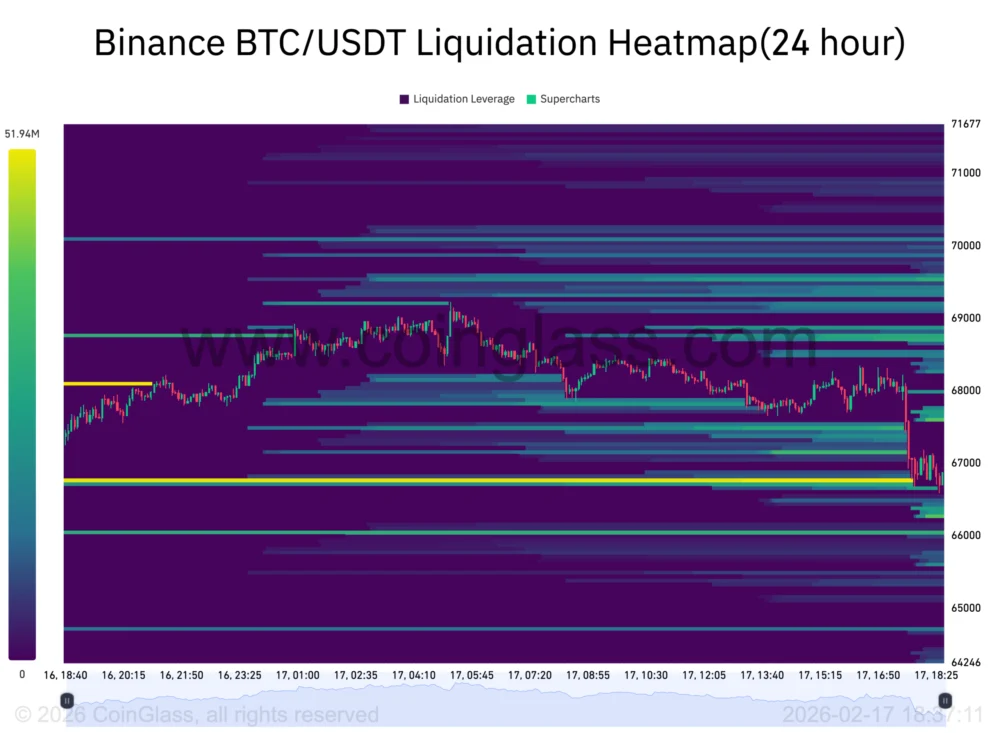
Bitcoin (BTC) experienced a notable dip below the $67,000 mark at Tuesday’s Wall Street open, as global financial markets, including digital assets, reacted sharply to escalating geopolitical pressures stemming from the Middle East. This downturn saw the flagship cryptocurrency shed over 3.8% of its value on Bitstamp within a single day, mirroring a broader "risk-off" sentiment that swept across traditional equities.
The primary catalyst for this market unease was a series of naval drills conducted by Iran in the strategically vital Strait of Hormuz. This narrow waterway is a critical chokepoint for global oil shipments, with an estimated one-fifth of the world’s petroleum supply passing through it daily. Any heightened military activity or perceived instability in the region can trigger significant anxieties in energy markets, leading to higher oil prices and a general aversion to riskier assets. While talks between the US and Iran, described by the latter as “serious and constructive,” concluded around the same time, the immediate market reaction was dominated by the visible show of force.

This geopolitical tremor quickly propagated through financial markets. The S&P 500 and Nasdaq Composite Index, key barometers of U.S. economic health and investor sentiment, saw declines of up to 1.25% as the trading session commenced. Concurrently, traditional safe-haven assets presented a mixed picture: while gold, often seen as a hedge against inflation and geopolitical instability, paradoxically dropped to lows of $4,842 per ounce, this movement might be attributed to profit-taking or a stronger U.S. dollar, which typically moves inversely to gold. The simultaneous sell-off across equities and cryptocurrencies underscored the prevailing market nervousness, illustrating Bitcoin’s growing correlation with broader macroeconomic and geopolitical narratives, despite its initial promise as an uncorrelated asset.
Analyzing the immediate impact on Bitcoin’s market structure, particular attention was drawn to exchange liquidity conditions. The X commentary account Exitpump highlighted the presence of significant bid liquidity at lower price levels, noting, “Really huge bids are still sitting there in the spot orderbooks around 60K level.” This observation, drawing on data from major exchanges like Binance and Coinbase, suggests that while the immediate selling pressure was pushing prices down, there was substantial buying interest positioned to potentially absorb further declines around the $60,000 psychological and technical support level. Bid liquidity refers to the volume of buy orders placed at various prices below the current market price, acting as a cushion against sharp drops. When price "grabs" this liquidity, it means these buy orders are being filled, often indicating that sellers are pushing prices lower into these waiting bids.
Further corroborating this dynamic, data from the monitoring resource CoinGlass, particularly its liquidation heatmap for Binance BTC/USDT, illustrated price movements slicing through nearby bid liquidity during the rapid descent. Liquidation heatmaps visualize areas where significant leverage positions (both long and short) are concentrated, indicating potential price magnets or accelerators. When prices move into areas of concentrated bid liquidity, it can trigger cascades of liquidations for over-leveraged long positions, further exacerbating the downward momentum as these positions are forcibly closed by exchanges, adding to selling pressure. This interplay between geopolitical events, investor sentiment, and market liquidity mechanics painted a clear picture of why Bitcoin saw such a swift decline.

The preceding day had already seen "liquidity games" dominate Bitcoin’s volatility, with both long and short positions finding themselves in precarious situations. This ongoing dance around liquidity zones is a common feature of consolidating markets, where price action often targets areas of high order density to trigger stop losses or liquidations before potentially reversing or continuing a trend.
Michaël van de Poppe, a well-known crypto trader, analyst, and entrepreneur, summarized the situation by stating, “Nothing special on $BTC. It’s stuck in a range and simply consolidating, through which it’s a waiting game until volatility slows down and the expansion is about to game.” His assessment points to a period of indecision and accumulation within a defined price channel. Consolidation phases are characterized by reduced volatility and a narrowing of price ranges, as buyers and sellers battle for dominance without a clear winner. The "waiting game" refers to the market anticipating a significant breakout, or "expansion," once enough pressure builds up, either to the upside or downside. For traders, identifying these ranges and anticipating the eventual breakout is key. The current range suggests that until a clear catalyst or fundamental shift occurs, Bitcoin may continue to oscillate within these established boundaries.
Despite the prevailing bearish sentiment, not all news was negative. MicroStrategy, the company renowned for holding the world’s largest corporate Bitcoin treasury, announced a significant acquisition of nearly 2,500 BTC over the past week. This consistent accumulation, as confirmed by CEO Michael Saylor, brought MicroStrategy’s total holdings to an impressive 717,131 BTC, with an average cost basis just over $76,000. This continuous, large-scale buying by a publicly traded company underscores a long-term conviction in Bitcoin’s value proposition and is often seen by many investors as a strong bullish signal, demonstrating institutional confidence despite short-term price fluctuations. However, the immediate market reaction to this news was muted, overshadowed by the broader geopolitical concerns.

Simultaneously, on-chain data tracked potential outflows from the newly launched U.S. spot Bitcoin exchange-traded funds (ETFs). For instance, BlackRock, a major player in the ETF space, reportedly deposited another 1,701 BTC ($115.2M) and 22,661 ETH ($44.5M) to Coinbase Prime. While these movements can sometimes signal rebalancing or strategic allocations rather than outright selling, sustained outflows from ETFs can indicate weakening institutional demand, which has been a significant price driver since their inception. The interplay of MicroStrategy’s accumulation and potential ETF outflows creates a complex picture of institutional sentiment, suggesting a nuanced environment where different institutional players have varying strategies and risk appetites.
Adding another layer of caution, Shark Tank cohost and venture capitalist Kevin O’Leary reiterated his concerns about the long-term security of Bitcoin. Speaking to mainstream media, O’Leary voiced the opinion that the theoretical threat of quantum computing cracking Bitcoin’s underlying security model was a deterrent for some institutional investors. He stated, “I’m still long this, but there’s a new concern floating around for 10% of the people out there: quantum, the idea that a quantum computer can break the chain.” O’Leary suggested that this perceived, albeit distant, threat was leading institutions to cap their potential exposure to Bitcoin at around 3% of their portfolios.
The concern surrounding quantum computing revolves around its potential to break current cryptographic algorithms, including those that secure Bitcoin’s network (SHA-256 for mining and ECDSA for digital signatures). While quantum computers capable of such feats are largely theoretical or in very early developmental stages, and the crypto community is actively researching post-quantum cryptography solutions, the mere mention of this possibility can introduce FUD (fear, uncertainty, and doubt) among less informed or risk-averse traditional investors. Most experts believe that by the time quantum computers pose a realistic threat, Bitcoin’s protocol would have adapted with quantum-resistant algorithms. Nevertheless, O’Leary’s comments highlight a narrative that occasionally surfaces in traditional finance circles, contrasting with the prevailing confidence within the crypto space regarding the protocol’s adaptability and resilience.

In conclusion, Bitcoin’s dip below $67,000 was a multifaceted event, primarily triggered by heightened geopolitical tensions in the Middle East, which fostered a broad "risk-off" environment across global markets. This sentiment, combined with specific market mechanics such as the activation of bid liquidity and the ongoing consolidation phase, painted a picture of a market grappling with external pressures. While underlying institutional accumulation by entities like MicroStrategy continues to provide long-term bullish signals, and concerns like quantum computing remain largely theoretical, the immediate future of Bitcoin will likely remain sensitive to both macro-geopolitical developments and its internal market structure dynamics, as traders await a clear expansion from its current range. Investors are advised to conduct their own thorough research and consider the inherent risks associated with such volatile assets.