anjir abdul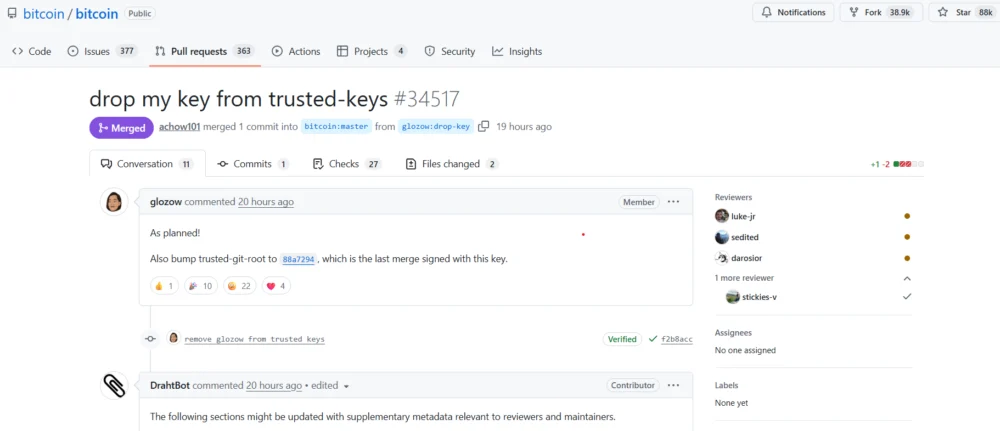
Bitcoin Core developer Gloria Zhao has formally stepped down from her esteemed position as a maintainer and, in a definitive act, revoked her Pretty Good Privacy (PGP) signing key, concluding a significant six-year tenure during which she served as one of the critical gatekeepers of the Bitcoin protocol. On Thursday, Zhao submitted her final pull request to the public Bitcoin GitHub repository, a symbolic and functional action that removed her key from the list of trusted keys and officially withdrew her from the exclusive group of maintainers empowered to update Bitcoin’s foundational software. Her departure marks a pivotal moment for the project, signifying the loss of a highly respected and influential contributor.
Zhao’s journey to becoming a Bitcoin Core maintainer was notable for several reasons. In 2022, she made history as the first known female maintainer, a significant achievement in a traditionally male-dominated field, underscoring her exceptional technical prowess and dedication. Throughout her tenure, her work primarily focused on the intricate domains of mempool policy and transaction relay. These areas are fundamental to the efficient and resilient operation of the Bitcoin network, governing the rules and peer-to-peer logic that dictate which transactions are accepted into nodes’ waiting rooms (the mempool) and how rapidly they propagate across the global network. Her contributions in these areas were instrumental in shaping how transactions are processed and confirmed, directly impacting user experience and the network’s overall health.
Her technical contributions were both extensive and impactful. Zhao played a crucial role in the design and implementation of several key Bitcoin Improvement Proposals (BIPs) and protocol upgrades. Among these were package relay (BIP 331), a sophisticated mechanism designed to improve the reliability of transactions that depend on one another, particularly critical for complex applications like the Lightning Network. She also contributed to Topologically Restricted Until Confirmation (TRUC, BIP 431), another innovative proposal aimed at optimizing transaction ordering and preventing certain types of network congestion. Furthermore, her expertise extended to significant upgrades to replace-by-fee (RBF) functionality, making fee bumping more reliable for users wishing to expedite their transactions, and broader improvements to peer-to-peer (P2P) behavior, which collectively enhanced network robustness and reduced the potential for transaction censorship. These improvements were vital for ensuring that Bitcoin transactions are processed efficiently, fairly, and securely, bolstering the network’s resilience against various forms of attack and manipulation.
Gloria Zhao’s vital work was made possible through funding from Brink, a non-profit organization dedicated to supporting Bitcoin Core development. She became Brink’s inaugural fellow in 2021, a testament to her talent and the recognition of her crucial role in the ecosystem. Her fellowship was generously backed by the Human Rights Foundation’s Bitcoin Development Fund and Jack Dorsey’s Spiral (formerly Square Crypto), placing her among a select cohort of publicly supported, full-time open-source Bitcoin protocol engineers. This unique funding model highlights the importance the wider Bitcoin community places on dedicated, independent developers who can focus entirely on maintaining and improving the core protocol, free from commercial pressures.
Beyond her profound technical contributions, Zhao was also a passionate advocate for community growth and mentorship. She actively mentored new contributors, helping to cultivate the next generation of Bitcoin Core developers. Her involvement in co-running the Bitcoin Core PR Review Club was particularly impactful. This initiative provided a structured environment where junior developers could learn the ropes of reviewing complex code changes and navigate Core’s notoriously conservative review culture. This culture, while sometimes challenging, is essential for maintaining the security, stability, and integrity of Bitcoin, a system that secures trillions of dollars in value. Her efforts in this area were critical for the long-term sustainability and decentralization of Bitcoin development.
Her resignation, however, does not come without a backdrop of intense community friction. It follows more than a year of public disputes, particularly between Bitcoin Core and Bitcoin Knots, an alternative implementation of the Bitcoin protocol, and heated debates surrounding the removal of OP_RETURN limits. The "OP_RETURN war" centered on a fundamental philosophical disagreement: whether Bitcoin’s default node software should implement stricter measures to make it harder to use block space for non-monetary data. OP_RETURN is a script opcode that allows a small amount of arbitrary data to be embedded in a transaction, and the debate revolved around how much and what kind of data should be permitted, and whether allowing too much non-monetary data "bloats" the blockchain or deviates from Bitcoin’s primary purpose as a monetary system.
The controversy took a personal turn in 2025 when Zhao deleted her X (formerly Twitter) account amidst a torrent of personal attacks during the peak of the OP_RETURN war. This online harassment intensified following a livestream in which another core developer publicly questioned her credentials, undermining her authority and expertise in front of the community. Such incidents highlight the severe pressures and often toxic environment that prominent open-source maintainers, especially women, can face within the highly opinionated and often contentious Bitcoin community. The public questioning of her credentials by a peer was particularly damaging, as it struck at the core of her professional standing and commitment to the project.
The announcement of her departure elicited a polarized response within the Bitcoin community. While some Bitcoin Core critics, who perhaps disagreed with her stance on certain policy decisions or the direction of Bitcoin Core development, expressed a sense of triumph, others adopted a decidedly more somber and reflective tone. These individuals viewed her resignation as a significant loss, lamenting the circumstances that led to it.
Pseudonymous Bitcoiner Pledditor articulated a strong condemnation of the perceived bullying, stating, "They bullied her and made her life as miserable as possible until she rage quit, and quite frankly, I think what they did to her was tragic." Pledditor further added that this outcome set a "terrible precedent" for the future of Bitcoin Core development, labeling the situation as "sad and pathetic." This sentiment reflects a deep concern about the community’s ability to retain valuable talent, particularly when faced with aggressive internal conflicts.
Echoing this sentiment, Chris Seedor, co-founder and CEO of Bitcoin wallet backup company Seedor, offered a sarcastic yet poignant remark: "Congratulations you finally did it. You bullied one of Bitcoin Core’s most prolific and consistently excellent maintainers until she gave up." This statement underscores the belief that Zhao’s departure was not a voluntary career change but a forced exit driven by relentless pressure and hostility. The loss of a maintainer of Zhao’s caliber, with her specialized knowledge in mempool and transaction relay, leaves a significant void in the development team. Her departure could impact the pace and direction of future protocol improvements in these critical areas, and it raises broader questions about the sustainability of a decentralized development model when key contributors are driven away by internal strife and personal attacks. The incident serves as a stark reminder of the challenges inherent in open-source communities, particularly those governing high-stakes, globally significant projects like Bitcoin, where passionate disagreements can sometimes escalate into destructive personal attacks.