anjir abdul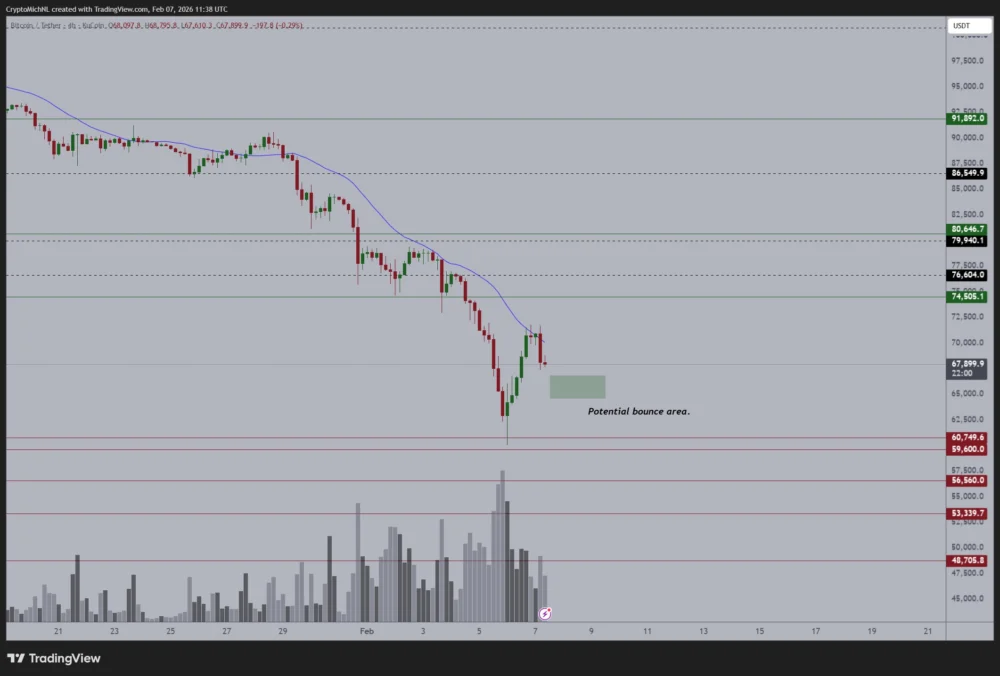
Bitcoin’s aspirational ascent above the critical $69,000 threshold proved fleeting as the weekend commenced, quickly succumbing to selling pressure and reigniting fears of a deeper market correction that could see the flagship cryptocurrency plunge to new macro lows, even as some analysts eye potential short-term rebounds driven by unfulfilled CME futures gaps. The recent price action, marked by a significant $4,000 drop from the daily open, has left the market in a state of heightened uncertainty, with a clear divergence between technical indicators signaling further downside and specific market anomalies suggesting immediate bullish potential. This precarious positioning underscores a battle between deeply entrenched cyclical patterns and the immediate gravitational pull of market inefficiencies, leaving investors to navigate a complex landscape of conflicting signals.
The immediate catalyst for the renewed bearish sentiment was Bitcoin’s inability to firmly reclaim and consolidate above its previous all-time high of $69,000, established in November 2021. This pivotal level, which many hoped would flip from resistance to robust support, instead acted as a formidable ceiling, rejecting attempts at upward momentum. The failure to hold this psychological and historically significant price point triggered a cascade of sell orders, pushing BTC/USD back into a range that has characterized much of its recent volatility. Data from TradingView vividly illustrates this retreat, showing Bitcoin’s price action undergoing a rapid depreciation, losing over $4,000 in a single trading day, a move that quickly extinguished any nascent bullish enthusiasm. The reversion of the old 2021 all-time high into a clear resistance level has left already wary traders in no mood for relief, with many now bracing for further declines.

Prominent market analysts have been quick to articulate a cautious, if not outright bearish, outlook. Keith Alan, co-founder of the trading resource Material Indicators, minced no words in his assessment, warning X followers that the "BTC bottom, is not in." His priority, he stated, was "capital preservation," a sentiment echoing across the trading community as risk appetite waned. Alan’s analysis highlighted the deceptive nature of recent price movements, advising against premature declarations of a market recovery. "If you’re thinking, ‘We’re so back,’ we’re not. There is literally no evidence of that yet," he emphatically stated. His observations on order-book liquidity, which reveal significant whale orders and shifting bid-ask dynamics, underscored the fragility of the market structure. The $69,000 level, according to Alan, was "important" within what he termed an ongoing "relief rally"—implying that any upward moves were merely temporary corrections within a larger downtrend. He further elaborated on the fleeting nature of prior gains, suggesting that "$60k was a gift yesterday, but there’s a high probability that lower is likely before the Bull Market returns." This perspective suggests that the market needs to undergo a more profound cleansing or capitulation event before a sustainable bull run can truly resume, with current price levels still potentially overvalued in the context of broader market cycles.
Zooming out to a macro perspective, trader and analyst Rekt Capital presented a compelling argument for continued downside based on historical Bitcoin halving cycles. His analysis, widely respected for its long-term cyclical insights, suggested that the worst of the bearish BTC price move was far from over. Rekt Capital noted a recurring pattern: "Whenever Bitcoin peaks in its Bull Market in Q4 of the Post-Halving year… It tends to produce a multi-month Relief Rally from the Macro Triangle Base before breaking down from the Triangle to transition into Bearish Acceleration." He pointed out that this pattern, characterized by an initial surge followed by a prolonged consolidation and eventual breakdown, has consistently played out across Bitcoin’s history. The current market cycle, according to Rekt Capital, is merely the "4th consecutive cycle that this historical tendency has continued." His stark conclusion, derived from the consistent repetition of this pattern, is that "history suggests there’s more downside to come." This cyclical analysis implies that the market is currently in a phase akin to the multi-month relief rally, which historically precedes a more aggressive bearish acceleration, potentially targeting lower support levels before a genuine accumulation phase can begin. This framework casts a long shadow over any short-term bullish aspirations, placing the current price action within a larger, predetermined trajectory of decline.
Amidst these pervasive bearish warnings, a contingent of traders and analysts remains focused on specific market anomalies that could trigger short-term upward movements: CME (Chicago Mercantile Exchange) gaps. Saturday’s sharp retracement, which saw Bitcoin futures on the CME close at a higher price than the subsequent Monday open on the spot market, left a new potential "gap" in CME Group’s Bitcoin futures market. These gaps, representing price disparities between the closing price of CME Bitcoin futures on Friday and their opening price on Monday, are often viewed by some traders as "short-term price magnets." The prevailing theory is that the market has a tendency to "fill" these gaps, meaning the price will eventually move to trade within the range of the unclosed gap. This new gap joins another, more significant one, left at approximately $84,000, creating two distinct targets that could pull Bitcoin’s price higher if the market decides to pursue these fills.

The prospect of CME gap fills injects a counter-narrative into the otherwise bearish landscape. Michaël van de Poppe, a well-known crypto trader, analyst, and entrepreneur, articulated a bullish short-term forecast rooted in this phenomenon. He boldly predicted, "Today: correction day. Tomorrow: back up again towards the CME gap. Next week: continuation to $75k+." Van de Poppe’s outlook suggests that the immediate downside may be limited, paving the way for a swift rebound driven by the market’s inclination to address these price inefficiencies. Such a move would not only fill the newly created gap but also potentially propel Bitcoin towards the more ambitious $84,000 target, providing significant relief for bulls. This perspective often aligns with the idea that market structure, while influenced by macro trends, can also be dictated by specific technical levels and patterns in the shorter term.
Further amplifying the bullish case from a fundamental perspective, Samson Mow, CEO of Bitcoin adoption company JAN3, highlighted the higher CME gap as one of two crucial questions "every financial analyst should be asking themselves." The second topic revolved around the ability of large-scale corporate buyers to accumulate BTC for their treasuries at current "15-month lows." Mow’s perspective posits that the current price weakness, while concerning for short-term traders, presents an attractive entry point for institutions and corporations with a long-term Bitcoin strategy. He optimistically concluded, "I believe the answers are not for long and very soon," implying that significant institutional buying pressure is imminent, which could rapidly absorb available supply and drive prices higher. This argument rests on the premise that the underlying demand for Bitcoin as a treasury asset or a hedge against inflation remains strong, and temporary price dips are seen as opportunities rather than threats by sophisticated long-term investors.
In essence, Bitcoin finds itself at a critical juncture, pulled in opposing directions by deeply ingrained market cycles and immediate technical targets. On one side, seasoned analysts like Keith Alan and Rekt Capital warn of an unfinished bearish cycle, predicting further declines based on historical patterns and current market structure. Their warnings emphasize capital preservation and the likelihood of new macro lows before a sustainable bull market can emerge. On the other side, the presence of unfilled CME gaps provides a beacon of hope for short-term rallies, with analysts like Michaël van de Poppe forecasting immediate upward momentum. This optimistic view is buttressed by Samson Mow’s anticipation of imminent institutional accumulation at what he perceives as attractive prices.

The market’s immediate future hinges on which of these powerful forces gains dominance. Will the gravitational pull of historical bearish cycles and macro economic headwinds drag Bitcoin further down, perhaps testing critical support levels significantly below current prices? Or will the magnetic effect of CME gaps, coupled with renewed institutional interest, provide a short-term reprieve, potentially leading to a sharp recovery towards higher price targets? For now, Bitcoin remains caught in this tug-of-war, with volatility likely to persist as traders and investors attempt to decipher the true direction amidst these conflicting signals. Navigating this environment demands a careful balance of risk management, an understanding of both technical and cyclical analysis, and a keen eye on evolving market sentiment.
This article does not contain investment advice or recommendations. Every investment and trading move involves risk, and readers should conduct their own research when making a decision. While we strive to provide accurate and timely information, Cointelegraph does not guarantee the accuracy, completeness, or reliability of any information in this article. This article may contain forward-looking statements that are subject to risks and uncertainties. Cointelegraph will not be liable for any loss or damage arising from your reliance on this information.