anjir abdul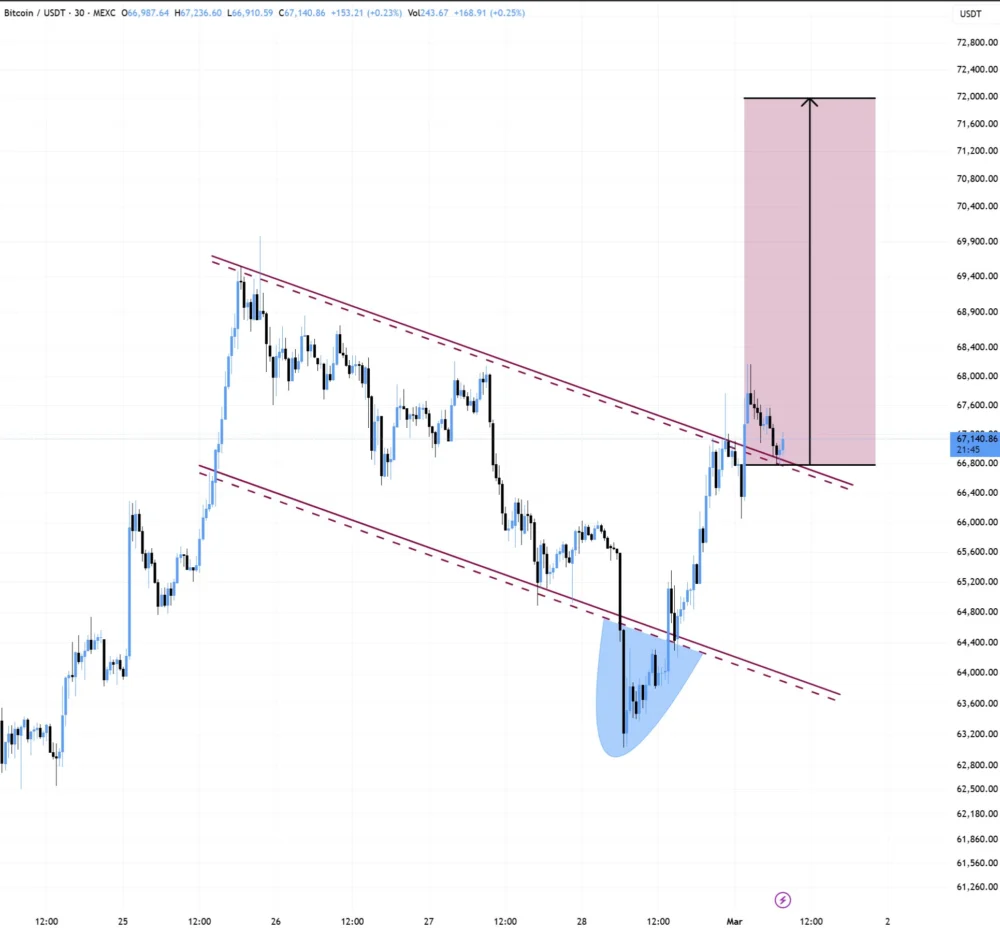
Bitcoin (BTC) demonstrated remarkable resilience over the weekend, seemingly ignoring a fresh wave of geopolitical volatility emanating from the Middle East as traders braced for the opening of traditional markets and their anticipated reaction to escalating tensions between Iran and Israel. The world’s leading cryptocurrency, often seen as a barometer for broader risk sentiment, managed to stabilize around the $67,000 mark, with several prominent analysts suggesting a significant upside potential despite the prevailing global uncertainties.

The latest round of conflict saw a direct military engagement between Iran and Israel, a development that typically sends shockwaves through global financial markets, driving investors towards perceived safe-haven assets like gold, the U.S. dollar, and government bonds, while risk assets like equities and, at times, cryptocurrencies, tend to suffer. However, Bitcoin’s price action on Sunday painted a more nuanced picture. While there was an initial dip, the digital asset quickly recovered, avoiding a major breakdown from its established local trading range. This behavior sparked debate among market participants regarding Bitcoin’s evolving role in a turbulent world and its potential to decouple from traditional market reactions.
A key factor influencing Bitcoin’s weekend performance was the closure of traditional financial (TradFi) markets. With major stock exchanges in the U.S. and Europe shuttered, real-time adjustments to the geopolitical events were primarily confined to 24/7 markets like crypto. U.S. stock market futures, which trade continuously, were down approximately 0.65% at the time of writing, signaling a cautious sentiment among institutional investors awaiting Monday’s open. This delay often means that cryptocurrency markets bear the initial brunt of news, but also sometimes offer a preview of how broader markets might react. In this instance, Bitcoin’s relatively quick stabilization was interpreted by some as a sign of underlying strength or that the negative news might have already been "priced in" by astute market participants.

Commenting on the market’s initial response, Michaël van de Poppe, a well-known crypto trader, analyst, and entrepreneur, described it as "positive." He noted that despite the uncertainty, Bitcoin held its ground relatively well. "Now, markets are correcting back down, as there’s uncertainty on how US markets will open tomorrow (and there’s still an outstanding gap of the CME)," van de Poppe wrote in a post on X (formerly Twitter). He elaborated on the technical indicators he was watching, specifically pointing to the Bitcoin’s 21-day simple moving average (SMA) at $67,627. The 21-day SMA is a commonly used short-term trend indicator; a break above it often signals bullish momentum, while a fall below it can suggest weakness. For van de Poppe, breaching this level would be crucial for initiating a "relief rally."
Van de Poppe also highlighted the "gap" in CME Group’s Bitcoin futures market, which lay to the downside at $65,880. A CME gap occurs when the price of Bitcoin at the close of traditional trading hours on Friday differs significantly from its opening price on Monday. Traders often watch these gaps, believing that the price tends to "fill" them by returning to that level at some point. The existence of a downside gap suggested a potential magnet for prices, adding to the immediate uncertainty. Despite these technical considerations, van de Poppe maintained an optimistic outlook for the medium term, suggesting, "I think we’ll see it in March/April, question of how we’re opening the markets tomorrow and whether it finds a higher low." A "higher low" is a fundamental concept in technical analysis, indicating that each subsequent low point in price is higher than the previous one, which is a strong signal of an ongoing uptrend.

Another prominent trader, BitBull, echoed a similar sentiment, expressing confidence in Bitcoin’s short-term prospects. " $BTC looks good in the short-term," BitBull agreed, specifically referring to the three-day chart. He observed a crucial technical pattern: "Deviation below the support zone and has now flipped resistance into support." This phenomenon, where a price level that previously acted as a ceiling (resistance) now acts as a floor (support) after being broken, is a highly bullish signal for technical analysts. It indicates a strengthening market structure and a potential continuation of the upward trend. Based on this analysis, BitBull confidently predicted, "I think a rally towards the $73K-$74K level could happen." This target range is significant as it approaches Bitcoin’s all-time highs and represents a substantial recovery from recent dips.
The idea that geopolitical instability might have been "priced in" by the market in advance gained traction among some analysts. This concept suggests that savvy investors, anticipating potential conflicts, may have already adjusted their positions, leading to a more modest price action than might otherwise be expected during the actual event. Trader Crypto Caesar, for instance, concluded, "We will probably move side ways the next days…," implying a period of consolidation as the market digests the news and awaits further clarity on both the geopolitical front and the opening of traditional markets. Sideways movement, or consolidation, is a common phase in market cycles where supply and demand are relatively balanced, often occurring after significant price moves or during periods of uncertainty before the next major trend emerges.

Beyond Bitcoin’s immediate price action, a separate point of concern focused on the broader macroeconomic implications of the Iran tensions, particularly the potential for oil price volatility. Reports emerged that Iran claimed to be closing the Strait of Hormuz, a critical choke point for global oil shipping. The Strait of Hormuz, while international waters, is strategically vital, as approximately one-fifth of the world’s total petroleum consumption and one-third of the world’s liquefied natural gas (LNG) transits through it daily. Any disruption or perceived threat to shipping in this narrow passage can send global oil prices soaring, with immediate and profound knock-on effects for economies worldwide.
The potential closure or disruption of the Strait of Hormuz immediately led to swift analysis of its impact on U.S. inflation. Trading resource The Kobeissi Letter referenced research by JPMorgan, suggesting that such a development could cause the Consumer Price Index (CPI) to jump significantly, potentially reaching 5%. The CPI is a key indicator of inflation, measuring the average change over time in the prices paid by urban consumers for a market basket of consumer goods and services. A jump to 5% would be a stark increase from recent figures and would have serious implications for monetary policy. "The last time we saw US inflation at 5% was in March 2023, when the Fed was aggressively hiking rates," The Kobeissi Letter noted in a dedicated X thread. This historical context is crucial, as the Federal Reserve has recently been signaling a potential shift towards interest rate cuts later in the year. A resurgence in inflation, particularly driven by energy prices, could force the Fed to maintain higher rates for longer, or even consider further hikes, which would generally be bearish for risk assets like Bitcoin.

Indeed, recent U.S. inflation prints have already outpaced expectations, adding to the macroeconomic concerns. Friday’s Producer Price Index (PPI) numbers, which measure the average change over time in the selling prices received by domestic producers for their output, also came in higher than anticipated. Elevated PPI often translates to higher CPI as producers pass on increased costs to consumers. In such an environment of rising inflation and potential economic uncertainty, Bitcoin’s narrative as "digital gold" or an inflation hedge could gain renewed traction. Proponents argue that Bitcoin, with its fixed supply and decentralized nature, offers a store of value independent of government-issued fiat currencies, which can be debased by excessive money printing or inflationary pressures. This characteristic might explain some of its resilience during periods of geopolitical and economic instability.
In conclusion, while the geopolitical landscape remains fraught with tension and traditional markets brace for a potentially volatile opening, Bitcoin has demonstrated a degree of independence and resilience. The immediate market reaction suggests that some of the conflict’s impact may have been anticipated, or that the crypto market’s unique dynamics are at play. Technical analysts like Michaël van de Poppe and BitBull are identifying key support levels and patterns that, if held, could propel Bitcoin towards the $73,000-$74,000 range. However, the broader macroeconomic picture, particularly the potential for escalating oil prices and a resultant spike in inflation due to developments like the Strait of Hormuz situation, looms large. How traditional markets react in the coming days, and whether central banks adjust their monetary policies in response to renewed inflationary pressures, will ultimately shape the broader investment landscape and influence Bitcoin’s trajectory. As always, the cryptocurrency market remains highly volatile, and investors are advised to conduct their own thorough research and exercise caution.