anjir abdul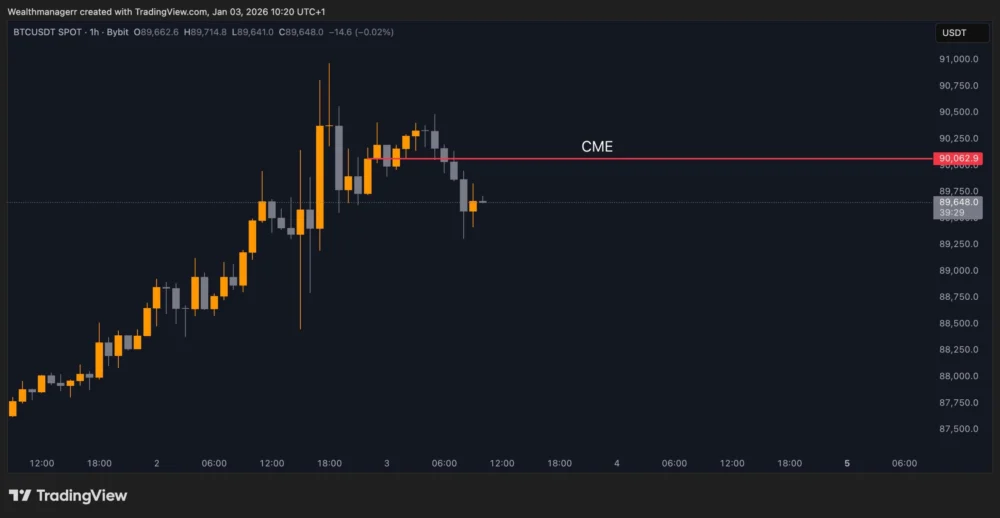
Bitcoin (BTC) experienced a notable dip below the critical $90,000 threshold on Saturday, as global cryptocurrency markets responded sharply to an unexpected escalation of geopolitical tensions stemming from reported U.S. military actions in Venezuela. This sudden price movement underscored Bitcoin’s growing sensitivity to international political instability, transforming the digital asset into an immediate barometer for market sentiment amidst evolving global events.
The cryptocurrency market, often touted for its decentralization and supposed insulation from traditional financial systems, found itself directly in the crosshairs of geopolitical pressure. Bitcoin’s price action, which had seen highs near $90,940 on Bitstamp just prior, reversed course rapidly following reports of U.S. military engagement. Data from TradingView illustrated this abrupt shift, capturing the market’s instantaneous reaction to the unfolding drama. (Refer to the BTC/USD one-hour chart for visual confirmation of the price reversal.)

The catalyst for this market turbulence was a series of startling announcements. News agencies began reporting U.S. airstrikes in the Venezuelan capital, Caracas, an unprecedented move that immediately sent shockwaves through international relations. This was quickly followed by a public statement from then-President Donald Trump on Truth Social, where he dramatically declared that Venezuela’s President had been captured and "flown out of the country." This pronouncement, delivered via a social media platform, injected an acute level of uncertainty and alarm into an already tense global landscape. (Refer to the screenshot of President Trump’s Truth Social post for the original announcement.)
With traditional financial markets — equities, bonds, and major forex — closed for the weekend, Bitcoin’s reaction served as an early indicator of how broader risk assets might behave once trading resumed. This unique timing meant that the decentralized crypto market bore the brunt of the initial investor response, attempting to preserve some of its impressive early-year gains ahead of the return of futures trading on Sunday. The situation highlighted Bitcoin’s emerging role as a global risk asset that can respond to significant events even when traditional markets are dormant.

Market analysts were quick to weigh in on the unfolding situation. A prominent analytics account, @Wealthmanager, reacted on X (formerly Twitter), stating, "We’re seeing some short-term selling pressure due to the ongoing US action against Venezuela, but I remain bullish in the near term." This sentiment encapsulated a cautious optimism, suggesting that while the immediate impact was negative, the long-term trajectory might not be fundamentally altered. Wealthmanager further elaborated on their perspective, noting, "If this situation doesn’t escalate further, I view the move as a temporary pullback, with a recovery likely soon. $96,000–$100,000 remains my target for the coming days/weeks." (Refer to the BTC/USDT one-hour chart from Wealthmanager/X for their analysis.)
A key element of Wealthmanager’s bullish outlook hinged on the concept of CME Group’s Bitcoin futures market "gap." They observed that CME Group’s Bitcoin futures market had concluded the week above $90,000. This created a potential "gap" on the charts, a phenomenon that often acts as a magnet for price action. A CME gap occurs when the price of Bitcoin futures on the Chicago Mercantile Exchange closes at one level on Friday and then opens at a significantly different level on Monday, leaving a "gap" on the chart. Traders often anticipate that the price will eventually move to "fill" these gaps, making them important technical analysis points and potential price targets. In this instance, a gap to the upside above $90,000 suggested a strong likelihood of price appreciation once institutional trading resumed, potentially pushing Bitcoin towards the $96,000-$100,000 range.

Echoing this sentiment regarding the influence of institutional players, crypto analyst Lennaert Snyder concurred that much of Bitcoin’s immediate future hinged on the reopening of traditional finance (TradFi) next week. "There’s a lot of geopolitical tension and next week the big players will return. So we’ll probably see more volatility on Bitcoin after the weekend," he told his X followers. Snyder’s analysis underscored the significant capital and influence wielded by institutional investors and large-scale traders in the TradFi sector. Their return to the markets after a weekend, especially following such a major geopolitical development, was expected to amplify price movements and potentially dictate Bitcoin’s short-to-medium-term direction. The institutional response would not only reflect their assessment of the geopolitical situation but also their broader investment strategies concerning risk-on and risk-off assets. (Refer to the BTC/USDT perpetual futures one-hour chart from Lennaert Snyder/X for his perspective.)
Adding another layer of interpretation, crypto trader, analyst, and entrepreneur Michaël van de Poppe characterized Bitcoin’s latest price movement as a "classic Venezuela reaction." This implies that such geopolitical events, particularly involving countries with significant economic instability or those targeted by international actions, have historically elicited a predictable response from the crypto market. Despite the immediate downturn, Van de Poppe maintained a resolutely bullish outlook for Bitcoin. "The direction is clear for January: up we go, as long as Bitcoin remains above the 21-Day MA," he concluded. He referenced the 21-day simple moving average (SMA) at $87,850, a widely watched technical indicator. The 21-Day MA is often used by traders to gauge the short-term trend of an asset. Maintaining price above this moving average is typically considered a bullish signal, indicating that buying pressure remains dominant. If Bitcoin were to dip significantly below this level, it could signal a shift towards a more bearish sentiment, but as long as it held, Van de Poppe saw the broader upward trend intact for the start of the year. (Refer to the BTC/USD one-day chart with 21SMA for this technical analysis.)

Beyond the immediate geopolitical fallout, Bitcoin bulls also drew confidence from the cryptocurrency’s relatively strong performance against gold during the New Year period. Gold (XAU/USD), traditionally considered the ultimate safe-haven asset, had reached new all-time highs of $4,551 per ounce on December 26. However, it subsequently experienced a significant correction, falling by up to 6% before stabilizing. In stark contrast, during this same timeframe, BTC/USD managed to gain up to 5%. This divergence in performance reignited discussions about Bitcoin’s role as "digital gold" and its potential to siphon capital away from the traditional precious metal.
Trading and analytics resource Bull Theory highlighted this intriguing dynamic, commenting on X: "An important thing to remember is that the last time Bitcoin started its parabolic rally was after Gold made the top." They continued, "So if $4550 was the top for Gold, this could be the start of money rotation from Gold to BTC." This perspective suggests a cyclical relationship where, after gold reaches its peak and begins to consolidate or retract, investors might look for alternative stores of value or inflation hedges, with Bitcoin emerging as a prime candidate. The narrative of Bitcoin as "digital gold" has gained significant traction, especially among younger investors and those seeking an asset with a fixed supply, independent of central bank policies. While gold has centuries of history as a safe haven, Bitcoin offers decentralization, portability, and increasingly, institutional adoption, presenting a compelling alternative in times of economic and geopolitical uncertainty. (Refer to the BTC/USD vs. XAU/USD chart from Bull Theory/X for a comparative view.)

As Cointelegraph had previously reported, gold concluded 2025 as the year’s best-performing major asset, demonstrating its enduring appeal amidst global economic volatility. Bitcoin, conversely, despite reaching its own all-time highs in October of that year, had brought up the rear in terms of overall yearly performance compared to other major asset classes. This recent reversal in fortunes, with Bitcoin outperforming gold during a period of geopolitical stress, could signal a significant shift in investor allocation strategies heading into the new year. It suggests that a growing segment of investors might be increasingly viewing Bitcoin not just as a speculative tech asset, but as a legitimate safe-haven or inflation hedge, capable of rivaling gold’s traditional dominance in times of crisis.
The implications of such a "money rotation" are profound. Should this trend continue, it could provide a powerful tailwind for Bitcoin’s price, attracting capital from investors traditionally confined to gold. However, the short-term volatility induced by geopolitical events like the Venezuela situation also highlights Bitcoin’s inherent risk. While its price action serves as an immediate reflection of global sentiment, its relatively young history and susceptibility to rapid swings mean that it remains a high-stakes asset. The coming days and weeks will be crucial in determining whether the "Venezuela reaction" proves to be a temporary blip on a bullish trajectory, or if it ushers in a period of sustained volatility influenced by an increasingly interconnected and unpredictable global landscape. The crypto market, with Bitcoin at its forefront, is undeniably becoming an essential yardstick for gauging market responses to the world’s most pressing geopolitical developments.

This article does not contain investment advice or recommendations. Every investment and trading move involves risk, and readers should conduct their own research when making a decision. While we strive to provide accurate and timely information, Cointelegraph does not guarantee the accuracy, completeness, or reliability of any information in this article. This article may contain forward-looking statements that are subject to risks and uncertainties. Cointelegraph will not be liable for any loss or damage arising from your reliance on this information.