anjir abdul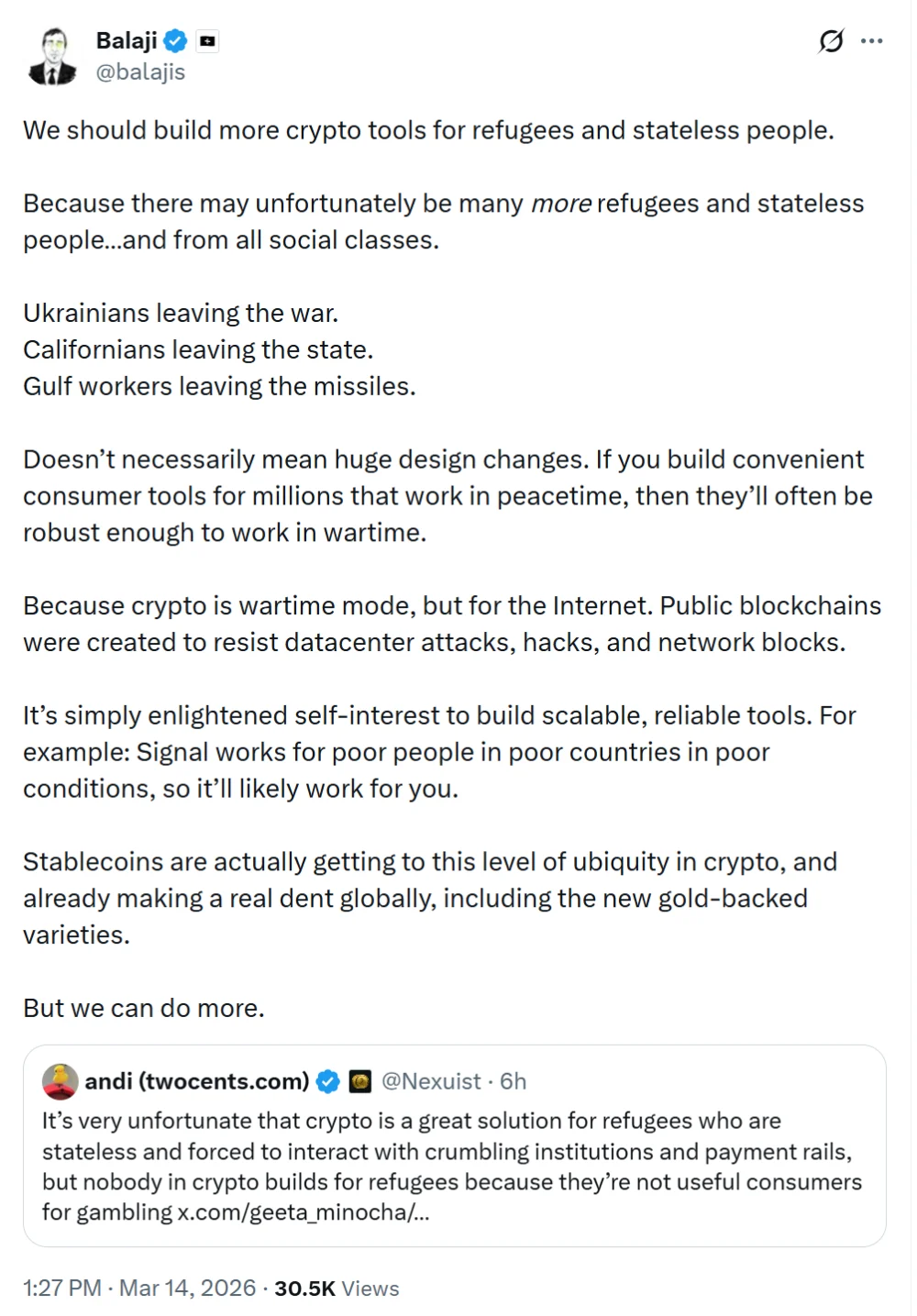
Tech investor and former Coinbase chief technology officer Balaji Srinivasan has issued a compelling call to action, urging the burgeoning crypto industry to pivot its innovation towards developing robust financial tools specifically designed for refugees and stateless individuals, a demographic increasingly vulnerable to global instability and financial exclusion. Srinivasan, renowned for his futurist perspectives and deep understanding of decentralized technologies, articulated this vision in a recent post on X (formerly Twitter), highlighting the critical role blockchain-based systems can play when traditional institutions falter or become inaccessible during humanitarian crises.
Srinivasan’s intervention comes at a crucial juncture, as geopolitical tensions escalate and economic migrations intensify, leading to an unprecedented rise in the number of displaced persons worldwide. He cited diverse examples, from Ukrainians forced to flee war-torn regions to workers departing Gulf countries amidst regional instabilities, underscoring the universal nature of this growing challenge. His assertion that "We should build more crypto tools for refugees and stateless people" is not merely an idealistic sentiment but a strategic proposition rooted in the inherent resilience and borderless nature of decentralized networks.
To understand the profound implications of Srinivasan’s call, it’s essential to grasp the unique and often dire financial predicaments faced by refugees and stateless people. These individuals frequently lose their official identification documents during displacement, rendering them invisible to traditional banking systems. Without passports, proof of address, or recognized legal status, opening a bank account, receiving remittances from family abroad, or even accessing basic financial services becomes an insurmountable hurdle. They are often reliant on informal, costly, and insecure channels, making them susceptible to exploitation, theft, and the erosion of their limited assets. Furthermore, the currencies of their home countries often suffer hyperinflation or devaluation, stripping them of their life savings and any semblance of financial stability.
Srinivasan conceptualized crypto as "wartime mode for the internet," a powerful metaphor that encapsulates the technology’s inherent ability to function under duress. He argued that decentralized networks were architected precisely to operate resiliently even amidst hostile conditions, such as cyberattacks, widespread infrastructure failures, or severe financial restrictions imposed by authoritarian regimes or collapsing states. Unlike centralized financial systems, which have single points of failure susceptible to government control, censorship, or physical destruction, public blockchains are distributed globally, ensuring continuous transaction processing regardless of localized disruptions. This makes them an ideal infrastructure for individuals who exist outside or at the fringes of state-controlled systems.
The core premise is that in times of crisis, when banks close, payment rails collapse, or governments impose capital controls, a decentralized, permissionless financial network remains operational. This offers a lifeline for those who desperately need to preserve value, transfer funds, or simply maintain a modicum of financial autonomy. For refugees, this could mean holding their savings in stablecoins, which are pegged to a stable asset like the U.S. dollar, thereby protecting them from hyperinflation or confiscation. It could also mean receiving direct aid or remittances from international donors or family members without the exorbitant fees and delays of traditional money transfer services, and crucially, without requiring official identity documents.
This perspective resonates deeply with observations from various conflict zones and economically unstable regions, where cryptocurrencies, particularly Bitcoin and stablecoins, have seen increased adoption. In countries like Venezuela, Lebanon, and Ukraine, where national currencies have plummeted and traditional banking services have been compromised, crypto has emerged as a pragmatic alternative for value preservation and cross-border transactions. The ability to send and receive funds globally with minimal friction and without relying on any single intermediary is a game-changer for individuals whose lives are constantly uprooted.
Srinivasan’s comments were made in direct response to a poignant observation from Andi Duro, founder of the research site TwoCents. Duro lamented the stark contrast between crypto’s potential to serve refugees and the industry’s actual output. "It’s very unfortunate that crypto is a great solution for refugees who are stateless and forced to interact with crumbling institutions and payment rails," Duro wrote, adding a critical caveat: "But nobody in crypto builds for refugees because they’re not useful consumers for gambling." This critique highlights a significant disconnect: while the technology offers profound solutions to humanitarian challenges, much of the industry’s focus remains on speculative trading, DeFi yield farming for wealthy participants, and other profit-driven ventures that often bypass the most vulnerable populations.

Despite Duro’s valid critique, Srinivasan acknowledged that some progress has been made, particularly with the proliferation and growing acceptance of stablecoins. He noted their increasing global reach as a borderless form of digital money, demonstrating a nascent but impactful use case for displaced individuals. However, he quickly added, "But we can do more," emphasizing that the current efforts are merely scratching the surface of what’s possible.
One compelling real-world illustration of stablecoin utility in times of uncertainty comes from recent market dynamics. As Cointelegraph reported, the market capitalization of the USDC stablecoin has been nearing a record $80 billion, with its supply surging significantly in recent weeks. The circulating supply reached approximately $79.2 billion, surpassing its previous high set in December and rising sharply from about $70 billion in early February. A Dubai-based analyst attributed a portion of this spike to capital flight from the United Arab Emirates amidst turbulence in the real estate market, particularly after the DFM Real Estate Index dropped sharply since the start of regional conflicts. This phenomenon demonstrates how stablecoins act as a safe haven, allowing individuals and businesses to protect their assets from local economic instability or geopolitical uncertainty, much like refugees would need to protect their savings.
To truly build for refugees, the crypto industry needs to move beyond simple stablecoin adoption and explore a wider array of decentralized tools:
- Decentralized Identity (DID): A critical component for stateless individuals. DID systems allow individuals to create self-sovereign digital identities that are owned and controlled by them, not by a government or corporation. This could enable refugees to prove their existence, education, skills, and even medical history without relying on fragile physical documents or state-issued IDs, which are often lost or not recognized internationally. Verifiable credentials stored on a blockchain could unlock access to aid, education, and employment opportunities.
- Decentralized Finance (DeFi) Micro-Lending and Savings: Beyond basic value storage, DeFi protocols could offer refugees access to micro-loans to start small businesses, build new lives, or simply cover emergency expenses, bypassing traditional banks that exclude them. Decentralized savings accounts could offer interest-bearing opportunities, providing a path to financial recovery.
- Transparent and Direct Aid Distribution: Blockchain technology can ensure that humanitarian aid reaches its intended recipients directly and transparently, minimizing corruption and administrative overhead. Smart contracts could automate the distribution of funds based on predefined conditions, providing accountability and efficiency in crisis response.
- Remittance Solutions with Lower Fees: The current remittance market charges exorbitant fees, disproportionately affecting low-income workers and refugees who send money home. Crypto-based remittance services can drastically reduce these costs and transaction times, ensuring more money reaches the families who need it most.
However, realizing this vision is not without significant challenges. The "useful consumers" critique from Andi Duro points to a fundamental hurdle: the lack of clear profit motives for building complex, tailored solutions for a demographic with limited spending power. Furthermore, technical literacy and access to necessary infrastructure (smartphones, internet connectivity, electricity) remain significant barriers for many refugees. The user experience of many crypto applications is still far too complex for non-technical users, let alone those under immense stress.
Regulatory uncertainty is another major obstacle. Governments worldwide are still grappling with how to regulate cryptocurrencies, and their use by unbanked and stateless populations could raise concerns about money laundering and illicit financing, potentially leading to restrictive policies. On/off ramps – the ability to easily convert crypto into local fiat currency for daily necessities – are also often underdeveloped or non-existent in regions where refugees reside. Finally, the inherent volatility of many cryptocurrencies, while mitigated by stablecoins, still poses risks, and the security of digital assets against scams, phishing, and lost private keys requires robust user education and support.
To overcome these challenges, a concerted effort is needed from the crypto community, policymakers, and humanitarian organizations. This includes:
- Dedicated Builders and Funding: Encouraging and funding projects specifically focused on social impact, perhaps through grants, philanthropic initiatives, or impact investment funds.
- Simplified User Experience (UX): Developing intuitive, mobile-first applications that abstract away the complexities of blockchain technology, making them accessible to a broader audience.
- Education and Onboarding: Providing comprehensive educational programs on digital literacy, financial basics, and safe crypto practices for refugee communities.
- Partnerships with NGOs: Collaborating with established humanitarian organizations that have existing networks and trust within refugee camps and communities to facilitate adoption and support.
- Policy Advocacy: Working with governments and international bodies to create regulatory frameworks that protect vulnerable users while fostering innovation in humanitarian aid.
Srinivasan’s call is a powerful reminder of crypto’s foundational ethos: to create a more open, accessible, and resilient financial system. While the industry has often been criticized for its speculative nature and exclusive focus on early adopters, the plight of refugees presents an urgent and profound opportunity to demonstrate the technology’s true potential for social good. By building tools for those most in need, the crypto industry can fulfill its promise of financial inclusion and resilience, proving itself not just a "wartime mode for the internet," but a beacon of hope for a more equitable future.