anjir abdul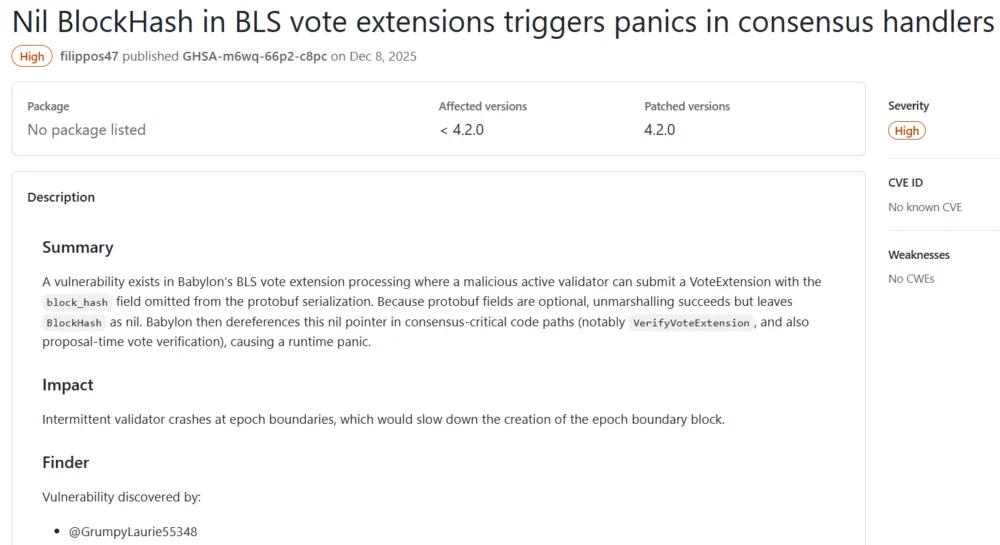
A critical software flaw has been newly disclosed within the Babylon protocol, a pioneering Bitcoin staking solution, revealing a vulnerability that could allow malicious validators to severely disrupt the network’s consensus mechanism, potentially leading to a significant slowdown in block production, particularly during crucial network periods. This development highlights the complex challenges inherent in extending Bitcoin’s capabilities while maintaining robust security.
The vulnerability specifically targets Babylon’s block signature scheme, known as the Boneh-Lynn-Shacham (BLS) vote extension. This cryptographic mechanism is fundamental to proving that validators have reached a consensus on a given block, a cornerstone of the protocol’s Proof-of-Stake (PoS) security model built upon Bitcoin. According to a detailed GitHub security advisory published on Thursday, the bug empowers malevolent actors among the validators to intentionally omit the vital block hash field when transmitting their vote extension. This seemingly minor omission carries profound implications for the network’s stability.
The block hash field serves as a crucial identifier, unequivocally informing validators which specific block they are affirming during the consensus process. By enabling its omission, the bug creates an environment ripe for validator consensus failures, especially when the network transitions between epochs. Epoch boundaries are critical junctures in blockchain operations, often involving complex state transitions, reward distributions, and validator set updates. Disruptions at these points can have cascading effects across the entire network.
The technical root of the problem, as described by pseudonymous contributor GrumpyLaurie55348, who discovered the vulnerability, involves a "nil pointer dereference" in consensus-critical code paths. When a malicious validator omits the block hash, the system attempts to process a null or empty pointer in functions like VerifyVoteExtension and proposal-time vote verification. This erroneous attempt to access a non-existent memory location triggers a "runtime panic," causing the affected validator’s software to crash. If multiple validators were to exploit this vulnerability simultaneously, particularly during epoch boundary checks, the cumulative effect could be a substantial slowdown in block production. The immediate impact would be "intermittent validator crashes at epoch boundaries, which would slow down the creation of the epoch boundary block," as GrumpyLaurie55348 detailed.
The severity of such a vulnerability cannot be overstated. While it doesn’t directly compromise staked Bitcoin assets in a way that allows theft, it represents a denial-of-service vector against the network’s operational integrity. A prolonged slowdown in block production can lead to delayed transaction confirmations, a degraded user experience for applications relying on Babylon, and a potential loss of trust in the protocol’s reliability. For a protocol aiming to unlock Bitcoin’s liquidity for staking, ensuring consistent and robust block finality is paramount. Developers have emphasized that the bug has not been actively exploited, but they issued a stern warning about its potential for abuse if left unaddressed.
Babylon has rapidly emerged as a pivotal innovation for Bitcoin-based decentralized finance (DeFi), often termed BTCFi. Its groundbreaking contribution lies in introducing Bitcoin-native staking, a feature previously unavailable in the crypto ecosystem. Historically, utilizing Bitcoin in DeFi required wrapping it into synthetic tokens on other blockchains (like wBTC on Ethereum), introducing custodial risks and additional layers of complexity. Babylon’s approach seeks to leverage Bitcoin’s unparalleled security directly, allowing BTC holders to stake their assets and earn yield without relinquishing custody to third parties or relying on wrapped derivatives. This innovation is seen as a major step toward making Bitcoin a more active and yield-generating asset within the broader DeFi landscape.

The broader movement of BTCFi has gained significant momentum, especially with the introduction of the Runes protocol during the 2024 Bitcoin halving event. Runes, a fungible token standard built directly on Bitcoin, has opened new avenues for creating and managing assets on the network, further enabling DeFi capabilities. This burgeoning ecosystem aims to bring the rich functionalities of decentralized finance – lending, borrowing, exchanges, and more – directly to the world’s most secure and decentralized blockchain. Babylon’s native staking mechanism is a cornerstone of this vision, promising to unlock billions in dormant Bitcoin capital for productive use within DeFi.
In recent weeks, Babylon has been on a strong growth trajectory, attracting significant institutional interest. Just last Wednesday, the protocol secured a substantial $15 million in funding from a16z Crypto, the digital asset arm of the prominent venture capital firm Andreessen Horowitz. This investment, facilitated through the sale of Babylon’s native BABY tokens, underscores the market’s confidence in Babylon’s potential to revolutionize Bitcoin utility. A16z Crypto explicitly stated that this funding would fuel the continued development of Bitcoin-native DeFi infrastructure, reinforcing Babylon’s strategic importance in the evolving crypto landscape.
Beyond fundraising, Babylon has also forged key strategic partnerships. In December, it announced a collaboration with Aave Labs, one of the leading lending protocols in DeFi, to integrate Bitcoin-backed lending into Aave v4. This partnership is particularly significant because it aims to enable BTC to be used as collateral directly, without the need for wrappers or centralized custodians. The product is slated to enter its testing phase in the first quarter of 2026, with a joint mainnet launch anticipated for April 2026. Such integrations are crucial for expanding Bitcoin’s role beyond a mere store of value, positioning it as a foundational asset for a robust, decentralized financial system. The ability to lend and borrow against native BTC would significantly enhance capital efficiency and liquidity across the entire DeFi space, drawing in a new wave of users and capital.
The discovery and public disclosure of this vulnerability, while concerning, also underscore the inherent transparency and collaborative nature of open-source blockchain development. The immediate response from the Babylon development team will involve patching the identified flaw, a process that typically involves rigorous testing, security audits, and coordination with network validators. Validators will be responsible for updating their software to incorporate the fix, a critical step to ensure network integrity. For users, the primary concern would be to stay informed through official Babylon channels regarding the resolution and any potential impacts on staked funds or transaction processing. The fact that the bug was discovered and disclosed responsibly before active exploitation speaks to the vigilance within the crypto security community.
From a broader perspective, this incident serves as a crucial reminder that even the most innovative protocols are subject to vulnerabilities, especially in their nascent stages. The continuous evolution of blockchain technology demands constant vigilance, robust security audits, and a proactive approach to identifying and mitigating risks. For Bitcoin’s integration into DeFi, such security challenges are an expected part of the journey. The ability of protocols like Babylon to swiftly address these issues and maintain network reliability will be key to fostering long-term trust and adoption. The future success of BTCFi hinges not only on innovative features but also on an unwavering commitment to security and resilience against potential attacks.
As Babylon navigates this security challenge, its trajectory remains under close watch. The successful resolution of this vulnerability will solidify its position as a leader in the Bitcoin-native staking space, paving the way for further integrations and the realization of a truly decentralized Bitcoin economy. The ongoing efforts to unlock Bitcoin’s vast potential for yield generation and active participation in DeFi represent a significant frontier in cryptocurrency, with Babylon at its forefront, constantly refining its security posture to build a more robust and inclusive financial future.