Faris Adani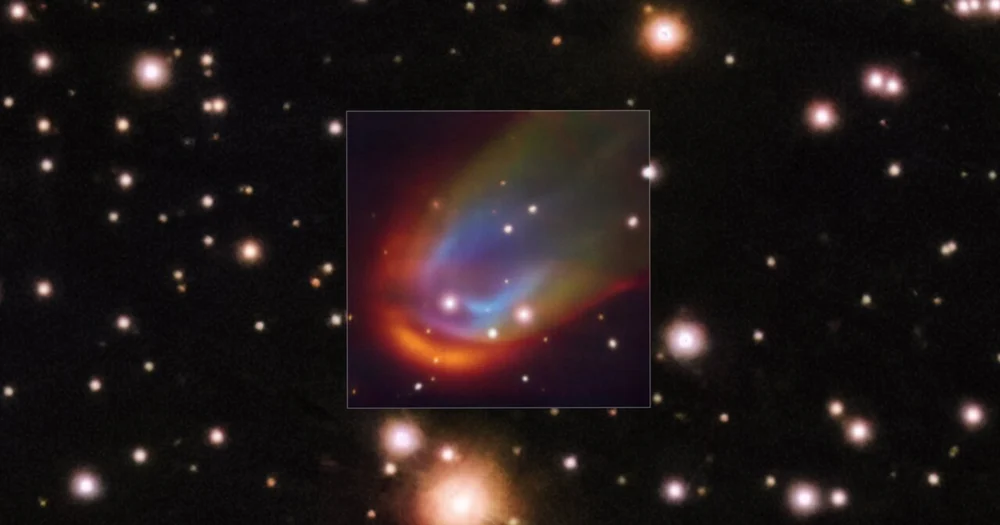
A profound astrophysical mystery is unfolding 730 light-years away, where a dead star, designated RXJ0528+2838, appears to be generating a vast, energetic structure around itself in defiance of conventional understanding. This cosmic enigma, featuring a highly luminous cloud known as a nebula, has left astronomers scratching their heads, as the standard mechanisms for its formation seem to be entirely absent. The discovery, detailed in the prestigious journal Nature Astronomy, challenges long-held theories about stellar evolution and the dynamics of binary star systems, prompting a reevaluation of how matter interacts in the extreme environments of the cosmos.
At the heart of this puzzle is RXJ0528+2838, an incredibly dense stellar remnant known as a white dwarf. White dwarfs represent the final evolutionary stage for stars of moderate mass, like our own Sun, once they have exhausted their nuclear fuel. After billions of years of burning hydrogen and helium, these stars swell into red giants, shed their outer layers into space, and leave behind a compact core composed primarily of carbon and oxygen, roughly the size of Earth but containing the mass of the Sun. These stellar corpses are incredibly dense, packing immense gravitational pull into a small volume, and slowly cool over trillions of years.
What makes RXJ0528+2838 particularly intriguing is its companionship with a Sun-like star, orbiting around it in a binary arrangement. Such binary systems are common throughout the universe, often leading to fascinating interactions as the more evolved star (in this case, the white dwarf) can sometimes "steal" material from its companion. This siphoning of matter, driven by the white dwarf’s powerful gravity, typically forms a luminous, swirling disk of gas and dust around the white dwarf, known as an accretion disk. It is these accretion disks that are usually responsible for generating powerful outflows of material and energetic nebulae observed in many interacting binary systems.
The presence of a spectacular, highly energetic, and luminescent nebula surrounding RXJ0528+2838, however, is what defies current astrophysical models. This particular type of nebula is characterized as a "bow shock," a curved arc of material that forms when an object moves supersonically through a medium, pushing gas and dust ahead of it like a ship creating a wave in water. In the context of binary stars, these bow shocks are typically created by powerful outflows of material ejected from the accretion disk as the entire system revolves around the galactic center and moves through the interstellar medium. The sheer scale and brilliance of the bow shock around RXJ0528+2838 unequivocally indicate a powerful, sustained outflow of material from the white dwarf.
"Our observations reveal a powerful outflow that, according to our current understanding, shouldn’t be there," stated Krystian Iłkiewicz, a researcher at the Nicolaus Copernicus Astronomical Center in Warsaw, Poland, and co-lead author of the groundbreaking study. This statement encapsulates the core paradox: a strong effect (the nebula) without the apparent cause (the accretion disk). The European Southern Observatory’s Very Large Telescope (VLT) provided the crucial imaging data that revealed this baffling phenomenon, offering an unprecedented look at the system.
The anomaly deepens when considering the standard explanations for such outflows. In many binary systems where a white dwarf accretes material from its companion, the stolen matter accumulates on the white dwarf’s surface. If enough material gathers, the intense pressure and temperature can trigger runaway thermonuclear reactions, leading to a violent explosion known as a nova. Novae are powerful, temporary brightenings of the star, capable of ejecting vast amounts of material into space, which could certainly form a nebula. However, the team’s meticulous images taken with the VLT conclusively ruled out a recent nova explosion as the cause for the observed bow shock around RXJ0528+2838. There were no tell-tale signs of the residual debris or the characteristic light curve associated with such an event.
Furthermore, the scale and persistence of the bow shock suggest an incredibly long-lived process. Coauthor Noel Castro Segura, a researcher at the University of Warwick in the UK, explained the "ship’s wave" analogy, emphasizing that the size of the bow shock around RXJ0528+2838 indicates that the white dwarf has been producing a powerful outflow for at least 1,000 years. This sustained activity is particularly challenging to explain for a "dead star" that is not actively burning fuel and, critically, lacks the typical energy-releasing mechanism of an accretion disk.
"The surprise that a supposedly quiet, discless system could drive such a spectacular nebula was one of those rare ‘wow’ moments," remarked co-lead author Simone Scaringi, an associate professor at Durham University in the UK. This sentiment underscores the profound impact of the discovery on the astrophysical community. The very definition of a "quiet" system has been upended, forcing scientists to confront the possibility of unknown physical processes at play.
The absence of an accretion disk is the linchpin of the mystery. If the white dwarf is indeed siphoning material from its stellar companion, as the outflow suggests, why is that material not forming a visible, luminous disk around it? Current models dictate that gas captured by a compact object like a white dwarf should settle into a disk due to angular momentum conservation, gradually spiraling inwards. The fact that this isn’t happening in RXJ0528+2838 points to an entirely different pathway for mass transfer and energy release.
The researchers’ leading hypothesis to explain this unprecedented phenomenon centers on the white dwarf’s powerful magnetic field. It is conceivable that a sufficiently strong magnetic field could directly channel the incoming material from the companion star, preventing it from forming a disk. Instead, the magnetic field might funnel the material directly onto the white dwarf’s poles, or even more remarkably, directly launch it into powerful outflows before it can settle into a disk. While magnetic fields are known to play crucial roles in many astrophysical processes, their ability to drive such sustained and powerful outflows without an accretion disk is a mechanism that is not yet fully understood or incorporated into current theoretical frameworks.
This discovery significantly challenges the "standard picture" of how matter behaves and interacts in extreme binary systems. It implies that there may be alternative, previously unrecognized mechanisms for driving powerful stellar winds and outflows, especially from compact objects. The implications extend beyond just white dwarfs, potentially offering new insights into other systems involving neutron stars or even black holes, where accretion processes are also fundamental but sometimes exhibit puzzling behaviors.
Future research will undoubtedly focus on unraveling this magnetic mystery. Astronomers will likely seek to conduct more detailed observations of RXJ0528+2838, potentially using different wavelengths of light or higher-resolution instruments to probe the magnetic field directly and search for subtle signs of gas flows. Theoretical astrophysicists will be tasked with developing new models that can incorporate the role of powerful magnetic fields in preventing accretion disk formation and directly powering outflows. Such models will need to explain the observed luminosity, energy, and longevity of the bow shock, all without the conventional energy source of a swirling disk.
The universe continues to surprise us, constantly revealing phenomena that push the boundaries of our understanding. Just as scientists have been "weirded out by cosmic bones in distant space" – another recent enigmatic discovery – the "impossible structure" around RXJ0528+2838 serves as a potent reminder that our cosmic knowledge is ever-evolving. This dead star, 730 light-years away, is far from quiet; it is loudly proclaiming the existence of physics yet to be fully comprehended, inviting a new era of exploration into the fundamental workings of the cosmos.