anjir abdul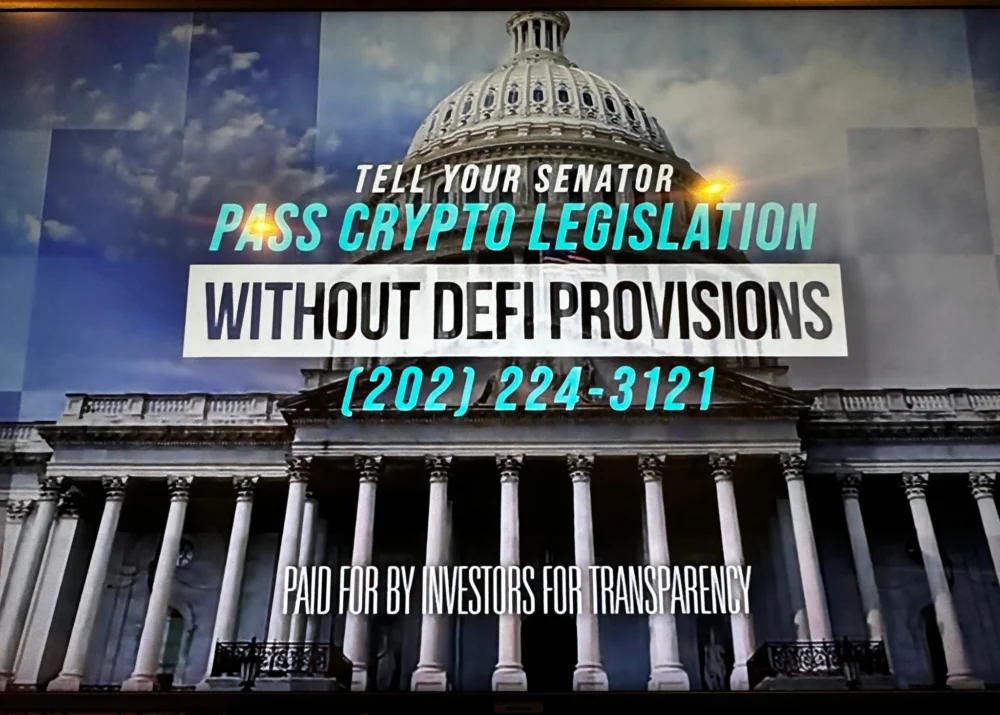
A concerted lobbying effort by a shadowy anti-decentralized finance (DeFi) group, "Investors For Transparency," has escalated with a series of advertisements reportedly airing on Fox News, directly appealing to the American public to pressure their senators into removing crucial DeFi provisions from the proposed CLARITY Act crypto market structure legislation. These ads represent a significant, publicly visible front in the ongoing battle between traditional financial institutions and the burgeoning crypto industry, specifically targeting elements of DeFi perceived as a direct threat to the established banking system.
The advertisements, brought to light by two screenshots shared on X by Crypto in America host Eleanor Terrett, prominently feature calls to action such as "Tell Your Senator: Pass Crypto Legislation Without DeFi Provisions" and "Don’t Let DeFi Stall Innovation." Accompanying these urgent messages is a hotline number, providing a direct channel for concerned citizens to contact their local Senators and echo the group’s sentiments. This tactic underscores a sophisticated and well-funded campaign designed to influence public opinion and, subsequently, legislative outcomes, by framing DeFi as a hindrance rather than a catalyst for financial innovation.
At the heart of this contentious debate is the CLARITY Act, a pivotal piece of legislation intended to provide much-needed regulatory clarity for the cryptocurrency market in the United States. While the broader bill seeks to establish a comprehensive framework for digital assets, the specific DeFi provisions under attack relate to the ability of stablecoin issuers to offer interest-bearing products. Banking lobbyists argue vehemently that such products could be "disguised as bank-like deposits," creating a parallel financial system that could draw trillions of dollars away from traditional banks, thereby undermining their deposit bases and potentially destabilizing the financial sector.

The concerns articulated by the banking industry are not without some backing from official analyses. The U.S. Treasury Department, in an April report, estimated that a staggering $6.6 trillion worth of traditional banking deposits could flow out of the banking system if stablecoins achieve widespread adoption. This projection paints a vivid picture of the potential seismic shift in financial flows, should digital assets gain mainstream acceptance as a viable alternative to traditional banking services. The report also suggested that stablecoins could be on track for a $2 trillion market capitalization by 2028, further amplifying the perceived threat to incumbent financial institutions. The prospect of stablecoins, particularly those offering yield, acting as competitive alternatives to savings accounts, directly impacts banks’ ability to lend and generate revenue, striking at the core of their business model.
The "Investors For Transparency" group, despite its name, has maintained a notable degree of anonymity regarding its funding and membership. This lack of transparency has drawn sharp criticism from the crypto community, with prominent figures like Uniswap Labs CEO Hayden Adams labeling the situation as both "ironic and unsurprising." Adams’ comments reflect a broader sentiment within the DeFi space, where the very ethos of decentralization and transparency in financial operations contrasts starkly with the opaque lobbying tactics employed by groups seemingly acting on behalf of established interests. The crypto industry argues that if traditional finance players are genuinely concerned about market integrity and consumer protection, they should be upfront about their identities and financial backing when engaging in public discourse and lobbying efforts.
The timing of these advertisements is particularly critical, as the Senate Banking Committee recently published an official notice for its CLARITY Act markup, scheduled for this Thursday, January 15, at 10:00 AM Eastern Time. A "markup" session is a crucial stage in the legislative process where committee members review, debate, and amend proposed legislation. This is the moment where the bill’s language can be significantly altered, and where the lobbying efforts of groups like "Investors For Transparency" can have a direct impact on the final text presented for a floor vote. The high stakes involved mean that every ad, every phone call to a senator, and every behind-the-scenes lobbying meeting could sway the delicate balance of power.
Beyond the stablecoin provisions, the broader crypto market structure bill faces additional challenges, including pushes from several Democratic lawmakers for robust conflict-of-interest safeguards. These lawmakers are concerned about the potential for market manipulation and consumer harm if crypto exchanges are allowed to act simultaneously as custodians, brokers, and market makers without adequate checks and balances. These proposed safeguards, while aimed at protecting investors, could add further complexity to the bill and potentially slow its progress.

Adding to the legislative uncertainty are fears that the upcoming 2026 U.S. midterm elections may significantly impede the momentum of the CLARITY Act. Historically, legislative activity tends to slow down or become more politically charged in the lead-up to major elections, as lawmakers become more focused on campaigning and partisan divisions intensify. TD Cowen’s Washington Research Group has even projected that the bill might not pass Congress until 2027, with final implementation potentially pushed to as late as 2029. Such delays would leave the U.S. crypto industry in a prolonged state of regulatory limbo, potentially ceding its competitive edge to jurisdictions with clearer frameworks.
Despite these hurdles, Senate Banking Committee Chair Tim Scott remains outwardly confident that the CLARITY Act can be passed much sooner, asserting that it will "deliver real results for the American people." His optimism suggests that there may be a degree of bipartisan support for certain aspects of crypto regulation, or that the economic imperative to foster innovation in the digital asset space is recognized by key leaders. However, the path to passing comprehensive crypto legislation is fraught with political complexities, competing interests, and a steep learning curve for many policymakers unfamiliar with the nuances of blockchain technology and decentralized finance.
The broader context of this legislative battle underscores a fundamental tension between traditional finance and the emerging decentralized economy. Proponents of DeFi argue that it offers a more efficient, transparent, and accessible financial system, capable of fostering unprecedented innovation and economic inclusion. They point to use cases such as instantaneous cross-border payments, peer-to-peer lending, and permissionless access to financial services as evidence of DeFi’s transformative potential. Venture capital firms like a16z have heavily invested in the space, with the firm raising $15 billion and publicly stating that crypto is "key" to America winning the next 100 years, emphasizing its role in national competitiveness.
Conversely, critics, often aligned with traditional financial institutions, raise concerns about consumer protection, illicit finance, market volatility, and systemic risks associated with a largely unregulated DeFi landscape. They argue that the anonymity and decentralized nature of some DeFi protocols make them ripe for money laundering, terrorist financing, and investor exploitation. These concerns, while valid in some instances, are often amplified to paint a picture of an inherently dangerous and uncontrollable sector.

The "Investors For Transparency" ad campaign is more than just an attempt to influence a single piece of legislation; it is a strategic move in a larger ideological and economic war. By attempting to strip DeFi provisions from the CLARITY Act, traditional banking interests are seeking to contain the growth and influence of a nascent industry that threatens their long-held dominance. The outcome of this legislative skirmish will not only determine the regulatory future of DeFi in the United States but also send a powerful signal about America’s stance on financial innovation and its willingness to embrace or resist the paradigm shifts brought about by blockchain technology. The next few weeks, particularly leading up to and during the Senate Banking Committee’s markup session, will be critical in shaping the contours of this pivotal legislation and, by extension, the future of finance itself.