Imroatul Nasiyah
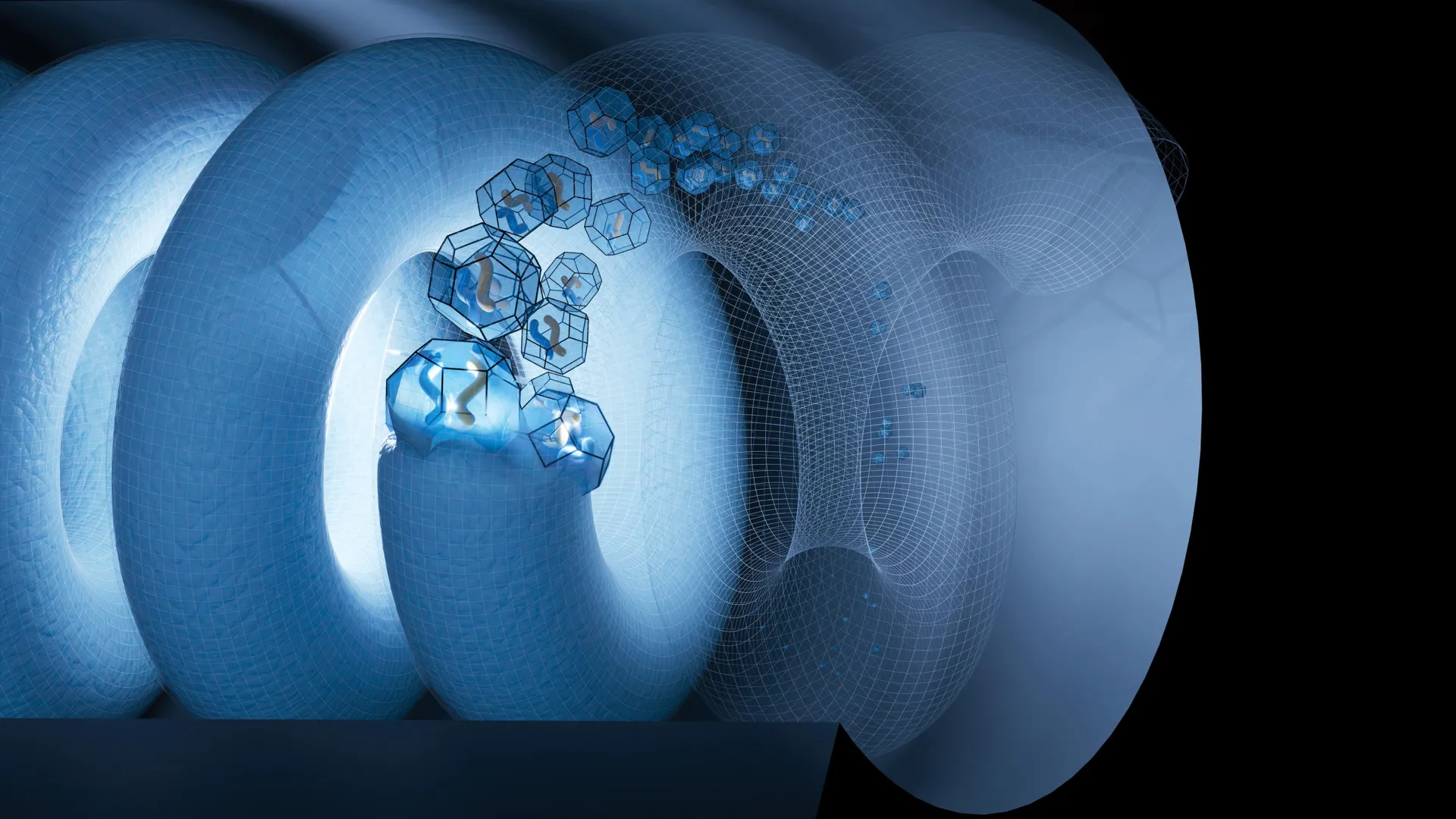
This research fundamentally challenges the long-held assumption that magnetic phenomena in stacked van der Waals magnets would strictly adhere to the length scales defined by the moiré interference pattern. In most moiré systems, the size and characteristics of emergent physical effects are directly dictated by the intricate overlap of the two crystal lattices. The new findings shatter this expectation, revealing a more complex and emergent behavior of magnetism. The team meticulously investigated twisted double bilayer chromium triiodide (CrI3) using scanning nitrogen-vacancy (NV) magnetometry, a cutting-edge technique capable of imaging magnetic fields with exquisite nanoscale precision. Through these experiments, they observed the formation of colossal magnetic textures that extended up to approximately 300 nanometers. This is a remarkable feat, vastly surpassing the dimensions of a single moiré cell and representing a wavelength roughly ten times larger than the underlying moiré pattern itself.
The study uncovered a counterintuitive relationship between the twist angle and the resulting magnetic textures. Typically, as the twist angle decreases, the moiré wavelength increases, leading to larger moiré unit cells. However, the magnetic textures did not simply scale up in tandem. Instead, their size exhibited an inverse relationship with the moiré wavelength, reaching a maximum size near a twist angle of 1.1 degrees and then diminishing entirely above approximately 2 degrees. This reversal is a crucial insight, indicating that the magnetism is not merely a passive replica of the moiré template. Instead, it arises from a delicate interplay of several competing fundamental forces. These include exchange interactions, which govern the alignment of neighboring spins; magnetic anisotropy, which dictates the preferred direction of magnetization; and Dzyaloshinskii-Moriya interactions (DMI), which introduce chirality and can stabilize complex spin textures like skyrmions. The precise balance of these forces is subtly tuned by the relative rotation of the stacked layers. Complementing these experimental observations, large-scale spin dynamics simulations provided robust theoretical backing for this interpretation. These simulations vividly demonstrated the spontaneous formation of extended Néel-type antiferromagnetic skyrmions, precisely engineered to span multiple moiré cells.
The implications of these findings extend far beyond the realm of fundamental physics, holding immense promise for future information technologies. Magnetic skyrmions are particularly attractive candidates for next-generation spintronic devices due to their inherent stability, topological protection, and their ability to be manipulated with remarkably low energy expenditure. The ability to create these desirable skyrmionic structures simply by adjusting the twist angle, without the need for complex lithographic patterning, exotic heavy metals, or high-current densities, represents a remarkably clean, geometry-driven pathway toward the development of ultra-low power spintronic devices.
The researchers have aptly termed this phenomenon "super-moiré spin order," emphasizing that twist engineering transcends mere atomic alignment and operates effectively across multiple length scales. A seemingly minor adjustment in atomic orientation at the nanoscale can, in this context, give rise to topologically protected magnetic structures on much larger, mesoscopic distances. This discovery fundamentally challenges the long-held notion that moiré physics is exclusively a local effect. Instead, it positions the twist angle as a potent thermodynamic control parameter, capable of finely tuning the critical exchange, anisotropy, and chiral interactions necessary to stabilize exotic topological magnetic phases.
From a practical standpoint, the creation of these large and robust Néel-type skyrmionic textures is a significant advancement. Their substantial size makes them considerably easier to detect and manipulate with greater precision in device architectures. Simultaneously, their inherent topological protection, coupled with the insulating nature of the host material, suggests the potential for exceptionally low energy loss during device operation. As scientists continue to delve deeper into the intricate ways in which geometry governs quantum behavior, these emergent magnetic states are poised to play a pivotal role in the development of energy-efficient, post-CMOS computing technologies, paving the way for a new generation of high-performance, low-power electronic devices.
Dr. Elton Santos, a Reader in Theoretical/Computational Condensed Matter Physics at the University of Edinburgh, whose team spearheaded the crucial modeling aspects of this groundbreaking project, offered his expert perspective: "This discovery is transformative, revealing that twisting is not merely an electronic control knob, but a powerful magnetic one as well. We are witnessing collective spin order spontaneously self-organize on scales that far exceed the dimensions of the underlying moiré lattice. This opens up exciting new avenues for designing topological magnetic states solely by controlling the twist angle – a remarkably simple physical parameter that carries profound implications for technological applications."