Imroatul Nasiyah
For years, the ambitious pursuit of building powerful quantum computers has been hampered by slow progress, a bottleneck primarily stemming from the challenge of efficiently extracting information from the fundamental building blocks of these machines: qubits. Qubits, the quantum analogue of classical bits, are often represented by individual atoms, which store quantum information in their delicate states. The critical hurdle has been the ability to read out this information quickly and reliably, especially as the number of qubits scales up. Classical computers operate on bits that are definitively either a 0 or a 1. In stark contrast, qubits leverage the principles of quantum mechanics to exist in a superposition of states, meaning they can be 0, 1, or a combination of both simultaneously. This fundamental difference grants quantum computers the potential to explore a vast number of possibilities concurrently, a capability that eludes classical machines, which must process information sequentially. This parallel processing power is what enables quantum computers to tackle specific types of problems, such as complex simulations and optimizations, exponentially faster than even the most powerful supercomputers available today.
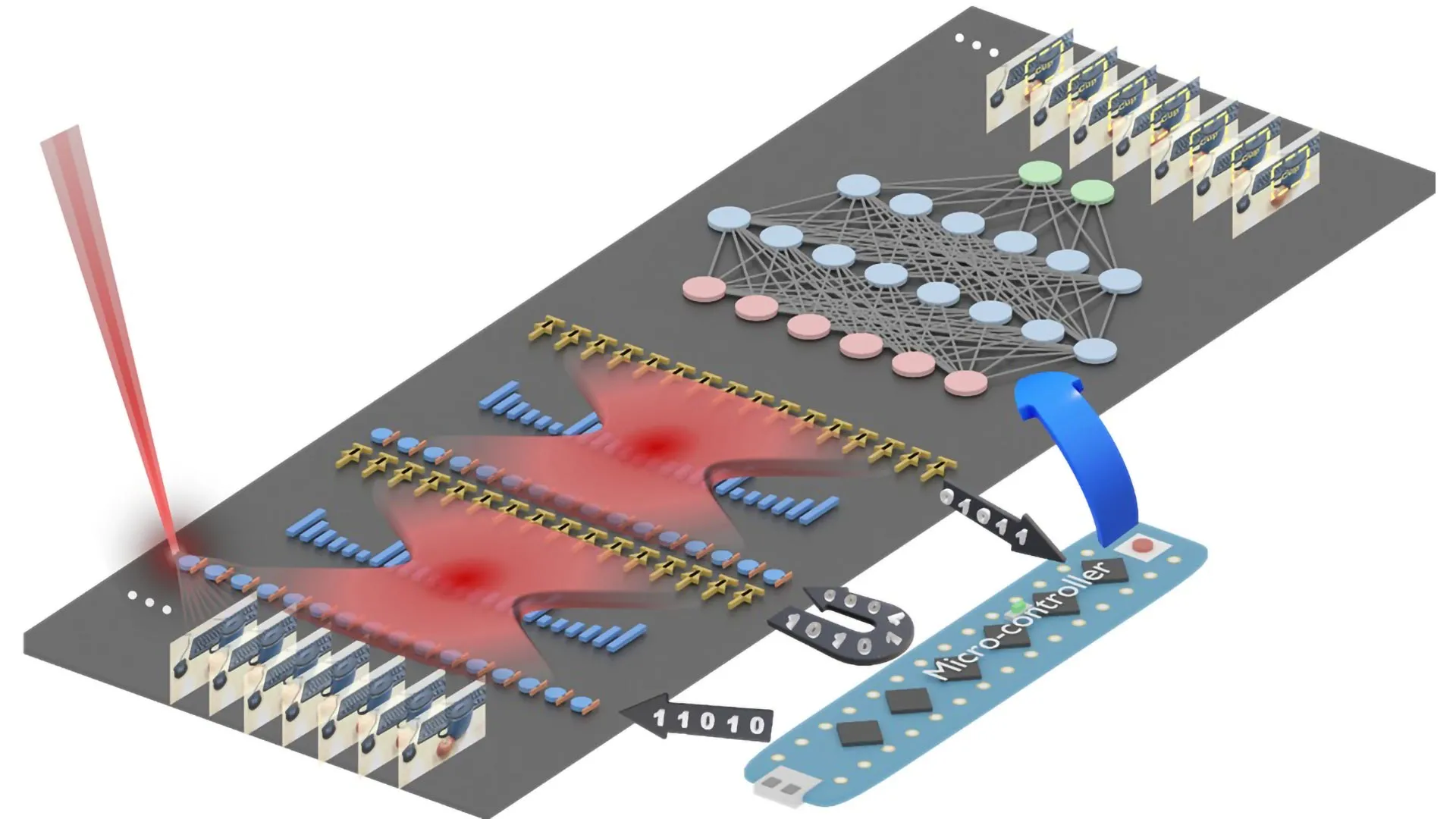
The Stanford-led team has engineered a novel optical cavity, a sophisticated device designed to precisely capture single photons – the fundamental particles of light – emitted by individual atoms. This breakthrough is pivotal because these atoms serve as the core components of a quantum computer, housing the qubits. The newly developed optical cavity acts as an incredibly efficient funnel, directing the light emitted by each atom towards a detector. Crucially, this innovative approach allows for the simultaneous collection of information from all qubits within the system, a feat that has long been a significant impediment to scaling up quantum computing architectures.
In a landmark publication in the prestigious journal Nature, the researchers detail their ingenious system. It comprises an array of 40 individual optical cavities, each meticulously designed to house a single atom qubit. Furthermore, they have developed a larger prototype showcasing over 500 such cavities. The implications of these findings are profound, pointing towards a tangible and realistic pathway to constructing expansive quantum computing networks that could eventually encompass a staggering one million qubits.
Jon Simon, the senior author of the study and an esteemed associate professor of physics and applied physics at Stanford, emphasized the critical need for rapid qubit readout. "If we want to make a quantum computer, we need to be able to read information out of the quantum bits very quickly," Simon stated. "Until now, there hasn’t been a practical way to do that at scale because atoms just don’t emit light fast enough, and on top of that, they spew it out in all directions. An optical cavity can efficiently guide emitted light toward a particular direction, and now we’ve found a way to equip each atom in a quantum computer within its own individual cavity." This quote highlights the dual challenge of slow light emission from atoms and its omnidirectional dispersal, both of which are elegantly addressed by the new cavity design.
The principle behind an optical cavity is straightforward yet powerful: it traps light between two or more highly reflective surfaces. This confinement causes the light to bounce back and forth repeatedly, a phenomenon that can be vividly imagined by the infinite reflections experienced when standing between two mirrors. In scientific applications, these cavities are engineered to be exceptionally small and are often used in conjunction with laser beams. The repeated passes of the laser within the cavity amplify its interaction with the atom, allowing for the extraction of quantum information.
Despite decades of research into optical cavities, their application with individual atoms has presented considerable difficulties. Atoms, being infinitesimally small and nearly transparent, make it challenging to achieve a strong enough interaction with light. This persistent issue has been a major roadblock in harnessing the full potential of atomic qubits.
The Stanford team’s innovative solution lies in their reimagined cavity architecture. Instead of relying solely on numerous reflections to enhance light-matter interaction, they have ingeniously incorporated microlenses within each cavity. These microlenses are precisely engineered to tightly focus the light beam onto the single atom housed within. This concentrated beam, even with fewer light bounces, proves to be remarkably more effective at extracting the delicate quantum information stored within the atom.
Adam Shaw, a Stanford Science Fellow and the first author of the study, elaborated on this novel design. "We have developed a new type of cavity architecture; it’s not just two mirrors anymore," Shaw explained. "We hope this will enable us to build dramatically faster, distributed quantum computers that can talk to each other with much faster data rates." This statement underscores the transformative nature of their work, moving beyond conventional cavity designs to facilitate more robust and high-speed inter-quantum computer communication.
The fundamental difference between classical and quantum computing lies in their information processing units. Classical computers rely on bits, which can only represent either a 0 or a 1. Quantum computers, however, utilize qubits, which can exist in a superposition of states, representing 0, 1, or both simultaneously. This quantum property allows quantum computers to explore a vast landscape of possibilities in parallel, leading to an exponential speedup for certain computational tasks. Simon further illustrated this advantage with an analogy: "A classical computer has to churn through possibilities one by one, looking for the correct answer. But a quantum computer acts like noise-canceling headphones that compare combinations of answers, amplifying the right ones while muffling the wrong ones." This analogy effectively conveys how quantum computers can efficiently identify optimal solutions by simultaneously evaluating multiple possibilities.
The scientific community widely estimates that millions of qubits will be necessary for quantum computers to surpass the capabilities of today’s most advanced supercomputers. Professor Simon believes that achieving this monumental scale will likely involve interconnecting numerous quantum computers into sophisticated networks. The parallel light-based interface developed in this study provides a crucial and efficient foundation for building such massive, interconnected quantum systems. The researchers have already demonstrated a functional 40-cavity array and a proof-of-concept system containing over 500 cavities. Their immediate objective is to scale this up to tens of thousands of cavities. Looking further into the future, the team envisions the creation of quantum data centers where individual quantum computers are linked via these advanced cavity-based network interfaces, forming truly formidable quantum supercomputers.
While significant engineering challenges undoubtedly remain, the potential benefits of this breakthrough are immense. Large-scale quantum computers hold the promise of revolutionizing fields such as materials science and chemical synthesis, leading to advancements in drug discovery, the development of novel materials with unprecedented properties, and even breakthroughs in code-breaking.
Beyond the realm of computing, the ability to efficiently collect and manipulate light at the single-photon level has broader scientific and technological implications. These advanced cavity arrays could significantly enhance biosensing technologies and microscopy, paving the way for more profound discoveries in medical and biological research. Furthermore, quantum networks built using this technology might contribute to astronomy by enabling optical telescopes with vastly improved resolution, potentially allowing scientists to directly observe exoplanets orbiting distant stars. As Shaw aptly put it, "As we understand more about how to manipulate light at a single particle level, I think it will transform our ability to see the world." This sentiment encapsulates the transformative power of controlling light at its most fundamental level.
The research team includes distinguished individuals such as Professor Simon, also the Joan Reinhart Professor of Physics & Applied Physics, and Adam Shaw, a Stanford Science Fellow and an Urbanek-Chodorow Fellow. Additional Stanford co-authors contributing to this pivotal work are David Schuster, the Joan Reinhart Professor of Applied Physics, and doctoral students Anna Soper, Danial Shadmany, and Da-Yeon Koh. The collaborative spirit of this endeavor extends to researchers from Stony Brook University, the University of Chicago, Harvard University, and Montana State University. Funding for this groundbreaking research was generously provided by the National Science Foundation, the Air Force Office of Scientific Research, the Army Research Office, the Hertz Foundation, and the U.S. Department of Defense, underscoring the national importance of this quantum computing advancement. Notably, Matt Jaffe of Montana State University and Professor Simon serve as consultants to and hold stock options in Atom Computing, a company focused on quantum technology. Shadmany, Jaffe, Schuster, and Simon, along with Aishwarya Kumar from Stony Brook, have also filed a patent related to the resonator geometry demonstrated in this study, highlighting the innovative nature and potential commercialization of their findings.