Imroatul Nasiyah
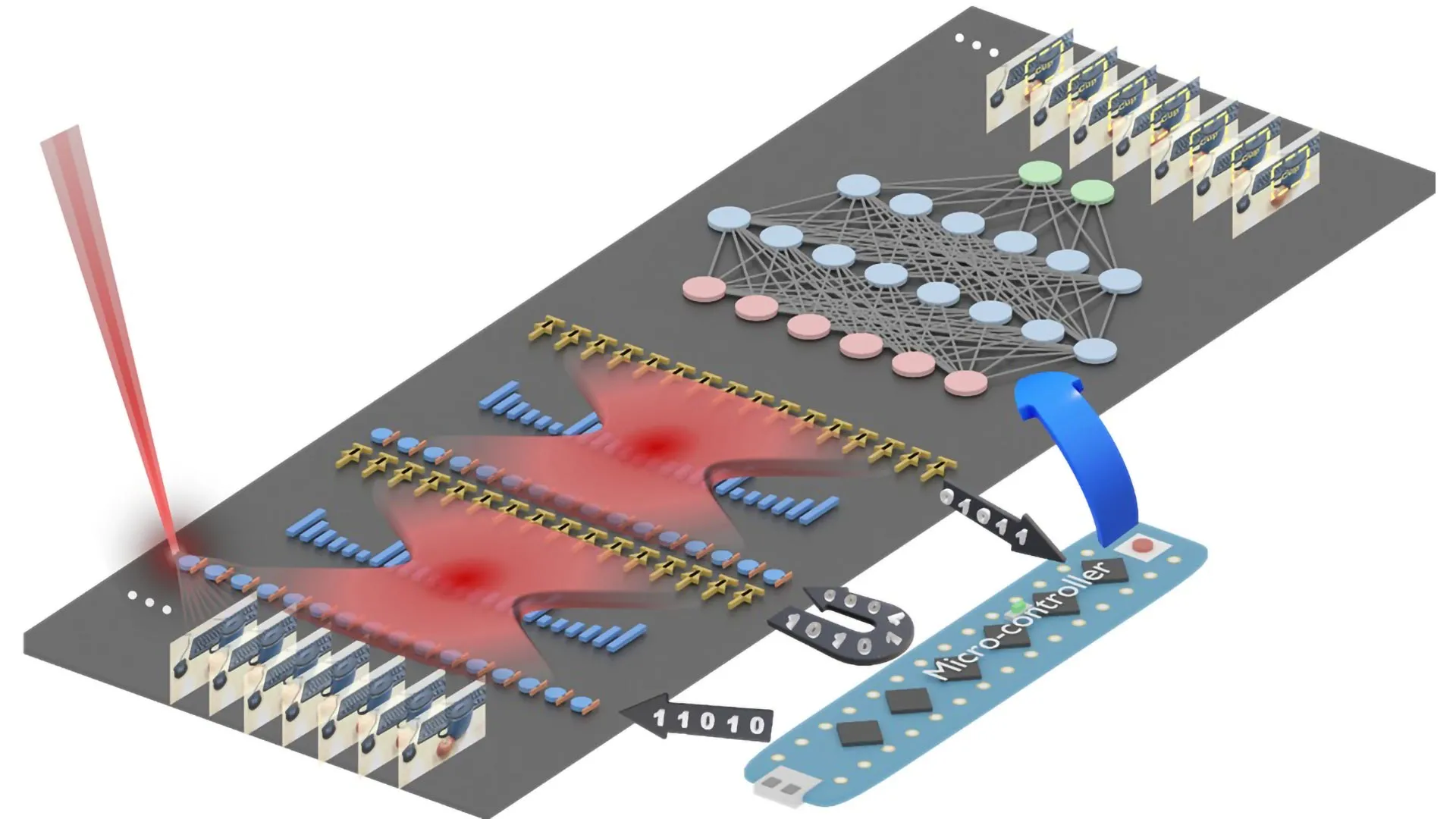
At the heart of this innovation lies the concept of "single-shot tensor computing with light." Unlike conventional digital processors that break down complex computations into sequential steps, this optical approach harnesses light’s ability to traverse multiple pathways and interact in intricate ways simultaneously. Imagine trying to solve a multi-dimensional Rubik’s cube; a human or a traditional computer would meticulously rotate, slice, and rearrange layers one by one. This new optical system, however, can, in essence, perform all these manipulations at once, utilizing a single pulse of light.
Dr. Yufeng Zhang, the lead researcher from Aalto University’s Photonics Group, elaborates on the transformative potential. "Our method performs the same kinds of operations that today’s GPUs handle, like convolutions and attention layers, but does them all at the speed of light," he states. "Instead of relying on electronic circuits, we use the physical properties of light to perform many computations simultaneously." This fundamental difference bypasses the bottlenecks inherent in electronic processing, where data must be converted, processed, and then converted back, introducing delays and energy losses at each stage.
The ingenuity of this technique lies in its ability to encode vast amounts of digital information directly into the physical characteristics of light. Researchers achieve this by manipulating the amplitude and phase of light waves. Amplitude refers to the intensity or brightness of the light, while phase describes the position of a point in time on a waveform cycle. By precisely controlling these parameters, numerical data is transformed into intricate patterns and variations within the optical field. When these modulated light waves interact within a specially designed optical system, they naturally perform complex mathematical operations, including matrix and tensor multiplication – the very operations that form the backbone of deep learning algorithms.
To further enhance its capabilities, the team has devised a method to support even more complex, higher-order tensor operations by utilizing multiple wavelengths of light. Different wavelengths of light can be thought of as carrying different sets of information, allowing for a richer and more comprehensive computational process. Dr. Zhang uses a compelling analogy to illustrate this parallel processing power: "Imagine you’re a customs officer who must inspect every parcel through multiple machines with different functions and then sort them into the right bins. Normally, you’d process each parcel one by one. Our optical computing method merges all parcels and all machines together – we create multiple ‘optical hooks’ that connect each input to its correct output. With just one operation, one pass of light, all inspections and sorting happen instantly and in parallel." This analogy highlights the dramatic reduction in processing time and the inherent parallelism of the optical approach.
One of the most significant advantages of this "passive optical processing" is its remarkable simplicity and compatibility. The computational magic happens intrinsically as the light propagates through the optical system. This means that the system doesn’t require active electronic control or switching mechanisms during the computation itself, drastically reducing complexity and energy consumption. Professor Zhipei Sun, the esteemed leader of Aalto University’s Photonics Group, emphasizes this point: "This approach can be implemented on almost any optical platform. In the future, we plan to integrate this computational framework directly onto photonic chips, enabling light-based processors to perform complex AI tasks with extremely low power consumption." This integration onto photonic chips is the crucial next step towards miniaturization and widespread adoption.
The ultimate goal for Dr. Zhang and his team is to seamlessly integrate this groundbreaking technology into the existing hardware and platforms utilized by major technology companies. They envision a future where AI hardware is not limited by the constraints of traditional electronics but is instead powered by the inherent speed and efficiency of light. The researchers estimate that this technology could be incorporated into current systems within a remarkably short timeframe of three to five years. This aggressive timeline underscores the maturity and practicality of their research.
The implications of this advancement are profound. It promises to usher in a new generation of optical computing systems that can dramatically accelerate complex AI tasks across a vast spectrum of fields. From scientific research and drug discovery to financial modeling and climate change prediction, the ability to process information at the speed of light will unlock new frontiers of innovation and problem-solving. The study, a testament to international collaboration and scientific ingenuity, was published in the prestigious journal Nature Photonics on November 14th, 2025, marking a significant milestone in the ongoing quest for more powerful and efficient computing. This research not only pushes the boundaries of what’s computationally possible but also offers a tangible pathway towards realizing the full potential of artificial intelligence.