anjir abdul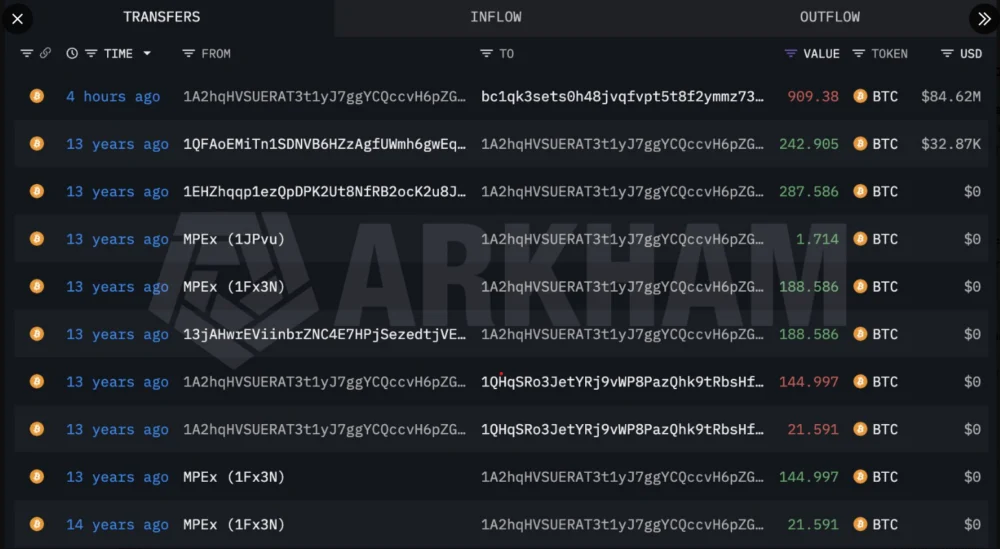
To truly grasp the scale of this financial transformation, consider alternative investment paths from that same era. Had the approximate $6,400 initially invested in 909.38 BTC in 2013 been instead allocated to a low-cost S&P 500 index fund, that investment would now be worth approximately $37,000, representing a respectable gain of around 481% over the same 13-year period. Similarly, over this identical window, benchmark gold prices have climbed by roughly 150%, a solid return for a traditional safe-haven asset, yet utterly dwarfed by Bitcoin’s explosive 13,900x surge. This stark comparison underscores the unparalleled, albeit volatile, growth trajectory of Bitcoin since its inception, transforming early bets into generational wealth.
This recent awakening is not an isolated incident but rather fits into a broader trend observed across 2024 and 2025, where a significant number of "old whales" – long-term holders from Bitcoin’s nascent stages – have been reactivating their dormant wallets. This phenomenon has seen "OG" holders, some dormant for over a decade, collectively move in excess of $50 billion worth of BTC, with on-chain data confirming that tens of thousands of these ancient coins were ultimately spent or repositioned. The implications of these large-scale movements are multifaceted, often interpreted by market observers as either a sign of renewed confidence and strategic repositioning, or as a precursor to eventual liquidation, which could introduce significant liquidity into the market.
Beyond the astounding financial figures, the human element of this story is perhaps even more compelling. The owner of this wallet demonstrated an almost unfathomable level of conviction, or perhaps sheer serendipity, to "HODL" through Bitcoin’s tumultuous history. Their journey would have encompassed multiple brutal bear markets, enduring 70-80% drawdowns that would test the resolve of any investor, watching their digital fortune seemingly evaporate only to resurface stronger. They navigated the exhilarating highs and crushing lows of the 2017 and 2021 bull markets, witnessing speculative bubbles inflate and burst. The challenges didn’t stop there; they would have lived through major exchange failures like Mt. Gox and FTX, which shook the very foundations of trust in the nascent crypto ecosystem. They also endured contentious forks, such as Bitcoin Cash (BCH) and Bitcoin SV (BSV), which created existential questions about Bitcoin’s future and identity. Adding to this cocktail of volatility and uncertainty were rolling regulatory crackdowns and persistent FUD (Fear, Uncertainty, Doubt) from mainstream media, constantly questioning Bitcoin’s legitimacy and longevity. To hold through all of this required either an extraordinary, almost prophetic, belief in Bitcoin’s long-term potential, an incredible degree of emotional resilience, or perhaps, the owner simply lost their private keys for an extended period and only recently managed to recover access, adding a layer of mystery to the narrative.

The motive behind this Jan. 19 shift to a new address remains a subject of intense speculation among on-chain analysts. Several possibilities exist: it could be a routine, albeit significantly delayed, act of security hygiene, moving funds from an older, potentially less secure address format to a more robust, modern one. It might also represent a change of custody, perhaps from self-custody to a professional institutional custodian, or a re-organization of personal holdings across different wallet solutions. Crucially, it could also be the initial step toward eventual liquidation, a prospect that on-chain analysts are now watching closely, scrutinizing whether these substantial funds will flow to known exchange wallets, which would signal an intent to sell. The sheer size of the transfer means any subsequent movements to exchanges would be closely monitored for potential market impact.
Another compelling motivation for early holders to reposition their assets stems from a growing chorus of warnings regarding future quantum attacks on Bitcoin’s elliptic-curve digital signatures (ECDSA). These cryptographic signatures are fundamental to Bitcoin’s security, proving that someone with the correct private key has authorized a transaction. The concern is that sufficiently powerful quantum computers, utilizing algorithms like Shor’s, could theoretically compromise these signatures, allowing malicious actors to deduce private keys from public keys. This threat is particularly pertinent for older Unspent Transaction Outputs (UTXOs) – the individual chunks of BTC that comprise a wallet’s balance – because when these early UTXOs were spent in the past, their public keys were exposed on the blockchain. While most cryptographers and quantum computing experts still estimate that practical, crypto-breaking quantum computers are years, if not decades, away, the rapid pace of technological advancement means that proactive measures are gaining traction. Recent research has increasingly urged the crypto ecosystem to begin preparing migration paths to "post-quantum" cryptographic schemes. This forward-looking risk could well be a significant motivator for security-conscious OGs to move their coins into newer setups, even if they have no immediate intention of selling, ensuring their assets are secured against a theoretical, future threat. As Kevin O’Leary famously quipped, quantum attacking Bitcoin might be a "waste of time" given the current state of technology, but the prudent still prepare.
In conclusion, the awakening of this 13-year-dormant Bitcoin wallet is far more than just a transaction; it is a profound narrative weaving together historical perspective, an almost unimaginable financial marvel, the testament to human endurance and conviction, and a forward-looking concern for future technological threats. It serves as a vivid reminder of Bitcoin’s revolutionary potential, its capacity to create unprecedented wealth, and the unique challenges and opportunities inherent in its decentralized architecture. Such movements, while rare, are invaluable data points, offering critical insights into the evolving landscape of Bitcoin ownership, security practices, and the long-term vision of its earliest believers, ensuring that the saga of Bitcoin continues to captivate and challenge.